

Think of your resume summary as your 30-second elevator pitch. It’s the very first thing a recruiter reads, so it needs to grab their attention and set the tone for everything that follows. In just two to four sentences, you’ll pack in your professional title, core skills, and a top accomplishment.
What to Include in Your Resume Summary
Start with a professional title that mirrors the role you’re targeting. Right after that, add your years of experience to immediately establish credibility. Simple, but effective.
Next, you’ll want to weave in two or three of your most critical skills—hard or soft—that you see listed in the job description. This is crucial for getting past the Applicant Tracking System (ATS) scans that filter resumes before a human ever sees them.
Finally, cap it off with a powerful, quantifiable achievement. Did you boost sales by a certain percentage? Cut costs? Improve efficiency? Using real numbers is the fastest way to prove your value.
It might seem like a small detail, but getting this right is a game-changer. Recruiters skim dozens, sometimes hundreds, of resumes a day. It’s no surprise that resumes with a professional summary get a whopping 340% more interview callbacks than those with an old-school objective. You can read more about those findings here.
To make it even clearer, let's break down the essential building blocks every job seeker should include in their resume summary for maximum impact.
Core Components of an Effective Resume Summary
| Component | What It Is | Why It's Important |
|---|---|---|
| Professional Title | The role you're aiming for, like "Senior Marketing Manager." | Instantly aligns you with the job title and helps with ATS searches. |
| Years of Experience | Your total time in relevant roles. | Establishes your credibility and shows the depth of your expertise. |
| Key Skills | Two or three skills pulled directly from the job description. | Shows you're a perfect match for the role's specific requirements. |
| Quantifiable Achievement | A specific metric or result, like "grew revenue by 15%." | Proves your impact with hard data, not just vague claims. |
With these components in place, you’re well on your way to crafting a summary that works. Now, let's fine-tune the delivery.
Writing Tips
- Keep it short and sweet. Aim for 2-4 sentences. Any longer and you risk losing the reader's attention.
- Lead with strong action verbs. Words like “led,” “grew,” and “launched” convey impact and energy.
- Mirror the keywords from the job posting. This is your ticket past the ATS and shows the hiring manager you’ve done your homework.
- Ditch the personal pronouns ("I," "my"). Keep it professional and focus on measurable results, not generic buzzwords.
Avoid These Mistakes
- Writing a novel. A summary that’s longer than four sentences feels unfocused and rambling.
- Listing duties instead of achievements. Don’t just say what you did; show how well you did it.
- Using clichés like “hardworking team player.” These phrases are empty and leave recruiters unimpressed.
Quick Summary Template
Ready to build your own? Just copy and fill in this simple framework:
[Your Job Title] with [X] years of experience in [Key Skill 1] and [Key Skill 2]. Proven ability to [Quantifiable Achievement].
Use this as your starting point, and tailor it for every single application. Your goal is to be so clear and compelling that the hiring manager can’t help but pause and read on.
The Four Essential Ingredients of a Winning Summary
Think of your resume summary like a great movie trailer. In just a few seconds, it needs to grab attention, hint at the story, and make the viewer want to see more. A truly effective summary does the same for a recruiter, combining four critical elements to tell a powerful story of your professional impact.
To pull this off, you can't just list your past duties. The goal is to create a focused, high-impact snapshot of your value. This simple hierarchy shows the core components that build a strong summary from the ground up.
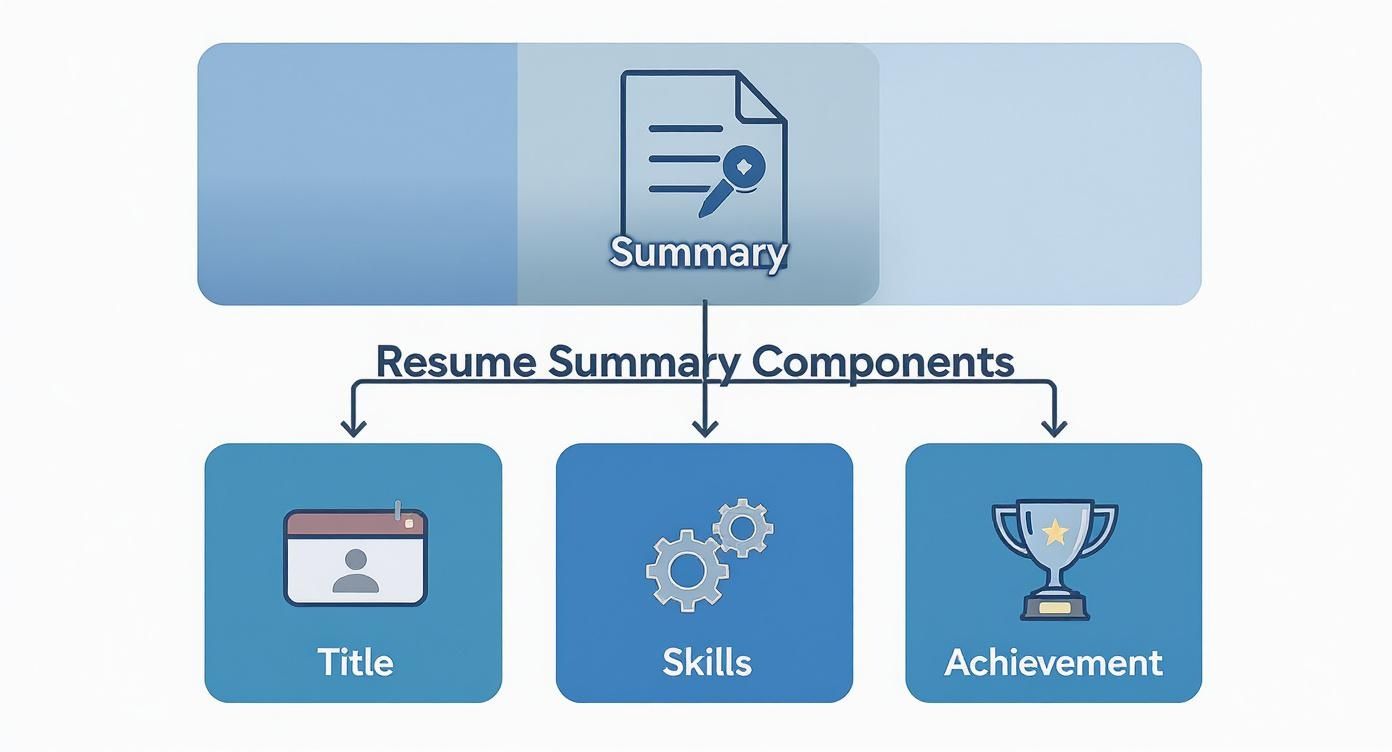
As you can see, it all starts with a strong title and the right skills. Those become the foundation for showcasing what you’ve actually accomplished.
Professional Title and Core Skills
First things first: choose a professional title that mirrors the job you want, not just the one you had. If you're currently an "Associate Marketing Coordinator" but you're applying for a "Marketing Specialist" role, go ahead and use "Marketing Specialist" in your summary. This small tweak immediately aligns you with the position and is a smart move for getting past Applicant Tracking Systems (ATS).
Next, you'll want to weave in the hard and soft skills recruiters are actively searching for. In today's job market, skills are king—they've become the second most important section on a resume right after work experience. In fact, projections show that by 2027, the skill sets needed for most jobs will have shifted by roughly 50% from where they were in 2015. That’s a huge change, and it highlights just how crucial it is to keep this section fresh.
Key Takeaway: Your summary isn't just a biography; it's a targeted marketing message. Every word should be carefully chosen to align with the specific job description and what the employer is looking for.
Action Verbs and Quantifiable Achievements
Once you have your title and skills down, it's time to inject some energy. Ditch passive language and bring in powerful action verbs. Words like "developed," "spearheaded," and "executed" don't just sound better—they convey confidence and transform your old responsibilities into active contributions. If you're looking for inspiration, you can find a whole list in our guide on the best resume keywords to get you hired.
Finally, we get to the most crucial ingredient: a quantifiable achievement. Numbers are your best friend here because they provide undeniable proof of what you can do. Instead of vaguely saying you "improved sales," get specific and state that you "increased quarterly sales by 15%." Using percentages, dollar amounts, and other metrics makes your impact tangible and memorable. It’s what turns a generic statement into a compelling testament to your value.
Getting Your Summary Past the Robot Gatekeepers (ATS)
Before a hiring manager ever lays eyes on your resume, it almost always has to get past a digital bouncer first: the Applicant Tracking System (ATS). Think of it as a robotic assistant that scans and filters every application, only passing the most relevant ones on to a real person.
Your resume summary is the very first thing this software reads, making it the most valuable piece of real estate on the page. If your summary is missing the right keywords or uses weird formatting, it could be rejected before you even get a chance. In fact, 76.4% of recruiters rely on ATS filters to find candidates with specific skills, so this isn't a step you can afford to skip.
This isn’t about trying to trick the system. It’s about learning to speak its language—translating your skills into the exact terms the ATS is programmed to look for so your resume gets the attention it deserves.
How to Find and Weave in the Right Keywords
So where do you find these magic keywords? It's simpler than you think: the job description is your cheat sheet. The employer is literally telling you what they want to see.
- Spot the Core Skills: Look for skills or software mentioned repeatedly, like "Salesforce," "Python," or "SEO strategy." These are non-negotiable.
- Borrow Their Verbs: Pay attention to the action words they use to describe the job, such as "manage," "analyze," or "develop."
- Mirror the Job Title: If the posting is for a "Digital Marketing Specialist," your summary should reflect that exact title.
Once you’ve collected these terms, weave them naturally into your summary. This direct alignment is the single best way to boost your chances of getting past that initial scan.
Key Takeaway: An ATS-friendly summary is a bridge connecting your experience to the employer’s checklist. By mirroring the language in the job description, you make that bridge strong enough for your qualifications to cross over to the hiring manager.
Keep the Formatting Simple and Clean
Even the best keywords won’t help if the ATS can’t read your summary. This software hates complexity and loves simplicity. To make sure your resume gets parsed correctly, stick to these rules:
- Use a standard, web-safe font like Arial, Calibri, or Helvetica. Fancy fonts can cause errors.
- Never put your summary in a header, footer, or text box. Keep it in the main body of the document.
- Steer clear of tables, columns, or any graphics in this section.
By keeping your formatting clean and your language aligned with the job description, you create a powerful summary that works for both the robot and the human reviewer. For a much deeper dive, don't miss our ultimate guide to ATS-friendly resumes.
Resume Summary Examples for Any Career Path
Putting those core resume‐summary principles into action can feel like night and day. Your summary must reflect your journey—whether you’re fresh out of college, deep into your career, or ready for a complete pivot. Below, you’ll find sample summaries that you can adapt to tell your own story.
These aren’t cookie-cutter templates; they’re frameworks to spark your own creative spin. Notice how each one leads with a clear title, weaves in essential skills, and highlights a concrete achievement for maximum impact.
For The Recent Graduate
Early in your career, employers look for promise and core capabilities. Focus on academic wins, leadership roles, and soft skills that translate smoothly to the workplace.
Example:
“Motivated Business Administration graduate with proven organizational skills honed as student‐government leader. Completed coursework in marketing and project management, emphasizing team efficiency and data-driven planning. Ready to apply analytical thinking and collaborative spirit in a fast-paced corporate setting.”
This summary works because it spotlights relevant classes, leadership experience, and a clear eagerness to contribute from day one.
For The Mid-Career Professional
With years under your belt, your summary should cut straight to results. Highlight your expertise, quantify key wins, and show how you’ve moved the needle in past roles.
Example:
“Data-Driven Operations Manager with 8+ years of experience in process optimization and supply chain oversight. Led the implementation of a new inventory-control system that slashed warehousing costs by 22% within 12 months. Skilled at scaling operations and guiding cross-functional teams to exceed targets.”
Numbers like 8+ years and 22% immediately convey credibility and impact.
For The Career Changer
Shifting industries means your summary needs to build a bridge between past and future. Emphasize transferable strengths and frame achievements in a way that resonates with your new field.
Example:
“Strategic Project Manager Transitioning to Digital Marketing. Bringing 8 years of expertise in data analysis, team leadership, and budget management. Recognized for delivering projects 20% under budget and boosting team efficiency by 35%. Eager to leverage planning skills for high-impact, data-driven marketing campaigns.”
By calling out the transition explicitly and backing it with metrics, this summary paints a clear path from project management to marketing.
Each of these approaches shows how to position your unique background. For more in-depth guidance on structuring every section of your resume, check out how to create the best resume for every job.
Avoiding Common Resume Summary Mistakes
It’s surprisingly easy to get the resume summary wrong. Crafting the perfect pitch is a balancing act, and many people fall into the same traps that water down their message and get their resumes ignored.
One of the most common mistakes is leaning on generic buzzwords. Phrases like "team player" or "results-driven" are so overused they've become meaningless. They tell a recruiter nothing specific about what you can actually do.
Instead of using clichés, focus on providing concrete proof. Your goal is to show, not just tell. Don't say you're a “hard worker”—prove it with a powerful, quantified achievement that shows the impact you made.
Another major misstep? The one-size-fits-all summary. Sending the same generic pitch for every application signals a lack of genuine interest and makes it nearly impossible to get past the Applicant Tracking Systems (ATS) that are scanning for specific keywords.
Forgetting the Numbers
If there's one mistake that sinks more summaries than any other, it's leaving out quantifiable results. Numbers are the ultimate proof of your value. They make your accomplishments tangible and undeniable. Without them, your claims are just words on a page.
For many recruiters, this isn't just a best practice—it's a dealbreaker. A recent survey revealed that for 34% of recruiters, a lack of measurable results is enough to reject a candidate outright. This problem is often tied to the fact that 54% of candidates don't bother customizing their resumes, which leads to summaries that completely miss the specific outcomes employers are looking for. You can dive deeper into the data in this job search trends report from Huntr.co.
Key Takeaway: Treat your resume summary like prime real estate. Every single word needs to earn its spot by communicating value, aligning with the job description, and backing up your claims with hard data.
Fixing Common Resume Summary Mistakes
It's one thing to know what not to do, but it's another to know how to fix it. This table breaks down the most frequent errors and gives you clear, actionable ways to turn those weaknesses into strengths.
| Common Mistake | Why It's a Problem | How to Fix It |
|---|---|---|
| Using vague buzzwords | Phrases like "team player" or "innovative thinker" are clichés that recruiters ignore. They lack specific meaning and don't differentiate you. | Replace the buzzword with a specific example. Instead of "results-driven," say "Drove a 15% increase in Q3 sales by implementing a new CRM workflow." |
| Writing a generic, one-size-fits-all summary | It tells recruiters you didn't care enough to tailor your application. It also fails to match the keywords the ATS is looking for. | Carefully read the job description and mirror its language. Pull out 2-3 key requirements and directly address them in your summary with relevant skills and achievements. |
| Forgetting to add numbers | Without metrics, your achievements sound weak and unconvincing. Numbers provide concrete proof of your impact and value. | Quantify everything you can. Use percentages, dollar amounts, or time saved. "Managed a team" becomes "Led a team of 8 to complete a project 2 weeks ahead of schedule." |
| Making it too long | Recruiters scan resumes in seconds. A long, dense paragraph is overwhelming and will likely be skipped. | Keep it short and punchy. Aim for 2-4 sentences or around 50 words. Get straight to the point and focus only on your most relevant qualifications. |
| Focusing on what you want (an objective) | An objective statement is outdated. It focuses on your goals, while a summary should focus on the value you bring to the employer. | Shift the focus from "I want" to "I can offer." Highlight your key skills and how they will solve the company's problems or help them achieve their goals. |
By dodging these common errors, you can transform a weak, forgettable summary into a dynamic and compelling pitch. A great summary doesn't just get your resume read—it gets it to the top of the pile.
Got More Questions About Resume Summaries?
Even after getting the basics down, a few tricky questions always seem to pop up. Let's tackle the most common ones so you can write your summary with complete confidence.
What’s the Perfect Length for a Resume Summary?
Aim for two to four sentences, or right around 50 words.
Think of it as your professional "elevator pitch." It needs to be long enough to hook the reader with your top qualifications and a standout achievement, but short and punchy enough for a busy recruiter to scan in just a few seconds. Go any longer, and you risk it getting skipped entirely.
Is a Summary the Same Thing as an Objective?
Nope, and this is a really important difference. An old-school objective statement is all about what you want from a job. A modern summary flips the script and focuses on the value you bring to the employer.
It’s a simple change, but it makes a huge impact. A summary instantly answers the hiring manager's biggest question: "Why should I care about this candidate?" by putting your skills and results front and center.
In a competitive job market, you have to position yourself as the solution to their problem, not just another person looking for a job. A strong summary does exactly that.
How Often Should I Tweak My Summary?
You need to customize your resume summary for every single job you apply for. I know, it sounds like a lot of work, but this is non-negotiable if you want to get past the initial screening.
A generic, one-size-fits-all summary won't make it through the Applicant Tracking Systems (ATS) that companies use, and it definitely won't grab a recruiter's attention. Sprinkling in keywords directly from the job description is the secret to showing you're the perfect fit for that specific role.
Ready to build a summary that actually gets you interviews? ResumeShaperAI creates a perfectly tailored, ATS-friendly resume and cover letter in minutes. Stop guessing what recruiters want and start applying with a resume that works at https://resumeshaperai.com.