
So, what’s the real purpose of a cover letter, anyway? Think of it as your personal sales pitch. It’s the bridge connecting the black-and-white facts on your resume to the specific needs of a job you’re genuinely excited about. It’s the story behind your skills, showing a hiring manager not just what you’ve done, but why you’re the perfect person to help their company win.
Your cover letter is like the trailer to your professional movie; it has to be compelling enough to make them want to see the full feature—by calling you in for an interview.
Your Cover Letter Is Your First Conversation
A lot of job seekers make the mistake of thinking a cover letter is just a formal intro or, even worse, a rehash of their resume. That mindset leads to dull, generic letters that get tossed aside immediately. The truth is, a powerful cover letter has a much deeper, more strategic role to play. It’s your first—and maybe only—chance to speak directly to the hiring manager.
Your resume is a structured, factual document. It’s the “what” and “where” of your career, listing your past roles, skills, and accomplishments in a format designed for a quick scan by both people and Applicant Tracking Systems (ATS).
But your cover letter? It provides the crucial “why.” It fills in the gaps and answers the questions a resume simply can’t:
- Why are you genuinely interested in this specific company and not just any old job?
- How do your past wins directly translate to solving their specific problems?
- What’s your professional personality like, and how would you vibe with their team?
Cover Letter vs Resume At a Glance
To see the difference clearly, here’s a quick breakdown of how these two critical documents work together.
| Element | Resume | Cover Letter |
|---|---|---|
| Purpose | To provide a factual summary of your skills and experience. | To tell a persuasive story connecting your skills to the job. |
| Format | Structured, scannable, often using bullet points. | Narrative, conversational, written in paragraph form. |
| Content | Past roles, responsibilities, quantifiable achievements. | Future potential, motivation, cultural fit, and passion. |
| Focus | “What I’ve done.” | “Why I’m the right person for you.” |
| Audience | Both ATS bots and human recruiters. | Primarily the human hiring manager. |
Each document plays a distinct role, but when they work in tandem, they create a powerful, convincing application.
Bridge the Gap Between Your Resume and the Job
Imagine your resume is a box of puzzle pieces. Each piece is a skill, a project, or a past job. On its own, it’s just a collection of facts. The cover letter is the picture on the box that shows the hiring manager exactly how all those pieces fit together to create the perfect image they’re looking for.
This isn’t just a nice-to-have formality; it has a real, measurable impact. The goal is to provide context that a resume alone can’t possibly convey. In fact, a recent analysis of over 6,000 applications found that candidates who included a customized cover letter received 53% more interview invitations than those who only sent a resume. Learn more about these cover letter findings.
Your resume proves you’re qualified. Your cover letter proves you’re the right fit. It’s the human element that brings your entire application to life.
Why a Cover Letter Is Your Secret Weapon
In a sea of qualified candidates, your resume is just a list of facts. It shows what you’ve done, but it doesn’t explain why you’re the right person for the job. If every applicant has a similar set of skills, how does a hiring manager possibly choose?
This is where the cover letter comes in. Think of it as your secret weapon—the tool that transforms your application from a dry list of qualifications into a compelling human story.
A great cover letter does three critical things a resume simply can’t. It goes beyond the bullet points to give a hiring manager the context they need to see you as the perfect addition to their team.
It Reveals Your Personality and Cultural Fit
Your resume is professional and factual, which is great. But it’s also pretty impersonal. A cover letter is your chance to inject some genuine personality into your application. It lets you use a tone that reflects who you are and shows you understand the company’s vibe, helping recruiters see how you’d mesh with their team.
This is especially important for smaller businesses where team dynamics are everything. You can show your enthusiasm, share your work ethic, and connect with the reader on a human level. That personal touch makes you memorable and helps the hiring manager see you as a future colleague, not just another name in a spreadsheet.
It Provides Tangible Proof of Communication Skills
Almost every job ad asks for “strong communication skills,” but how do you prove that on a resume? You can list it, sure, but a cover letter is your chance to actually demonstrate it. The clarity of your writing and the way you build your argument are on full display.
A well-written letter is immediate proof of your competence. It shows you can organize your thoughts and express them professionally—a skill that’s valuable in pretty much any role. It’s your first opportunity to show, not just tell, them you’re an effective communicator.
It Shows Genuine Interest and Motivation
Recruiters can spot a generic, copy-paste application from a mile away. A cover letter tailored to a specific company proves you’ve done your homework and are genuinely excited about this particular opportunity, not just any job.
By mentioning the company’s mission, a recent project, or a specific challenge from the job description, you signal that you’re an invested and proactive candidate.
A cover letter isn’t about repeating your resume; it’s about connecting your unique story directly to the company’s needs, proving you’re not just looking for any job—you’re looking for this job.
This show of genuine interest is incredibly powerful. Even when a job posting says a cover letter is optional, submitting one is a massive opportunity. Statistics show that 79% of companies that call a cover letter optional still read the ones they get, and 83% of HR professionals say cover letters are important in their hiring decisions. To learn more, discover the latest insights on cover letter statistics.
That small bit of extra effort can be the very thing that pushes your application to the top of the pile.
How Cover Letters Influence Hiring Decisions
To really get why cover letters matter, you have to put yourself in a recruiter’s shoes for a minute. They’re staring down a mountain of applications for just one open role. After a while, a lot of the resumes start to blur together, listing similar skills and work histories.
This is exactly where your cover letter steps in to become the ultimate tiebreaker.
It’s often the very first filter. Before a recruiter even bothers with the bullet points on your resume, the cover letter gives them a quick read on your professionalism, your attention to detail, and whether you’re genuinely fired up about this specific job. A generic, typo-filled letter can get your application tossed in the “no” pile instantly. But a great one? It makes them want to know more.
This is your shot to forge a personal connection and stand out from a sea of otherwise qualified, but faceless, applicants.
Turning Red Flags into Strengths
A resume is just a timeline of facts, which means it can’t tell the whole story. Things like employment gaps, a winding career path, or a switch to a brand-new industry can look like red flags on paper.
Your cover letter is where you get to control the narrative and reframe those potential issues into powerful stories of growth and intention.
Instead of letting a recruiter wonder why you took a year off, you can explain how that time was spent learning a new skill or gaining a fresh perspective. Rather than looking underqualified for a new field, you can directly connect your transferable skills to what the company needs, proving how your unique background is actually a huge asset.
This ability to shape your story is priceless. It lets you tackle potential concerns head-on, showing self-awareness and turning a perceived weakness into a memorable strength.
The Data Behind the Decision
The power of a good cover letter isn’t just a gut feeling; the numbers back it up. Recruiters consistently use them to make critical shortlisting decisions.
In one survey of US hiring managers, a massive 83% said they always or frequently read cover letters. Even more telling, 45% review the letter before they even glance at the resume. You can dig into more of the numbers in the full analysis of cover letter trends.
What does this mean for you? Your cover letter is often setting the first impression, coloring how a recruiter views your entire application from the get-go.
A strong cover letter can be a game-changer. The same survey found that 49% of hiring managers said a great one could convince them to interview a candidate. On the flip side, 18% admitted a weak letter could make them reject an otherwise qualified applicant.
Ultimately, the cover letter’s job is to put a human face on your application and make a compelling argument for why you’re the one they should talk to. While your resume lays out the facts of your qualifications, your cover letter is what convinces a hiring manager you’re the right person for their team. It’s crucial to understand both what recruiters look for in resumes and how a cover letter perfectly complements that information.
The Anatomy of a Purposeful Cover Letter
https://www.youtube.com/embed/5q4E5wP86o8
Knowing what a cover letter is supposed to do is one thing, but actually building one that hits the mark is a whole different ballgame. A truly effective cover letter isn’t just a jumble of paragraphs. It’s a carefully crafted story with a clear beginning, middle, and end, where every part has a specific job.
Think of it less like a stuffy, formal document and more like a three-act play designed to convince someone to hire you. This structure makes your letter easy to follow and ensures your best points land in a logical order, guiding the recruiter from “who’s this?” to “I need to talk to this person.”
An Unforgettable Introduction
Your opening paragraph is your handshake. It has to be firm and memorable. This is no place for tired lines like, “I am writing to apply for…” Instead, lead with a strong, confident statement that immediately plugs you into the role and the company.
This “hook” needs to quickly tell them who you are professionally and why this specific job caught your eye. The goal? Make the hiring manager sit up, lean in, and want to keep reading.
Example Introduction:
“As a project manager with over five years of experience driving efficiency in fast-paced tech environments, I was immediately drawn to [Company Name]’s innovative approach to logistics. My work scaling operational workflows at my previous role directly aligns with the challenges outlined in your Project Manager job description.”
The Proof: Persuasive Body Paragraphs
The body of your cover letter, usually one or two paragraphs, is where you lay your cards on the table. This is where you back up your claims with hard evidence. Don’t just list your skills—connect your top two or three qualifications directly to the needs you saw in the job posting.
For each point, use a simple formula: name a relevant skill, share a quick story of how you used it, and—most importantly—add a number to show the result. This turns a bland statement like “I’m a strong leader” into a powerful, unforgettable achievement.
This is the exact point where a cover letter acts as a filter, helping recruiters decide which strong candidates are worth bringing in for an interview.
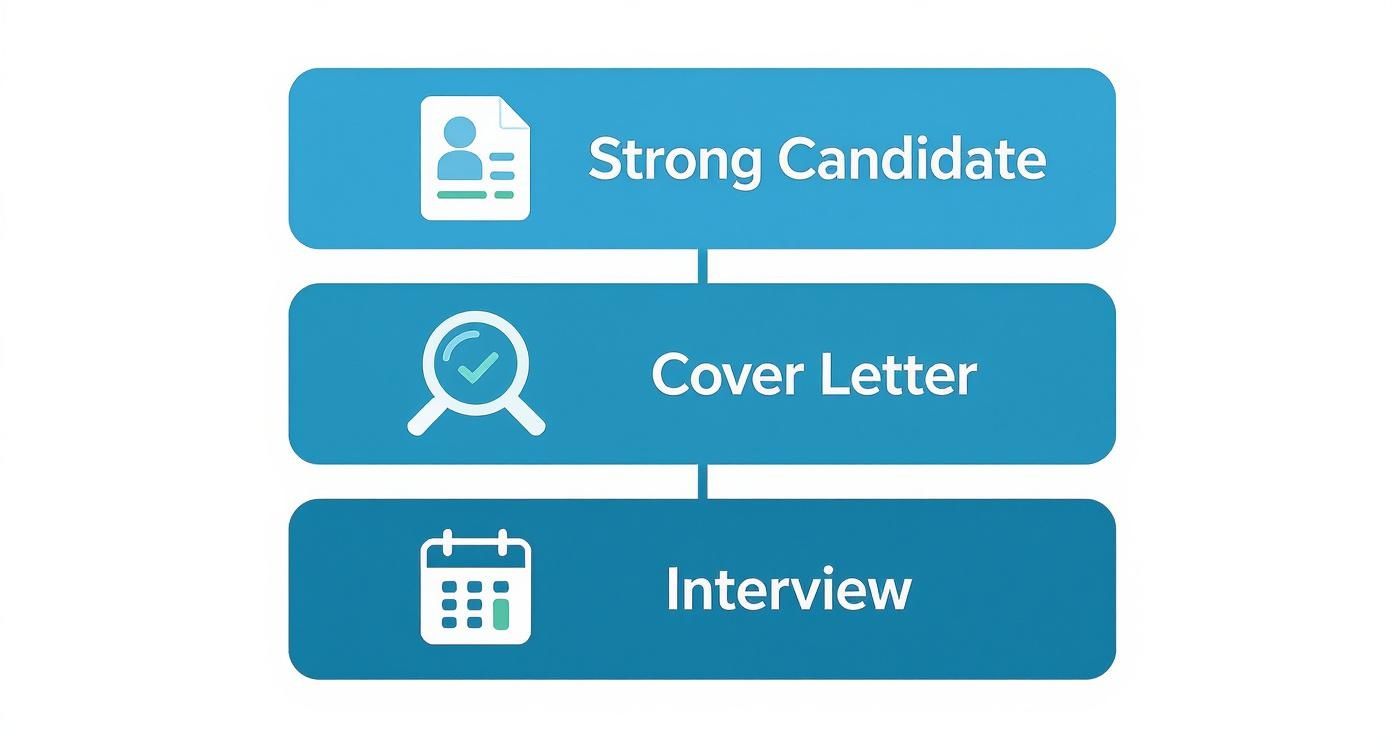
As you can see, even for a great candidate, the cover letter is a make-or-break step before an interview is ever offered.
The Close: A Confident Call to Action
Your conclusion needs to be more than just a polite “thank you.” It should be a confident, forward-looking closing that reinforces your excitement and tells them exactly what you want to happen next: an interview.
Wrap up your core value in a single sentence and express your genuine eagerness to talk about how you can help the company. End with a professional sign-off and a clear call to action. For a deep dive into each of these sections, check out our complete guide on how to write a cover letter for more tips and examples.
Example Closing:
“I am confident that my experience in streamlining complex projects and my passion for data-driven results would make me a valuable asset to your team. I have attached my resume for your review and look forward to discussing how I can contribute to [Company Name]’s goals in an interview.”
Tailoring Your Cover Letter for Maximum Impact
Think of a generic, one-size-fits-all cover letter like a junk mail flyer. It’s impersonal, doesn’t speak to you directly, and usually ends up in the trash. That’s exactly how a recruiter sees a non-customized application.
Customization is the single most important thing you can do. It transforms your letter from a simple formality into a powerful tool that proves you’ve done your homework and are genuinely serious about this specific role.
Recruiters are experts at spotting templates. They see hundreds of applications and can tell in a second if you just swapped out the company name. When you tailor your letter, you’re not just listing skills; you’re connecting the dots for them, showing how you are the direct solution to their problems. That effort alone puts you way ahead of most other applicants.
How to Tailor Your Letter Step-by-Step
Getting this right involves a little bit of detective work. You need to figure out what the company really needs and then frame yourself as the person who can deliver it. It boils down to a few key actions.
Dissect the Job Description: Don’t just skim it. Read the job posting line by line and highlight the key responsibilities, required skills, and specific qualifications they mention. These are the exact words you need to echo in your letter to signal you’re a perfect match.
Research the Company: Go deeper than their homepage. Look up recent news, understand their mission, and get a feel for their company culture. Mentioning a specific project or a company value shows you aren’t just looking for any job—you want to be part of their team.
Connect Your Experience to Their Needs: This is crucial. Don’t just say you have a skill. Give a quick, concrete example of how you used that skill to get a result that’s relevant to what they’re looking for.
Tailoring isn’t just about changing the company name. It’s about reshaping your story to align with what the employer actually cares about. You have to prove you understand their challenges and are the person who can solve them.
Modern tools often have an interface that guides you through adding these key details for customization, making the process much smoother.
This kind of setup makes it easy to add the specific details that connect your qualifications directly to the job’s must-haves.
Accelerate Customization with Modern Tools
While tailoring is non-negotiable, it doesn’t have to take all day. Smart tools can dramatically speed things up, helping you create high-impact, customized letters in just a few minutes. This turns a tedious chore into an efficient and powerful part of your job search.
For example, platforms like ResumeShaperAI can analyze a job description and generate a strong first draft that’s already lined up with the role’s key needs. Using an AI resume builder with a cover letter generator ensures your entire application is in sync and looks professional. It gives you a massive head start, so you can focus on adding the personal touches that make your application truly unforgettable.
Common Questions About Cover Letters
Even after you understand the why, the how can still feel a bit fuzzy. Let’s clear up some of the most common questions that pop up when you’re about to write one.
How Long Should a Cover Letter Be?
The golden rule is to keep it short and sweet. Aim for 250-400 words, which is just enough to fill about three-quarters of a single page. Think of it as an elevator pitch, not an autobiography.
Stick to a brief introduction, one or two body paragraphs that connect your best achievements to the role, and a strong closing. That’s all you need to grab their attention without overwhelming them.
Do I Need a Different Cover Letter for Every Job?
Yes. One hundred percent. Sending the same generic letter to every company completely misses the point. Tailoring your letter is non-negotiable if you want to be taken seriously.
The entire purpose of a cover letter is to make a specific case to a specific employer for a specific role. Customization shows genuine interest and effort.
What Is the Biggest Mistake to Avoid?
The single worst mistake you can make is just rehashing your resume. Your cover letter isn’t a summary; it’s a storyteller. It should add color, context, and personality to the facts listed on your resume.
Use this space to connect the dots between your past wins and the company’s future needs. Show them the passion and drive that a bulleted list just can’t capture. It’s your one chance to answer the real question: “Why should we hire you?”
Struggling to write a compelling, tailored cover letter for every application? ResumeShaperAI can generate a personalized first draft in seconds, perfectly aligned with the job description. Build your standout application now at ResumeShaperAI.