
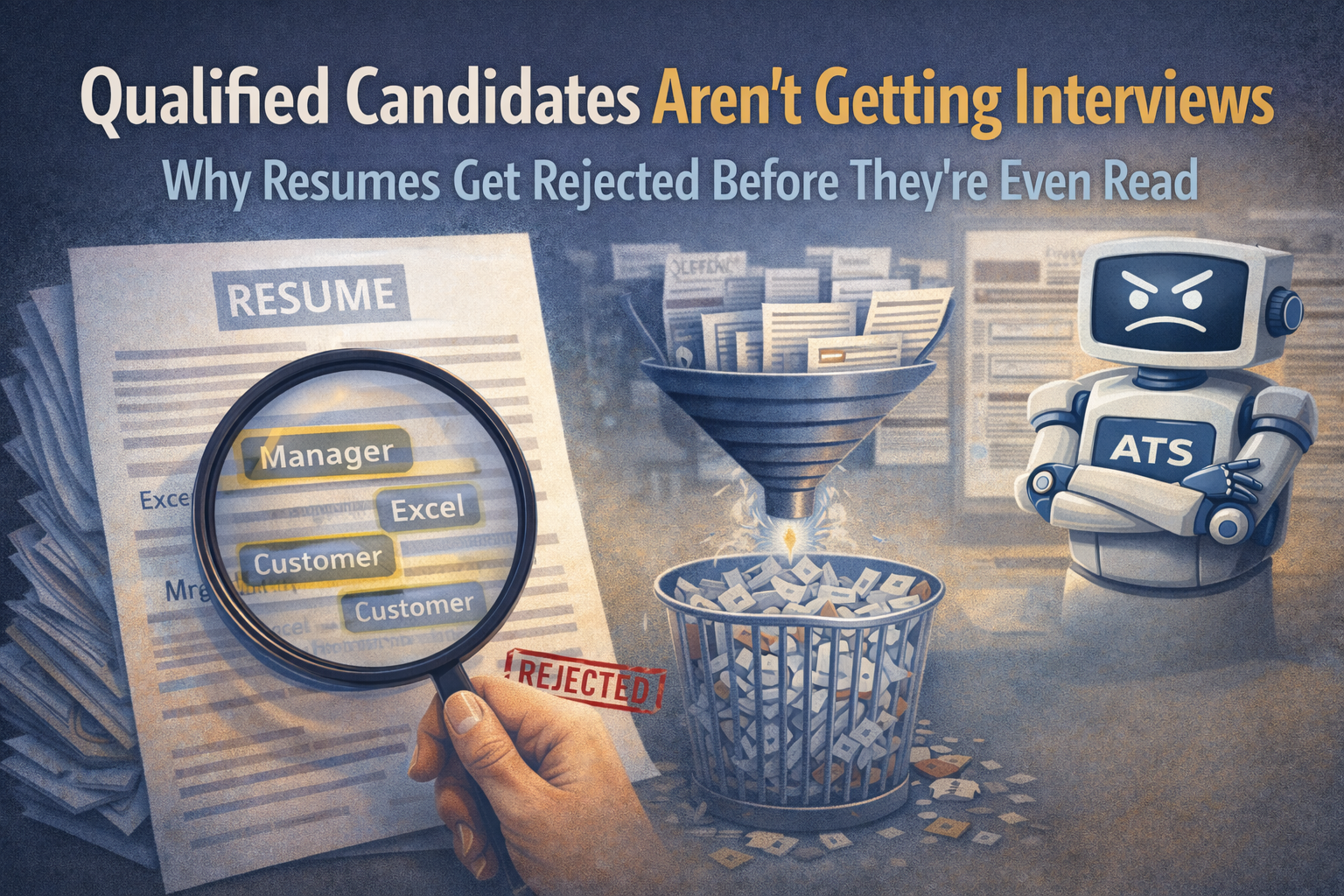
Why Qualified Candidates Aren’t Getting Interviews (And What the Hiring Process Is Actually Filtering For)
You meet the requirements.
You have experience.
You’re applying to roles you’re genuinely qualified for.
Yet the interviews don’t come.
This is one of the most common — and most misunderstood — problems in modern hiring. And the answer is not that you’re unqualified, lazy, or doing everything wrong.
In reality, most qualified candidates aren’t getting interviews because the hiring process filters people long before a human ever evaluates ability.
This article explains why qualified candidates aren’t getting interviews, using real hiring data, recruiter behavior, and how systems actually work — not assumptions or outdated advice.
Being “Qualified” Is Not the Same as Being Selected
One of the biggest disconnects in job searching is how candidates define qualified versus how hiring systems define it.
From a candidate’s perspective, qualification means:
You meet most or all listed requirements
You’ve done similar work before
You can realistically perform the role
From the hiring process’s perspective, qualification means:
Your resume matches a specific pattern
Your experience aligns exactly with the role’s framing
Your background is easily categorized and compared
These are not the same thing.
Hiring is not about finding capable people first.
It’s about filtering people efficiently.
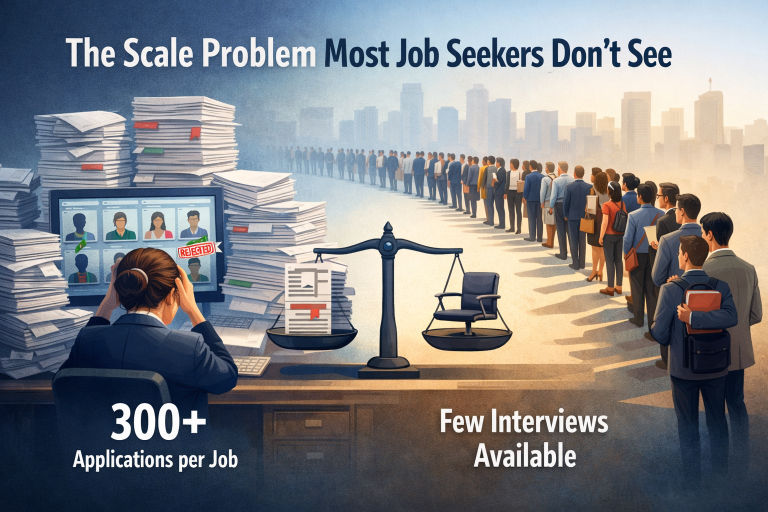
The Scale Problem Most Job Seekers Don’t See
According to multiple recruiting industry studies, a single job posting often attracts an overwhelming number of applicants. For mid-level roles, it’s common for employers to receive hundreds of resumes, while remote positions or roles at well-known companies can easily draw a thousand or more applications.
Even when only a small percentage of those applicants are truly qualified, recruiters are not dealing with a lack of talent — they are dealing with scale. The sheer volume of applications makes it impossible to evaluate each resume in depth.
As a result, hiring teams rely on screening systems and rapid filtering methods to reduce the applicant pool quickly. These systems are designed to narrow candidates down aggressively, not to carefully assess potential. In that environment, resumes that are “good enough” are often filtered out alongside clearly unqualified ones simply because they don’t stand out fast enough or fit expected patterns closely enough.
This is why many qualified candidates never reach the interview stage. The hiring process is structured to eliminate applicants efficiently, not to evaluate every capable person thoroughly.
Why Applicant Tracking Systems Reject Qualified Candidates
Applicant Tracking Systems (ATS) are not designed to judge talent. They are designed to organize data.
Here’s what they actually do:
Parse resume text into structured fields
Categorize experience based on job titles and keywords
Rank or group candidates by relevance to the job posting
What they do not do:
Understand nuance
Interpret transferable skills well
Recognize potential or growth
This leads to common rejection scenarios:
Your job title doesn’t match expected titles
Your experience is relevant but described differently
Your skills are implied, not explicitly stated
Your resume format breaks parsing rules
Even strong candidates can be filtered out before a recruiter ever sees their name.
In reality, most qualified candidates aren’t getting interviews because the hiring
process filters people long before a human ever evaluates ability. Read more here.
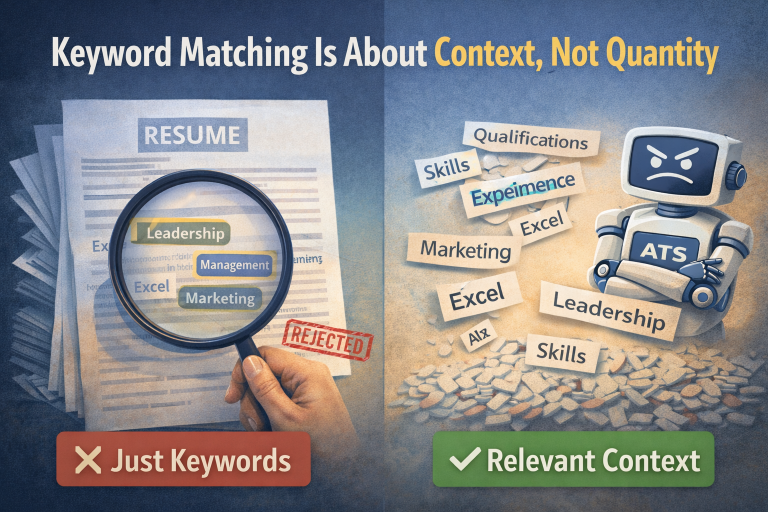
Keyword Matching Is About Context, Not Quantity
One of the most persistent myths is that resumes fail because they lack enough keywords.
In reality, most resumes fail because keywords are:
Used without context
Placed in irrelevant sections
Not aligned with how the role is defined
Modern systems and recruiters look for:
Skills tied to outcomes
Tools connected to responsibilities
Experience framed within role-specific language
This is why many candidates who “have the skills” still aren’t getting interviews — the resume doesn’t present those skills in a way the system recognizes.
Recruiters Spend Less Time Than You Think on First Reviews
Eye-tracking and recruiter behavior studies consistently show that the first resume review is extremely brief, often lasting only a few seconds.
During this initial scan, recruiters focus almost entirely on job titles, dates, and familiar keywords, using formatting and structure as quick signals of competence and role fit rather than reading content line by line.
Because this first pass is driven by speed and pattern recognition, qualified candidates can be rejected simply because their resumes are harder to process under time pressure, not because their experience is lacking or irrelevant.
Job Titles Matter More Than Most Candidates Realize
Job titles act like shortcuts in the hiring process. Recruiters and hiring systems use them to quickly understand what level you’re at, what kind of work you’ve done, and whether your background looks like a fit — often before reading anything else on your resume.
If your job title doesn’t line up with what they expect, your resume can get skipped even if you’re fully capable of doing the job.
For example, an “Operations Coordinator” and a “Business Operations Analyst” might do very similar work, but one title sounds more strategic than the other.
The same goes for “Customer Support Specialist” versus “Client Success Manager” — the responsibilities may overlap, but the titles send very different signals 📌.
When titles don’t match, it doesn’t mean you’re unqualified — it means your experience may be getting sorted into the wrong bucket.
This is one of the biggest reasons qualified candidates aren’t getting interviews, especially for career changers or people moving between industries 🔄.
Hiring systems move fast, and when titles don’t clearly reflect your role, your resume can be harder to understand at a glance — which makes it easier to pass over when time is tight ⏱️.
Overqualification Can Quietly Work Against You
Another uncomfortable reality: being too qualified can reduce interview chances.
Recruiters may worry that:
You’ll expect higher compensation
You’ll get bored and leave
You’re using the role as a stopgap
This concern often isn’t stated — it’s simply used as a silent filtering factor.
That doesn’t mean you should hide experience, but it does mean alignment matters more than raw achievement when trying to get job interviews.
The “Apply to Everything” Strategy Backfires
When candidates aren’t getting interviews, a common reaction is to apply more broadly — sending out more applications, targeting more roles, and even branching into new industries. While this feels productive, it often does the opposite of what candidates want and actually leads to fewer job interviews, not more.
As applications become more scattered, resumes tend to lose focus. They become more generic, less aligned with any specific role, and harder for hiring systems to clearly categorize. When applicant tracking systems can’t easily match your resume to how a role is defined, your chances of getting interviews drop, even if you’re qualified.
Getting job interviews isn’t about applying everywhere — it’s about precision. The closer your resume aligns with the role you’re targeting, the easier it is for hiring systems and recruiters to recognize you as a fit and move you forward in the process.
How Interviews Actually Happen (Simplified)
When candidates aren’t getting interviews, a common reaction is to apply more broadly — sending out more applications, targeting more roles, and even branching into new industries. While this feels productive, it often does the opposite of what candidates want and actually leads to fewer job interviews, not more.
As applications become more scattered, resumes tend to lose focus. They become more generic, less aligned with any specific role, and harder for hiring systems to clearly categorize. When applicant tracking systems can’t easily match your resume to how a role is defined, your chances of getting interviews drop, even if you’re qualified.
Getting job interviews isn’t about applying everywhere — it’s about precision. The closer your resume aligns with the role you’re targeting, the easier it is for hiring systems and recruiters to recognize you as a fit and move you forward in the process.
Getting Interviews Is About Translation, Not Transformation
One of the most important shifts candidates can make is understanding that resumes are not biographies.
They are translation documents.
Your resume doesn’t need to prove you’re exceptional.
It needs to clearly communicate relevance in the language hiring systems and recruiters use.
That distinction alone explains why so many qualified candidates aren’t getting interviews.
If you’re qualified but not getting interviews, it does not mean:
You chose the wrong career
You lack ability
You’re failing
It means your experience isn’t being interpreted the way hiring systems require.
Understanding that difference is the first step toward navigating the process without losing confidence, clarity, or momentum.
Effectively interpret and highlight transferable skills so they clearly align with the role you’re targeting. This helps employers quickly see your value, even when your experience comes from a different industry or role. Learn more about transferable skills here.
Your resume format breaks parsing rules, which can prevent applicant tracking systems from accurately reading and ranking your qualifications. When sections, headings, or spacing are inconsistent, key details may be misread or skipped entirely. This can cause strong candidates to be filtered out before a human ever sees the resume. Learn more about resume format in this blog.