

When you're changing careers, a cover letter isn't just a formality—it's your most powerful tool for telling the story behind your pivot. This is where you connect the dots between your past experience and your future goals, making sure recruiters see your potential, not just a resume that doesn't seem to fit.
Why Your Career Story Needs a Cover Letter
Staring at a resume that doesn't quite line up with your new career path can feel a little scary. You know your experience is valuable, but on paper, it might not scream "perfect fit" for the job you're targeting. This is exactly where a strong career change cover letter becomes your secret weapon. It stops hiring managers from jumping to the wrong conclusions about your switch.
Think of it like this: your resume is the cast list of your professional life, just a straightforward list of your skills and roles. Your cover letter, on the other hand, is the movie trailer. It’s the exciting preview that shows how all those seemingly unrelated pieces come together to create a compelling new story a recruiter will want to invest in.
Control Your Narrative
Without a cover letter, you're leaving recruiters to fill in the blanks on their own. They might see your move as a step back, a lack of focus, or just a random mismatch. A well-written letter lets you grab the reins and control that story.
For a career changer, this document is your opportunity to frame your pivot as an asset, not a limitation. It’s where you show that your diverse background brings a fresh perspective and unique value to the role.
This proactive approach is everything. Instead of letting your resume raise questions, your cover letter provides the answers right away, highlighting your motivation and dedication. This strategy is a huge part of learning how to switch careers successfully and positioning yourself as a thoughtful, intentional candidate.
Building the Bridge to a New Industry
Ultimately, a career change cover letter is a bridge. It connects your proven skills—like project management, communication, or data analysis—to the specific needs of the new role. It translates your past wins into the language of your future industry.
This document lets you:
- Explain your motivation: Clearly state why you're passionate about this new field and this specific company.
- Highlight transferable skills: Show, with concrete examples, how skills from your old job directly apply to the new one.
- Demonstrate commitment: Mention any relevant courses, certifications, or side projects you’ve tackled to get ready for this shift.
By doing this, you turn a background that could look like a red flag into a must-have asset.
The Blueprint for a Winning Cover Letter
Let's be honest, staring at a blank page and trying to write a cover letter that explains a major career pivot can feel overwhelming. But it doesn't have to be. A powerful career change cover letter isn't a long, winding essay; it's a strategic document with five key parts, each with a specific job to do.
Think of it like building a bridge. Each section connects your past experience to your future goals, creating a clear, sturdy path for the hiring manager to follow. Get this structure right, and you’ll answer their biggest questions before they even have to ask.
The Five Essential Parts
Your letter needs to flow logically, guiding the reader from a strong first impression to a clear call to action. Here’s how to break it down:
- The Hook: Your opening paragraph has one job: grab their attention. State the exact position you're applying for and share a quick, genuine reason why you're excited about this specific company.
- The Bridge: This is where you connect the dots. Acknowledge your career change head-on and introduce the core transferable skills that make you a surprisingly perfect fit for this role.
- The Evidence: Time to back it up with proof. Share one or two powerful accomplishments from your past roles. Use numbers and concrete results to show how your skills solve the kinds of problems they're facing.
- The Fit: Show them you've done your homework. Mention something specific about the company—their mission, a recent project, or their company values—that truly resonates with you. This proves you want to work for them, not just any company.
- The Closing: End on a strong, confident note. Reiterate your enthusiasm and make it easy for them to take the next step by clearly stating you'd welcome an interview to discuss your fit.
This five-part framework is your foundation. For a deeper dive into the finer points of each section, check out our comprehensive guide on how to write a cover letter that gets noticed.
This simple flowchart shows how your cover letter is the critical link between your resume and your new career, turning facts and dates into a compelling story.
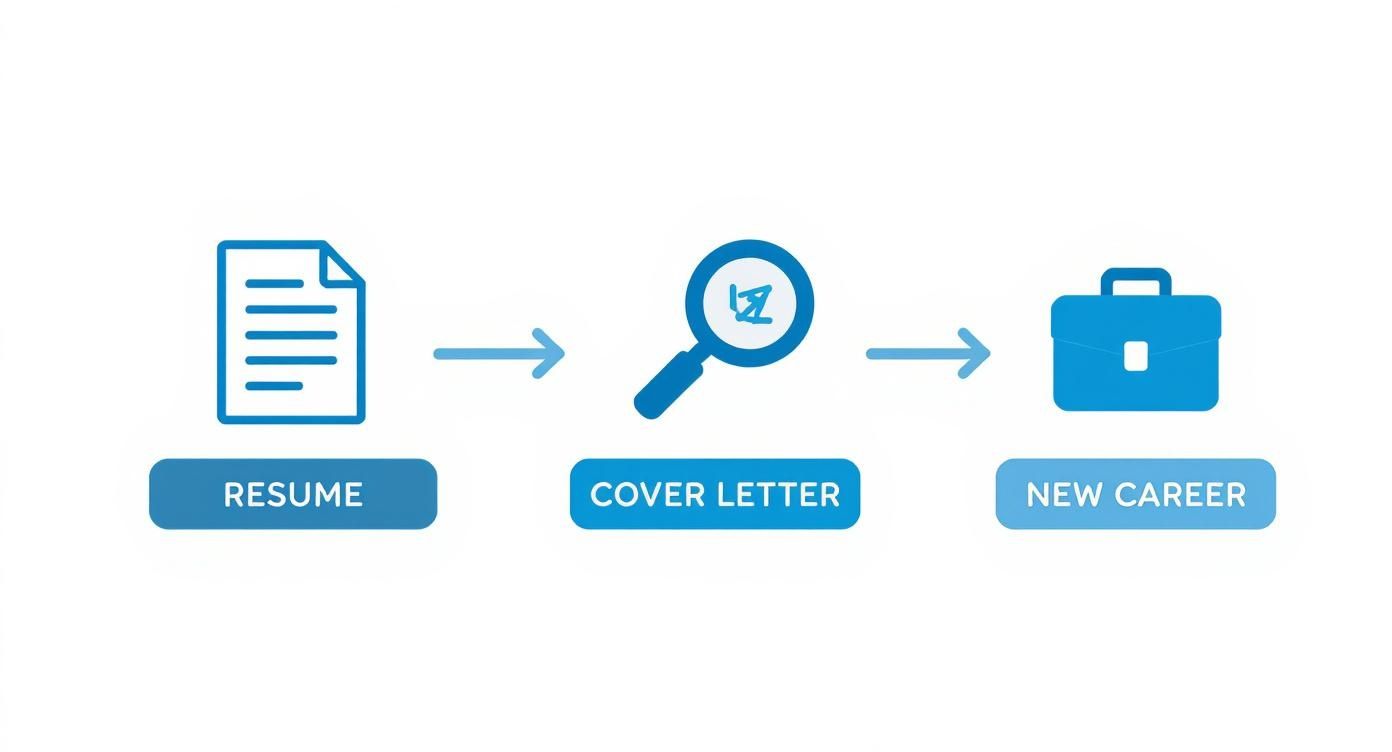
The takeaway here is that your cover letter doesn't just repeat your resume—it translates it for a brand-new audience.
Why This Structure Is So Effective
This blueprint works because it anticipates every question and doubt a hiring manager might have about a career changer. It proactively explains the "why" behind your pivot and shows your value in a clear, logical way.
And don't think for a second that cover letters are obsolete.
An analysis of dozens of hiring studies found that 89% of hiring professionals still expect to see a cover letter. More importantly, 94% of recruiters actually read them as part of their evaluation. For career changers, that letter is your single best chance to build a human connection.
That stat alone should convince you that skipping a cover letter is like leaving your best arguments on the table.
Anatomy of a Career Change Cover Letter
To make this blueprint crystal clear, let's lay out what goes into each section. This table breaks down how each part contributes to your overall narrative, making sure you put the right information in the right place.
| Section | Purpose | Key Elements to Include |
|---|---|---|
| 1. The Hook | To grab immediate interest and state your purpose. | The specific job title, the company name, and a sentence conveying genuine enthusiasm. |
| 2. The Bridge | To connect your past experience to the company's needs. | A brief mention of your career pivot and 2-3 of your most relevant transferable skills. |
| 3. The Evidence | To prove your value with concrete, quantified examples. | A short story or bullet points detailing 1-2 key achievements with real numbers. |
| 4. The Fit | To show you align with the company's mission and culture. | A specific mention of company values, a recent project, or their impact on the industry. |
| 5. The Closing | To prompt the next step with a confident call to action. | Reiterate your interest, thank the reader for their time, and clearly request an interview. |
By thoughtfully building out each of these five sections, your cover letter stops being a formality and starts being a powerful tool. It translates your past successes into future potential, making your application impossible for a hiring manager to ignore.
Translating Your Past Experience for Future Success
When you’re making a career change, your biggest hurdle isn’t a lack of experience—it’s learning how to translate that experience into a language the new industry understands. You can't just list your old job duties and expect a hiring manager to connect the dots. You have to build that bridge for them.

This is where the skill translation method shines. Think of yourself as a professional translator, converting the jargon from your old career into the dialect of your target role. The goal is to show how the core functions you performed are exactly what they're looking for, even if the titles and settings were totally different.
This isn't about fudging the truth; it's about reframing your value. You’re not just a "former teacher"—you're a professional who excels at curriculum development, stakeholder communication, and performance tracking.
The Art of Skill Translation
Start by dissecting the job description for your target role. Pinpoint the key skills and responsibilities they’re asking for. Now, look back at your own experience and find the parallels. The secret is to stop describing your tasks and start highlighting the underlying competencies.
The most effective career changers frame their transition as an asset, not a limitation. They show how their diverse background brings a fresh perspective and proven skills that add unique value to the team.
Let’s look at a couple of real-world examples to see how this translation works in a cover letter.
Example 1: From Teacher to Corporate Trainer
- Before (Task-focused): "As a teacher, I was responsible for planning lessons and grading assignments for my students."
- After (Skill-focused): "In my previous role, I designed and executed comprehensive learning curricula for over 150 stakeholders annually, resulting in a 15% improvement in performance metrics. I am adept at translating complex information into engaging training modules and providing constructive feedback to drive growth."
See the difference? The "after" version swaps classroom language for corporate speak like "stakeholders," "curricula," and "performance metrics." This makes the skills instantly recognizable to a business recruiter and adds a powerful, quantifiable achievement.
Quantify Everything to Prove Your Impact
Numbers are a universal language. Every hiring manager gets them. They cut through industry jargon and provide cold, hard evidence of what you can do. A vague claim like "improved efficiency" is easy to forget, but "streamlined a reporting process that saved 10 hours of administrative work per week" is impossible to ignore.
As you review your past roles, hunt for anything you can measure. Here are a few areas to focus on:
- Efficiency Gains: Did you save time, money, or resources? By how much? (e.g., "reduced project costs by 12%").
- Growth or Improvement: Did you increase sales, engagement, or customer satisfaction? (e.g., "grew social media engagement by 40% in six months").
- Scale of Responsibility: How many people did you manage, train, or serve? How large was the budget you oversaw? (e.g., "managed a client portfolio worth $500,000").
Even small numbers add a ton of credibility. They prove you’re a results-oriented professional who knows how to measure success—a critical skill in any field.
More Before and After Examples
Let's break down another common career pivot to see this reframing in action.
Example 2: From Retail Manager to Supply Chain Analyst
- Before (Task-focused): "My job involved managing store inventory and making sure we didn't run out of popular products."
- After (Skill-focused): "My experience in retail management provided me with a strong foundation in supply chain optimization and data-driven forecasting. I successfully managed an inventory of over 5,000 SKUs, using sales data to reduce stockouts by 25% and improve inventory turnover by 18%."
This translation shifts the focus from day-to-day store operations to high-level analytical skills. It uses industry-specific terms like "SKUs," "supply chain optimization," and "inventory turnover" to prove you already speak the language. Writing about your background this way is a crucial part of our top tips for writing transferable skills on a resume and, of course, in your cover letter.
By mastering the skill translation method and quantifying your achievements, you give your career change cover letter the power to do its most important job: showing that while your job title may be new, your ability to deliver results is already well-established.
Turning Your "Red Flags" into Green Lights
Let's be honest. When you're changing careers, your professional story probably isn't a straight line. Maybe you have an employment gap that feels like a crater on your resume, or you're leaping from an industry so different it feels like you're from another planet. It’s tempting to gloss over these parts, hoping no one will notice.
Don't do it. The secret is to do the exact opposite: address these so-called "red flags" head-on, with confidence.
Think of these moments as plot twists, not flaws. They make your story more interesting. Hiring managers don't expect perfection; they're looking for resilience, self-awareness, and a clear reason for your next move. Your cover letter is the perfect stage to reframe these experiences as strengths.
This isn't just feel-good advice—it's what recruiters are actively looking for. A recent survey found that 50% of recruiters see a clear explanation for a career change as a must-have. On top of that, 49% want to see an explanation for any employment gaps. The data is clear: hiding from your story is a mistake. You can dig into more stats on what recruiters want in this comprehensive report.
How to Explain a Major Industry Switch
One of the toughest parts of a career change is explaining why you're making such a massive leap. The best way to do this is to frame your story as a "pull," not a "push." In other words, focus on what's drawing you to the new industry, not what's pushing you away from your old one.
Your narrative should be one of deliberate growth, not of escaping a bad situation. It’s the difference between "I was totally burned out" and "I discovered a real passion for data analysis that my old role just couldn't satisfy."
To build a compelling "pull" story, try this:
- Share your "aha!" moment. Briefly mention what sparked your interest. Was it a side project? A volunteer gig? A single task at your old job that lit a fire in you?
- Show, don't just tell. Mention the work you've put in. Talk about the certifications you've earned, the courses you've aced, or the workshops you've attended. This is hard proof that you're serious.
- Connect it to their company. Explain why this company is the perfect place to bring your new passion and skills to life. Make it about them, not just you.
How to Reframe Employment Gaps
An employment gap can feel like a glaring hole on your resume. But in your cover letter, it's an opportunity to show what you did with that time. Instead of ignoring it, give a concise, positive explanation.
The goal is simple: show them you were productive and proactive, even if you weren't on a company payroll.
Example: Turning a Caregiving Gap into a Strength
Instead of just saying you took time off for family, highlight the skills you built.
- Before: "I had a two-year employment gap to care for a family member."
- After: "During a planned two-year career break to provide family care, I honed my skills in budget management, complex scheduling, and crisis resolution. This period reinforced my ability to remain calm and effective under pressure, and I am now eager to bring this focused dedication back to a professional setting."
See the difference? This reframes the gap as a period of intense, if unconventional, skill-building.
Here’s a quick guide to spinning different types of gaps into gold:
| Type of Gap | How to Frame It as a Strength |
|---|---|
| Upskilling | "I took a strategic six-month sabbatical to complete my PMP certification and deepen my expertise in project management methodologies." |
| Personal Project | "During my time away from the traditional workforce, I developed and launched a personal e-commerce project, gaining hands-on experience in digital marketing and inventory management." |
| Travel | "My year of international travel broadened my cross-cultural communication skills and adaptability, qualities I'm excited to apply in a global team environment." |
By getting ahead of these potential issues, you take control of your own narrative. You're no longer just a candidate with a weird career path—you're a resilient, intentional professional who is ready for whatever comes next.
Getting Past a Recruiter's Two Big Filters
To land an interview, your career change cover letter has to win over two completely different audiences. First, you need to get past the digital gatekeeper—the Applicant Tracking System (ATS). Only then does it get a chance to capture the attention of a human recruiter.
Nailing both is non-negotiable.
Think of the ATS as a security guard who only understands keywords. Its job is to scan every application for specific terms and phrases pulled directly from the job description. If your cover letter doesn't speak its language, it might never reach human eyes, no matter how perfect you are for the role.
Winning Over the Machine
Getting your letter past the ATS isn't about spamming it with jargon; it's about smart, strategic alignment. The first step is to comb through the job posting and pull out the core skills, qualifications, and responsibilities they mention.
Weave these keywords naturally into your letter. If the post asks for "stakeholder communication," "project management," or "data analysis," make sure those exact phrases show up in your story.
You'll also want to stick to a simple, standard format. Avoid columns, tables, or fancy graphics that can confuse the ATS software. A clean, single-column layout with a standard font like Arial or Times New Roman ensures the machine can read your content without a hitch.
The goal of ATS optimization is simple: make your cover letter readable and relevant to the machine. Think of it as the technical ticket you need to earn a human review. Don't get disqualified over a formatting mistake before a person ever sees your name.
Captivating the Human Recruiter
Once you're past the machine, your cover letter’s next job is to connect with a person. Human recruiters aren't just scanning for keywords—they’re looking for a story, for passion, and for a compelling reason to believe you're the right person for their team.
This is where your narrative truly comes alive. While the ATS responds to data, a recruiter responds to confidence and authenticity. Use an engaging tone that shows your genuine excitement for the new role and the company’s mission. Keep your paragraphs short and easy to scan, because nobody wants to read a wall of text.
To make your letter more engaging for a human, try these tips:
- Use Strong Action Verbs: Kick off your sentences with dynamic words like "led," "created," "managed," or "improved" to give your accomplishments more punch.
- Tell a Mini-Story: Briefly set up a challenge you faced, explain how you tackled it, and connect the successful outcome to the needs of the new role.
- Show, Don't Just Tell: Instead of just saying you're a "great communicator," describe a time your communication skills resolved a conflict or got a team on the same page.
Striking the right balance between technical optimization and a human connection is what sets a great career-change cover letter apart. Industry analysis shows that cover letters remain a vital tool, especially for career changers. While AI tools are making it easier to pass ATS scans, it’s the genuine, personalized story that makes you memorable to a hiring manager. To learn more, you can read about the evolving role of cover letters and find out if they are still necessary.
Common Cover Letter Mistakes to Avoid
Your career change cover letter is your chance to frame your story and win over a hiring manager. You've done the hard work, so the last thing you want is a simple, avoidable mistake sinking your application. This is your final quality check to spot and fix the most common traps career changers fall into.
Think of it as your pre-flight checklist. Making sure your letter is free from these blunders ensures it’s polished, professional, and ready to make a killer first impression.

Dwelling on Your Old Industry
One of the biggest blunders is writing a letter that’s all about your last job. Of course your experience is valuable, but the spotlight needs to be on the future and how your skills benefit the new company. Getting bogged down in the specifics of your old role will only confuse the reader and make it seem like you’re stuck in the past.
- Mistake: "In my previous role as a high school teacher, I was responsible for lesson planning, grading, and classroom management for five different history classes."
- Correction: "My experience developing curricula for diverse learning styles has honed my ability to create engaging training materials, a skill I am eager to apply to your corporate development team."
Sounding Apologetic About Your Pivot
Confidence is everything. Drop the apologetic language like, "Although I don't have direct experience…" or "I know my background is unconventional, but…". This immediately frames your unique journey as a weakness instead of the massive strength it actually is.
Your career change is a strategic move, not a random leap of faith. Present it with conviction. Your diverse experience brings a fresh perspective that candidates with a straight-line career path just can't offer.
Lead with what you do bring to the table. State your transferable skills and passion for this new field with total self-assurance. A confident tone is far more compelling than an apology could ever be.
Regurgitating Your Resume Bullet Points
If your cover letter just rehashes your resume, you've wasted a golden opportunity. Your resume lists the "what" and "when" of your career; the cover letter is where you explain the "how" and "why." Its real job is to build a narrative, connect the dots for the hiring manager, and let your personality shine.
Instead of just restating a bullet point, expand on it. Tell a quick story behind one of your proudest accomplishments. For instance, rather than just saying you "Increased efficiency by 15%," explain the challenge you faced and the specific steps you took to get that result.
Sending a Generic, One-Size-Fits-All Letter
Recruiters can spot a generic, copy-paste letter a mile away. When you don't bother to tailor your letter to the company and role, it screams low effort and a lack of real interest. In fact, research shows that 63% of hiring managers specifically value cover letters that explain why an applicant wants to join their company.
To avoid this trap, make sure every single letter you send includes:
- The specific job title you’re applying for.
- The hiring manager's name (if you can find it).
- A mention of the company's mission, values, or a recent project that genuinely excites you.
These small customizations prove you’ve done your homework and are truly invested in this specific opportunity.
Common Cover Letter Mistakes and How to Fix Them
To make it even clearer, let's break down these common missteps in a table. Think of this as your quick-reference guide to avoid the "no" pile.
| Common Mistake | Why It's a Problem | How to Fix It |
|---|---|---|
| Focusing on the past | It makes you seem stuck and irrelevant to the new role. | Frame past experiences through the lens of the future job. Focus on transferable skills and forward-looking goals. |
| Apologetic language | It undermines your confidence and highlights perceived weaknesses. | Use confident, direct language. Frame your unique background as a strength that brings a fresh perspective. |
| Repeating the resume | It's a missed opportunity to tell a story and show your personality. | Expand on a key accomplishment from your resume. Explain the "how" and "why" behind your success. |
| Being too generic | It signals a lack of genuine interest and effort to the hiring manager. | Research the company and customize each letter. Mention the company name, a specific project, or their mission. |
By keeping these points in mind, you can transform your cover letter from a simple formality into a powerful tool that truly sells your unique story. Each fix is a small adjustment, but together they make a massive difference in how you’re perceived.
Of course. Here is the rewritten section, designed to sound completely human-written and natural, following all the specified requirements.
Your Career Change Questions, Answered
Making a career change brings up a ton of questions, especially when it comes to the cover letter. It’s your one chance to connect the dots for a hiring manager. Let’s tackle some of the most common hurdles so you can write with confidence.
How Long Should a Career Change Cover Letter Be?
Keep it short and sweet. The sweet spot is 250 to 400 words.
Think of it this way: a hiring manager is juggling dozens, if not hundreds, of applications. They don’t have time for a novel. Your goal is to deliver a powerful, compelling story that fits neatly on a single page. A simple three-to-four paragraph structure is usually all you need to make your case.
A letter that’s concise, scannable, and respects their time will always outperform a long, rambling essay. Get in, make your point, and get out.
Should I Mention My Unrelated Old Job Title?
Yes, but it's all about the framing. Don't just drop an unrelated title like "High School Teacher" and hope they figure it out. You have to immediately connect it to the skills they actually care about.
Your focus should be on the function of your old role, not the formal title.
- Instead of this: "As a High School Teacher…"
- Try this: "In my previous role developing curricula for over 100 students, I mastered project management and stakeholder communication…"
See the difference? The second version instantly translates your past experience into valuable business skills. It shows the recruiter that you understand how your background is relevant, so they don't have to guess.
Can I Use AI to Help Write My Cover Letter?
Absolutely. Using an AI tool is like having a really smart assistant. It's fantastic for getting past that dreaded blank page, brainstorming how to phrase things, and making sure you’ve included the right keywords to get past an Applicant Tracking System (ATS). It's a huge time-saver.
But—and this is a big but—never just copy and paste what it gives you. An AI can’t capture your unique career story, your genuine excitement for the new field, or the authentic voice that makes you, you.
Use it to build a strong foundation. Then, it's your job to inject your personality and specific achievements. That personal touch is what connects with a human on the other side and makes you memorable.
Ready to create a standout career change cover letter in minutes? ResumeShaperAI uses intelligent automation to generate compelling, role-specific letters that highlight your transferable skills and tell your unique story. Stop staring at a blank page and start landing interviews. Build your perfect application today at https://resumeshaperai.com.