

A well-chosen resume template for a career change does more than just organize your work history. It’s a strategic tool that reframes your entire professional story to match where you’re going, not just where you’ve been.
Instead of getting bogged down in past duties that don't seem to fit, the right template helps you spotlight the transferable skills and untapped potential you bring to a brand-new industry. For anyone making a pivot, it's absolutely essential.
Why Your Current Resume Sabotages a Career Change

When you're gearing up for a career change, your old resume is often your biggest enemy. It was built to prove your expertise on a linear path, showcasing steady progress within one field. Now, that very same structure is working against you, practically screaming "no direct experience here!"
A traditional, chronological resume tells the story of what you were, not what you can become. For a hiring manager spending just seconds on each application, that creates an instant disconnect. They see job titles and tasks that don't line up with their needs and toss your resume in the "no" pile.
The Mindset Shift: From Past Duties to Future Potential
Here's the problem in a nutshell: your old resume is a historical document. It was designed to answer, "What have you done?" A career change resume needs to answer a completely different question: "What can you do for us in this new role?" This demands a total shift in how you tell your story.
Your new resume can't be a simple list of past jobs. It has to be a bridge, connecting what you've accomplished before to what a future employer needs right now. It's less about the timeline and more about your capabilities.
This is exactly why a generic template just won't cut it. The game has changed for career changers. We now know that around 32.9% of job seekers create a completely new resume for each application, a practice that's even more critical when switching fields. This shift is part of a larger move toward skills-based hiring, where smart recruiters value adaptability over a perfect on-paper history. You can find more data behind this trend in these resume statistics on Novoresume.
Your resume isn't just a record of your past; for a career change, it's a persuasive argument for your future. It must convince a skeptical reader that your unique background is a hidden asset, not a liability.
How a Traditional Resume Fails You as a Career Changer
The differences between a resume that keeps you stuck and one that opens new doors are stark. Here's a quick look at the fundamental shift in structure and focus.
Traditional vs Career Change Resume Templates
| Feature | Traditional Resume Template | Career Change Resume Template |
|---|---|---|
| Primary Focus | Chronological work history and job titles. | Transferable skills and relevant qualifications. |
| Summary/Objective | Generic statement about seeking a role. | A powerful summary connecting past skills to future goals. |
| Work Experience | Lists job duties under each role. | Highlights achievements and results that prove skills. |
| Skills Section | Often a short, generic list at the bottom. | A prominent, detailed section at the top. |
| Layout | Strictly reverse-chronological. | Functional, hybrid, or combination format. |
| Goal | To show linear career progression. | To prove potential and bridge the experience gap. |
This table shows why just updating your old resume won't work. The very foundation is wrong for a career pivot.
A standard template can torpedo your chances in a few specific ways, often before a human ever lays eyes on it. Understanding these traps is the first step to building a resume that actually works for you.
- It highlights irrelevant experience. Sticking a non-related job title right at the top of your work history is a recipe for instant rejection.
- It lacks the right keywords. Your old resume is almost certainly missing the specific industry terms and skills that Applicant Tracking Systems (ATS) are scanning for.
- It fails to showcase your transferable skills. It buries your most valuable assets—like project management, client communication, or data analysis—under job duties that look completely unrelated on the surface.
- It creates a confusing narrative. A straight chronological list of unrelated jobs makes it impossible for a recruiter to figure out your career goals or why you're even applying.
Clinging to your old resume is like trying to find your way around a new city with a map from ten years ago. You're set up to fail. The right resume template for a career change gives you the new framework you need, guiding the reader’s focus straight to your most relevant strengths and proving you have what it takes to succeed.
Choosing the Right Resume Format for Your Pivot
Not all resume templates are created equal, especially when your goal is to bridge the gap between two very different industries. The format you choose is probably the single most important decision you'll make when building your career change resume. It dictates what a recruiter sees first and frames your entire professional narrative.
The wrong format can force you into a box, immediately highlighting your lack of direct experience. But the right one? It puts your most valuable assets—your transferable skills—right in the spotlight.
Chronological, Functional, or Hybrid?
You have three main formats to consider, but for a pivot, only two are really effective.
-
The Chronological Resume: This is the traditional format everyone knows, listing your work history from newest to oldest. For a career changer, this is almost always the worst choice. Why? Because it immediately draws attention to a work history that doesn't seem to match the new role.
-
The Functional (Skills-Based) Resume: This format pushes your work history to the background and leads with broad skill categories like "Project Management" or "Client Communication." While it's great for hiding a lack of direct experience, many recruiters are suspicious of it. It can make them wonder where and when you actually developed those skills.
-
The Hybrid (or Combination) Resume: This is the gold standard for most career changers. It's the best of both worlds, kicking off with a powerful professional summary and a beefy skills section right at the top. Below that, you include a streamlined chronological work history. This structure lets you lead with your strengths while still giving recruiters the context they expect.
A hybrid resume lets you control the narrative from the very first glance. A marketing manager aiming for a project management role, for example, can use a hybrid template to instantly showcase leadership, budget management, and timeline coordination skills. Suddenly, their past marketing titles feel secondary to their proven abilities.
Real-World Scenarios and When to Use Each
Let's make this practical. Imagine a teacher aiming for a corporate training position. A traditional chronological resume would start with "High School English Teacher," which might not immediately click with a corporate hiring manager.
Using a functional resume, that teacher could lead with skill sections like "Curriculum Development," "Public Speaking & Presentation," and "Adult Learning Principles." This puts their most relevant abilities front and center. The downside is that a recruiter might get a little wary about their work history.
This is where the hybrid resume template for a career change truly shines. The same teacher could use a hybrid format to start with a summary and skills section that highlights those corporate-friendly abilities. Then, under their "High School English Teacher" role, they can frame their achievements in business terms: "Developed and implemented a new curriculum for 150+ students, resulting in a 15% improvement in standardized test scores." This gives them both the skills and the concrete proof.
The best resume template for a career change doesn't just list what you've done; it strategically translates your experience into the language of the industry you want to join.
The need for these kinds of specialized templates is blowing up. With about 59% of US professionals looking to switch jobs and the average person changing roles up to 12 times in their career, a resume has to be adaptable. Templates built specifically for career changers are essential for showing just how versatile you are. You can learn more from the latest career change statistics on High5Test.
A Quick Checklist for Your Template Choice
As you're looking at different resume templates, ask yourself these questions. Your answers will steer you toward the perfect layout for your unique transition.
- Does this layout let me highlight my most relevant skills first? The top third of your resume is prime real estate. Make sure the template has a strong summary and skills section right up top.
- Does the design feel modern and right for my new industry? A creative field might welcome a bit of design flair, while a finance role will demand a more conservative, buttoned-up look.
- Is there enough white space? Crowded templates are a nightmare to read and will overwhelm recruiters. A clean, airy layout makes your key qualifications much easier to spot.
- Will this format pass an ATS scan? Be careful with templates that use columns, text boxes, or fancy graphics. Simple, single-column layouts are the safest bet to ensure Applicant Tracking Systems (ATS) can actually read your information. Choosing a professional, easy-to-read font like Calibri, Arial, or Georgia is a small detail that makes a big difference.
How to Translate Your Experience for a New Industry
Alright, this is where the magic happens. Crafting a killer career change resume isn't just about listing old jobs—it's about reframing your entire professional story so it speaks directly to your future. You have to learn to see your own experience through the eyes of a hiring manager in your target industry.
Success comes down to translation. You need to convert what you've done into the language of the industry you want to join.
Think about it this way: a retail manager who "managed a team of 10 cashiers" has real leadership skills, but that phrase falls flat in a corporate B2B sales environment. It just doesn't connect.
But with a simple translation, that same responsibility becomes a powerful, universally understood achievement.
"Mentored a 10-person team to improve performance metrics by 15% through targeted coaching and development."
Now we're talking. This version screams leadership, performance management, and tangible results—skills that are valuable everywhere. Your mission is to build these kinds of bridges between your past and your future, one bullet point at a time.
H3: Uncover Your Transferable Skills
Before you touch a single bullet point, you need to take stock of your core abilities. Forget about job titles for a moment. Instead, think about the foundational skills that made you good at what you did.
These usually fit into a few key buckets:
- Communication & Interpersonal Skills: Ever negotiate with vendors, present to clients, calm down an angry customer, or write detailed reports? That's it.
- Leadership & Management: Have you trained new hires, overseen a budget, led a project from start to finish, or guided a team's direction? Check.
- Analytical & Problem-Solving Skills: Did you dive into data to spot trends, find a smarter way to do a tedious process, or fix a technical glitch? You've got it.
- Technical & Software Skills: What specific platforms, tools, or software did you master in your last role? List them out.
Once you have this list, you'll start to see your background not as a roadblock, but as a toolkit of valuable assets ready for a new challenge. This shift in mindset is more critical than ever, with a massive global move towards skills-based hiring.
The World Economic Forum predicts that 39% of workers’ core skills will need to change in the next few years. That makes your ability to adapt your superpower. With 20% more job postings now prioritizing skills over direct qualifications, your resume template for a career change has to nail this. You can get a deeper look at these job market shifts from the World Economic Forum.
H3: Reframe and Quantify Your Achievements
With your list of transferable skills in hand, it's time to rewrite your experience section. Every single bullet point should be a story of achievement, not a boring list of duties. The easiest way to do this is with the PAR method.
The PAR (Problem-Action-Result) framework is a game-changer. It helps you structure your accomplishments into short, compelling narratives.
- Problem: What was the challenge or goal you were up against?
- Action: What specific things did you do to tackle it?
- Result: What was the measurable, quantifiable outcome of your actions?
Let’s watch this work for a healthcare administrator pivoting into a tech operations role.
- Original Duty: "Responsible for patient scheduling and records management." (Yawn.)
- PAR Breakdown:
- Problem: The clinic's manual scheduling system was a mess, causing constant errors and long patient wait times.
- Action: I led the switch to a new digital records system, trained 15 staff members on how to use it, and documented the new workflows.
- Result: This single project cut scheduling errors by 40% and slashed patient wait times by an average of 25 minutes.
Now, which version do you think a tech hiring manager would rather read?
Here’s a great visual that shows how different resume formats can help you showcase these translated skills.
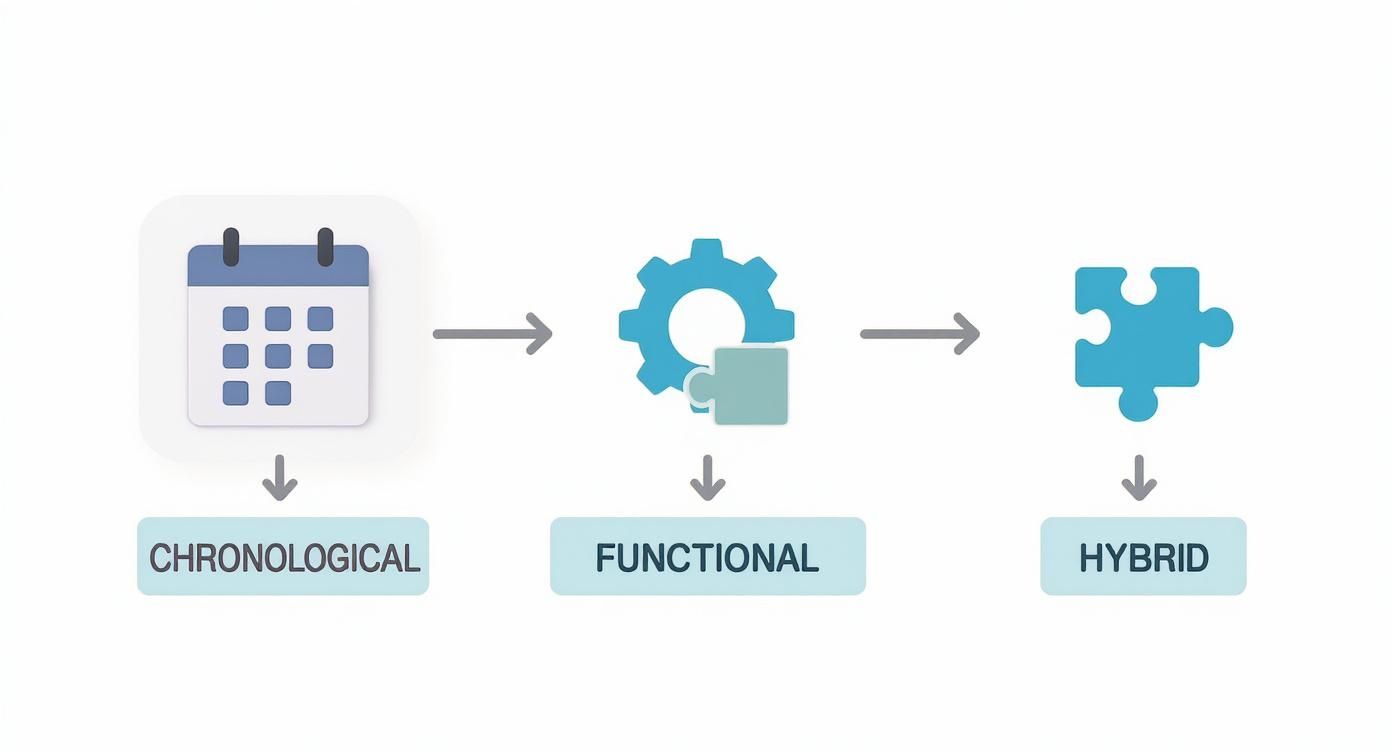
While all have their place, the hybrid format is often the most effective for career changers because it lets you lead with your most relevant skills before diving into your work history.
H3: Build a Skill Translation Matrix
To make this whole process even more concrete, create a simple "translation matrix" for yourself. It’s just a table that helps you systematically map your old skills to the new language of your target industry. It turns a daunting creative task into a logical, step-by-step process.
Skill Translation Matrix for Career Changers
| Original Skill (e.g., from Teaching) | Reframed Skill (for a Corporate Training Role) | Resume Bullet Point Example |
|---|---|---|
| Creating lesson plans | Curriculum Design & Development | Designed and launched 12 unique training modules for adult learners, adapting complex material for diverse skill levels. |
| Managing a classroom | Stakeholder Management & Engagement | Managed a cohort of 30+ learners, increasing engagement by 20% through interactive workshops and personalized feedback. |
| Grading assignments | Performance Assessment & Reporting | Developed a new assessment rubric that provided actionable feedback, leading to a 15% improvement in participant skill retention. |
See how that works? This systematic approach demystifies everything. By taking the time to properly translate your experience, you're not just hoping a hiring manager will connect the dots—you're drawing them a map straight to your potential.
Crafting a Powerful Career Change Summary
Think of your professional summary as your resume's opening act. It's the first thing a recruiter sees—your 30-second pitch to either get them hooked or have them move on. For a career changer, this short, powerful section is everything. It's your one chance to frame your entire story before they glance at a list of seemingly unrelated jobs.
Without a strong summary, a recruiter might see your past experience, get confused, and toss your application aside. A compelling summary, however, acts as a bridge. It connects your past skills to your future ambitions, telling a confident story about why this career pivot isn't just a whim—it's a smart move.
The Blueprint for a Winning Summary
Your summary needs to answer three questions a recruiter has right away: Who are you? What can you do for us? And why are you applying for this job?
Here’s a simple structure that works every time:
- Lead with your professional identity and top skills. Start with your current title, but immediately follow it with the transferable skills that matter most for the new role.
- Connect the dots to the new role. Explicitly name the industry or job you're targeting. Highlight 1-2 key qualifications that prove you’re a perfect fit, even without direct experience.
- State your goal with confidence. End with a forward-looking sentence that shows you're serious and committed to this new path.
This approach stops you from looking like a random applicant and positions you as a strategic candidate. It gets ahead of the "experience gap" by putting your capabilities front and center, rather than just your old job titles. For a deeper dive, our guide on what to include in a resume summary has even more tips and examples.
Your career change summary isn't just an introduction; it's a strategic argument. Its job is to convince the reader, in under 10 seconds, that the rest of your resume is worth their time.
Before and After: Bringing the Summary to Life
Let's look at how this plays out in the real world. The difference between a bland, passive summary and a sharp, targeted one is staggering. It's the secret to making a great first impression with any resume template career change.
Example 1: From Legal to Product Management
Before:
“Experienced legal professional with 8+ years of experience seeking a new opportunity in the tech industry. Highly motivated and a quick learner.”
This is a classic miss. It’s vague, full of clichés, and makes the recruiter do all the work to figure out why a lawyer would be good at product management. Spoiler: they won’t.
After:
“Detail-oriented legal professional with 8+ years in contract analysis and stakeholder negotiation. Eager to apply rigorous analytical and problem-solving skills to a product management role in the tech industry, contributing to user-centric product development and successful market launches.”
See the difference? This version is specific and confident. It directly links core legal skills like analysis and negotiation to the needs of a product manager and tells a clear, compelling story.
Example 2: From Hospitality to Customer Success
Before:
“Dedicated hospitality manager looking to transition into a new field. Skilled in customer service and team management.”
Again, too generic. It mentions skills but doesn't connect them to a target role or industry. The recruiter is left wondering, "A new field… like what?"
After:
“Accomplished hospitality manager with a decade of experience leading teams to achieve a 95% customer satisfaction rating. Seeking to leverage proven expertise in client relationship management, conflict resolution, and team training to drive customer retention and success in a SaaS environment.”
Now this is a powerful pitch. It quantifies achievements (95% satisfaction rating), uses industry-specific language ("SaaS environment," "customer retention"), and brilliantly translates hospitality experience into the language of customer success. It makes the career change feel like a completely natural progression.
Getting Your Resume Past a Robot and a Recruiter
Before your resume ever lands on a hiring manager's desk, it has to get past two very different gatekeepers. First, the robot—an Applicant Tracking System (ATS). Then, the human—a recruiter with about seven seconds to spare.
As a career changer, this is where the game is often won or lost. Your resume probably doesn't have the exact job titles or industry jargon the ATS is programmed to find, making that first hurdle a real challenge.
Getting past the robot is a science. It's about strategy, not style. Beat that, and you've earned your seven seconds with a real person. That's where the art comes in—clear storytelling and smart design that makes them stop and read.
Decoding the Job Description for ATS Keywords
Think of the job description as your cheat sheet. It’s packed with every single keyword the ATS and the recruiter are looking for. Your first job is to pull it apart and find the terms you need to weave into your resume template career change.
Don't just skim for the obvious stuff like "Salesforce" or "Python." You need to dig deeper.
- Hard Skills: These are the non-negotiables. Think software (Microsoft Outlook, Canva), methodologies (Agile, SCRUM), or specific abilities like Data Analysis or Contract Negotiation.
- Soft Skills: These are the human elements that make you a great hire. Look for recurring phrases like "stakeholder communication," "cross-functional collaboration," or "complex problem-solving."
- Company-Specific Lingo: How does the company talk about itself? If the job ad mentions being "customer-obsessed" or thriving in a "fast-paced environment," you should mirror that language. It shows you get their culture.
The trick is to sprinkle these keywords naturally throughout your summary, skills section, and work experience. It's not about stuffing them in; it’s about using their own language to prove you’re the right fit.
Keeping Your Formatting Simple and Scannable
If there's one thing that trips up an ATS, it's complicated formatting. Fancy fonts, columns, tables, and text boxes can scramble the software, causing it to misread or just skip over your best qualifications. Your design needs to work for both the robot and the human.
To make sure your resume sails through the scan:
- Use classic, web-safe fonts like Calibri, Arial, or Georgia.
- Stick to simple bullet points—the standard solid circles or squares are best.
- Use standard section headings like "Work Experience" and "Education." Don't get creative here.
- Avoid putting critical info like your contact details in the header or footer, as some systems ignore those areas.
If you want to see what this looks like in practice, you can check out this collection of ATS-friendly resume templates for career changers that are built to pass the test.
Modern tools like ResumeShaperAI are designed around this dual challenge, creating resumes that are both visually clean and perfectly optimized for scanning software.
Remember, the whole point of ATS optimization is to get your resume parsed correctly. Once that’s done, the spotlight shifts to making a real impression on the person who reads it next.
Engaging the Human Recruiter
Okay, you're past the ATS. The clock is now ticking. You have roughly seven seconds to convince a recruiter your resume is worth a closer look.
This is where visual hierarchy and clean design become your best friends. The same simple format that helped the robot also helps a busy human find what they're looking for—fast.
Guide their eyes with a few simple tricks:
- Use bold text for your biggest wins (e.g., "Increased team efficiency by 30%").
- Write a powerful professional summary at the top that immediately explains your career pivot.
- Leave plenty of white space. A cluttered resume is an unreadable resume.
Your bullet points need to be short, punchy, and focused on results, not just a list of your old duties. By making your resume incredibly easy to scan, you help the recruiter instantly see your value and understand why your unique background is exactly what they need.
Seeing It in Action: Real Career Change Resume Examples
Theory is one thing, but seeing the transformation for yourself is what makes it all click. Let's walk through a few "before and after" examples to see how these strategies play out in the real world.
These snippets show common mistakes career changers make and how a modern hybrid resume template for a career change can completely reframe your story. I'll break down the "why" behind each edit, giving you a clear roadmap for overhauling your own resume.
From Hospitality Manager to Customer Success
First up, we have Alex. He’s a seasoned hotel manager with over a decade in hospitality, now targeting a Customer Success Manager role at a SaaS company.
The "Before" Snippet
WORK EXPERIENCE
General Manager | Grand City Hotel | 2018 – Present
- Responsible for day-to-day hotel operations.
- Managed a team of 50+ staff members across all departments.
- Handled guest complaints and ensured a high level of customer service.
- Oversaw hotel budget and inventory.
This is a classic career change pitfall. It’s a list of duties entirely rooted in the hotel world. A tech recruiter would glance at this, see no connection, and move on in seconds. While accurate, it’s not doing any of the selling Alex needs it to do.
The "After" Transformation
PROFESSIONAL EXPERIENCE
General Manager | Grand City Hotel | 2018 – Present
- Drove client retention by implementing a personalized guest feedback program, increasing repeat bookings by 20% year-over-year.
- Mentored a team of 50+ employees in client relationship management, leading to a 95% customer satisfaction score.
- Acted as the primary point of contact for high-value corporate clients, resolving complex issues to preserve key accounts.
- Managed a $5M operational budget, optimizing resource allocation to improve service delivery without increasing costs.
The difference is night and day. We've shifted the entire focus from "hotel tasks" to "business outcomes." By using language like "client retention," "relationship management," and "preserving key accounts," Alex’s experience suddenly sounds tailor-made for a Customer Success role. The story is no longer about running a hotel—it's about making customers happy and keeping them loyal.
From Graphic Designer to UX/UI Designer
Next, let's look at Maya, a talented graphic designer aiming to move into the more user-focused world of UX/UI design. Her old resume was all about aesthetics.
The "Before" Snippet
SKILLS
- Adobe Creative Suite (Photoshop, Illustrator, InDesign)
- Branding & Logo Design
- Print & Digital Media
EXPERIENCE
Senior Graphic Designer | Creative Solutions Inc. | 2017 – Present
- Designed marketing materials for a variety of clients.
- Created logos, brochures, and website banners.
- Collaborated with the marketing team on campaign visuals.
Maya's original resume is perfectly fine for another graphic design job. For UX/UI, though, it completely misses the point. It describes what she made, not why she made it or who it was for. It’s missing the soul of UX: research, empathy, and problem-solving.
The "After" Overhaul
SKILLS
- UX/UI Design: Wireframing, Prototyping, User Research, Usability Testing, Persona Development
- Design Tools: Figma, Sketch, Adobe XD, Illustrator, Photoshop
- Methodologies: Design Thinking, User-Centered Design, Agile
EXPERIENCE
Senior Graphic & Product Designer | Creative Solutions Inc. | 2017 – Present
- Led a website redesign project by first conducting user interviews to identify pain points, resulting in a 30% reduction in bounce rate.
- Developed low-fidelity wireframes and high-fidelity interactive prototypes for a new mobile app feature, which increased user engagement by 15%.
- Collaborated with developers and product managers in an Agile environment to translate user needs into intuitive and accessible design solutions.
This "after" version is a total reinvention. The skills section is packed with UX-specific terms. Her job title is tweaked to "Graphic & Product Designer," bridging her past and future. Most importantly, the bullet points are rebuilt around the design process: research, prototyping, and collaboration. She's no longer just making things look pretty; she's a strategic thinker using design to solve user problems.
If you’re looking for more inspiration, browsing through other career change resume examples can be incredibly helpful. Seeing how others have successfully made the leap across different industries really shows you how to put these principles into practice.
Got Questions About Your Career Change Resume? We've Got Answers.
Pivoting your career is a huge step, and it naturally brings up some tricky questions. When you're trying to reframe your entire professional story for a new industry, it’s easy to get bogged down in the details.
Here are some of the most common questions I hear from career changers, along with some straightforward, practical advice.
Should I Include Jobs Unrelated to My New Career?
Yes, but you have to be incredibly strategic about it. Your goal isn't to list every single duty you've ever had. Instead, you need to mine those past roles for transferable skills that your new target employer will value.
Think about it this way: that bartending gig from a few years ago isn't about mixing drinks. It's about exceptional customer service, multitasking under intense pressure, and managing inventory. Frame the skills, not the tasks.
Keep the description short, sweet, and to the point. Quantify your impact if you can, and always connect it back to what the new role requires.
How Do I Fill an Employment Gap During a Transition?
This is a big one. Don't just leave a glaring blank space on your timeline—that’s a huge red flag for recruiters. Instead, address any employment gaps head-on and frame them as a deliberate, positive part of your transition.
You can do this by creating a specific section on your resume to account for that time.
Try using a heading like one of these:
- Professional Development
- Career Transition Focus
- Skills Enhancement
Under that heading, list any relevant courses you took, certifications you earned, freelance projects you tackled, or volunteer work you did. This approach flips the script entirely. It shows you were actively and intentionally building skills for your new field, turning a potential weakness into a compelling strength.
Your resume isn't just a dry record of paid employment; it's the story of your professional growth. Use every inch of it to show you've been purposefully preparing for this specific career change.
Is a Two-Page Resume Acceptable for a Career Changer?
This is a tricky one. The short answer is yes, a two-page resume can be acceptable, but only if every single piece of information on that second page is absolutely critical and adds significant value.
If you have over 10-15 years of rich, highly transferable experience that directly supports your pivot, a second page might be necessary to tell your complete story.
However, for most people changing careers, a powerful, concise one-page resume is far more effective. A well-designed hybrid or functional resume template for a career change should give you plenty of room to highlight your most compelling qualifications without overwhelming the reader.
When in doubt, aim for one page of pure impact.
Ready to build a resume that opens doors to your new career? With ResumeShaperAI, you can create a polished, ATS-friendly resume in minutes. Our AI-powered tools help you translate your skills, optimize for keywords, and choose the perfect template, so you can focus on what really matters—landing interviews. Try ResumeShaperAI for free and start building your future today.