

Feeling stuck in your career and not sure how to move forward? I get it. The path to a new professional life isn't a random leap of faith; it’s a journey built on three core phases: figuring out what you really want (self-discovery), creating a smart roadmap to get there (strategic planning), and making your move with confidence (launch).
It's a deliberate process, broken down into manageable, intelligent steps.
Starting Your Career Change Journey
If the thought of changing your professional path feels completely overwhelming, you’re in good company. This isn't just another job hunt. It’s a fundamental recalibration of your career to better match your life goals, whether that’s finding more meaningful work, finally getting some work-life balance, or boosting your earning potential.
The idea of a linear, one-company career is long gone. Today's job market is all about reinvention. In fact, recent data shows that nearly 30% of the workforce changes careers or jobs every 12 months. This isn't a sign of instability; it's proof of a dynamic landscape where evolving is the new norm. You can dig into more career change statistics to see just how common this journey has become.
Before you even think about updating your resume or scrolling through job boards, you need to pause and ask one critical question: Why? Why are you really considering this change, right now? Surface-level reasons like "I'm bored" or "I can't stand my boss" are often symptoms of a much deeper need.
A successful career change is built on a solid foundation of self-awareness. Are you truly looking for:
- A Greater Sense of Purpose? A role that feels like it contributes to something you believe in.
- Better Work-Life Integration? More flexibility, remote options, or just working fewer hours.
- A New Intellectual Challenge? The chance to learn new skills and tackle different kinds of problems.
- Financial Growth? A move into an industry with a higher salary ceiling and more opportunity.
Getting crystal clear on your "why" is like having a compass for your journey. It will guide every decision you make and keep you motivated when you hit the inevitable bumps in the road. It’s the difference between running from a job you hate and running toward a future you're excited about.
This high-level roadmap breaks down the entire process into three essential stages, moving from internal reflection to external action.
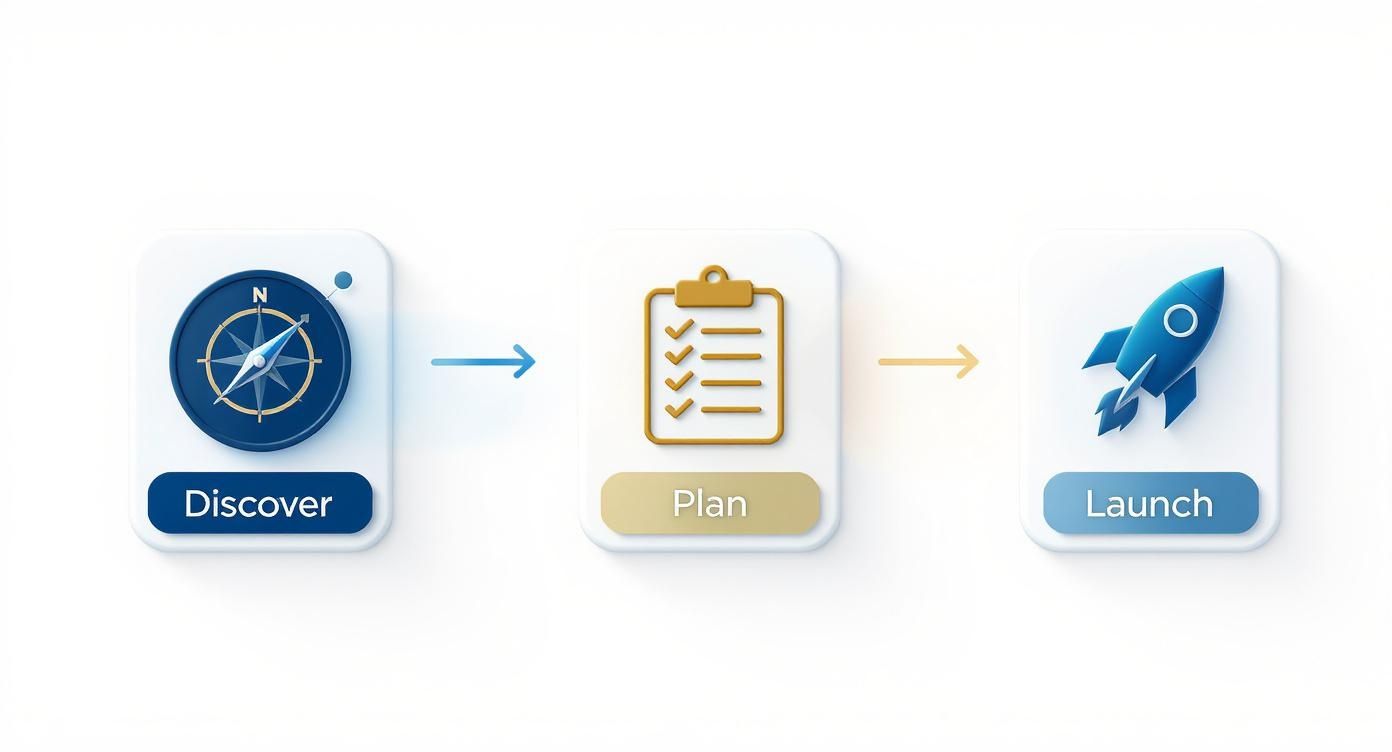
This simple workflow emphasizes that a successful pivot isn't magic—it’s a logical progression from discovery to launch.
The Career Switch Roadmap At a Glance
To give you a clearer picture of the journey ahead, here’s a quick overview of the key phases and what each one involves. Think of it as your high-level project plan.
| Phase | Key Objective | Core Activities |
|---|---|---|
| Phase 1: Discovery | Gain clarity on your motivations, skills, and target career paths. | Self-assessment, identifying transferable skills, researching industries, and defining your "why." |
| Phase 2: Planning | Bridge the gap between your current profile and your target role. | Gap analysis, creating a reskilling plan, building a tailored resume, networking, and informational interviews. |
| Phase 3: Launch | Execute your job search and secure a position in your new field. | Applying for jobs, preparing for interviews, negotiating offers, and successfully onboarding. |
This table shows how each phase builds on the last, turning an ambitious goal into a structured, achievable project.
Adopting the Right Mindset for the Journey
Let's be real: a career change is a marathon, not a sprint. It demands patience, strategy, and a healthy dose of self-compassion. You will have moments of doubt. You will face rejection. You will feel uncertain. That's all a normal, expected part of the process.
The key is to see your career switch not as one giant, risky jump but as a series of small, calculated steps. Each informational interview, online course, or networking coffee is a small win building momentum.
Embrace a mindset of curiosity and learning. Instead of aiming for perfection right out of the gate, focus on making steady, consistent progress. This guide is designed to give you that structure, turning what feels like a daunting mountain into your next achievable project. Your project.
Discovering Your Professional Compass
Before you can jump into a new career, you have to get brutally honest about where you're starting from. This isn’t just about your last job title; it's about mapping out your entire professional DNA. A successful career pivot is powered by self-awareness. It’s what ensures you move toward a future that genuinely fits, instead of just running from a past that doesn’t.
This is the foundational work. It’s about asking the tough questions and giving yourself straight answers. Skip this, and you risk landing in another role that looks great on paper but feels just as empty as the one you left. Think of it as calibrating your internal compass so it points toward your true north.

Identify Your Core Values and Non-Negotiables
Your values are the invisible forces that dictate what feels right in a work environment. When your job clashes with them, you feel drained and checked out. But when your work aligns with your values, you feel energized and purposeful.
Start by listing what actually matters to you. Is it autonomy? Collaboration? Creativity? Stability? Making a social impact? Don't sugarcoat it. If a high salary is a top priority for your family's security, own it. If you need a flexible schedule to be there for your kids, that’s a critical data point for your search.
Next, define your non-negotiables—the absolute deal-breakers. These are the lines you simply won't cross, no matter how shiny the opportunity looks.
- Commute Time: "I will not accept a job with more than a 45-minute commute."
- Company Culture: "I refuse to work in a high-pressure, 'always-on' sales environment again."
- Work Flexibility: "I must have the option to work from home at least two days a week."
Defining these now acts as your first filter. It stops you from wasting time on roles that are fundamentally incompatible with the life you want to live.
Reframe Your Skills as Transferable Assets
One of the biggest mental roadblocks for career changers is the feeling that you're starting over from square one. I promise you, that’s almost never true. You're sitting on a goldmine of valuable skills; you just need to learn how to translate them for a new audience.
Transferable skills are the abilities you've honed in one job that are just as valuable in another, even if the industries feel worlds apart. Smart employers care less about your old job title and more about your ability to solve their problems.
Your past experience isn't about the specific projects you managed. It’s about the process you used to get results. You’re selling your problem-solving methodology, not just your industry knowledge.
Let’s look at some real-world examples of this reframing in action:
- A teacher who managed a classroom of 30 kids has exceptional stakeholder management, conflict resolution, and public speaking skills—perfect for a corporate trainer or customer success manager role.
- A retail manager who consistently crushed sales targets has deep experience in inventory management, team leadership, and data analysis for forecasting—all critical skills for an operations manager.
- A paralegal who meticulously organized complex case files has mastered project management, attention to detail, and clear communication, making them a prime candidate for an executive assistant or project coordinator position.
To do this for yourself, list out your biggest accomplishments. Then, break down the skills that made them happen. This simple exercise shifts your whole perspective from what you did to what you can do.
Conduct a Personal SWOT Analysis
Okay, it’s time to bring all this self-reflection together into something you can actually use. A personal SWOT analysis is a surprisingly powerful tool for this. It gives you a structured way to look at your internal attributes (Strengths and Weaknesses) and the external landscape (Opportunities and Threats) related to your career change.
| Category | Description | Example Questions to Ask Yourself |
|---|---|---|
| Strengths | Your internal positive attributes and skills. | What do I do better than anyone else? What unique skills do I have from my past career? |
| Weaknesses | Your internal areas for improvement. | Where are my skill gaps for the roles I'm targeting? What constructive feedback have I received? |
| Opportunities | External factors you can use to your advantage. | Are there growing industries that need my skills? Can I leverage a new technology or trend? |
| Threats | External factors that could hinder your progress. | Is my target industry highly competitive? Could automation impact the role I want? |
This exercise gives you a clear, honest snapshot of where you stand right now. It helps you build a strategy that plays to your strengths, actively addresses your weaknesses, seizes the right opportunities, and prepares you for the bumps in the road. This becomes the compass that guides every single step you take from here on out.
How to Research and Validate New Career Paths
Okay, you’ve done the soul-searching. Now it’s time to move from internal reflection to external investigation. This is where you take your list of values, skills, and non-negotiables and start matching them to real-world jobs. The goal is to find promising industries and roles, then put them under a microscope to see if they hold up.
A classic mistake career changers make is falling for the highlight reel of a job. You see a cool title and a great salary, but you miss the reality of the day-to-day. This research phase is your defense against that. It ensures your next move is grounded in fact, not fantasy.

Begin with Broad Exploration
First, cast a wide net. You're looking for high-growth fields where your transferable skills are actually in demand. Try not to limit yourself to the obvious choices; you might just discover roles you never even knew existed.
Use a few different resources to build your initial list of possibilities:
- Industry Reports and Trends: Check out publications from major consulting firms that analyze the future of work. These reports are goldmines for identifying sectors with huge growth potential and the specific skills they're desperate for.
- LinkedIn Sleuthing: Use LinkedIn's search function for more than just jobs. Look up professionals with backgrounds similar to yours and see where their careers went. What paths did they take? What titles do they hold now?
- Niche Job Boards: General job boards are fine, but niche sites focused on specific industries (like tech, healthcare, or creative fields) give you a much clearer picture of the roles and qualifications out there. We've got a great breakdown of the best job boards for job seekers to get you started.
This is all about data gathering. Your goal is to create a list of 5-10 potential career paths that seem to tick your boxes.
Deep Dive into the Day-to-Day Reality
With a shortlist in hand, it's time to zoom in. A job isn’t an industry report; it’s what you actually do from 9 to 5. Now you need to understand the lived experience of people in your target roles.
This is also where you future-proof your decision. The World Economic Forum predicts that by 2030, almost 39% of workers' existing skills will be transformed or outdated. Targeting fields that value creativity, tech literacy, and continuous learning is a smart play for long-term career stability. You can dig into these trends in The Future of Jobs Report.
The single biggest mistake a career changer can make is skipping the validation step. Reading job descriptions isn't enough. You have to talk to real people doing the actual work.
Conduct Informational Interviews
The most powerful tool you have for validating a new career is the informational interview. This is just a short, informal chat with someone working in a role or industry you're eyeing. It’s not a job interview; it’s a fact-finding mission.
Reach out to people on LinkedIn who are in the roles you're considering. Keep your message short, professional, and respectful of their time.
Something like this works well: "Hi [Name], I'm exploring a career change from [Your Field] to [Their Field] and your experience at [Their Company] looks fascinating. Would you be open to a brief 15-minute chat so I could learn more about your journey?"
When you land a conversation, show up prepared with questions that get beneath the surface:
- What does a typical day or week really look like for you?
- What's the most frustrating part of your job that isn't in the official job description?
- What are the skills someone absolutely needs to succeed and get promoted in this field?
- What do you wish you'd known before you got into this career?
These conversations will give you the unfiltered truth. They'll either confirm your interest and give you the confidence to move forward, or they'll raise red flags that send you back to your list—saving you from a massive misstep.
Building Your Reskilling Action Plan
Once you've done the research and landed on a new career path, that big, abstract goal starts to feel very real. Now comes the fun part: building the bridge to get you from where you are today to where you want to be. This is all about creating a tangible, step-by-step plan to close the skill gaps you’ve identified.
This isn't about collecting random certificates. It’s about methodically learning the exact skills and tools that hiring managers in your target field are looking for. A solid reskilling plan is what makes your career change believable to employers and, just as importantly, achievable for you. It turns your ambition into a real project with a clear finish line.
Choosing Your Learning Pathway
Gone are the days when a formal degree was the only way into a new profession. Today, you have a ton of options, each suited for different goals, timelines, and budgets. The trick is to pick the one that delivers the most relevant skills in the most efficient way for your specific pivot.
Here are a few of the most common routes:
- Online Certifications: Platforms like Coursera and edX offer industry-recognized credentials from top-tier companies and universities. They’re perfect for gaining specific, targeted knowledge—like a Google Project Management Certificate—without the time and cost of a full degree.
- Intensive Bootcamps: If you're targeting fields like software development, UX/UI design, or data analytics, a bootcamp can be a game-changer. These are immersive, project-based programs designed to get you job-ready in a compressed timeframe, usually three to six months.
- Self-Directed Projects: Never, ever underestimate the power of just building something. Creating a personal website, developing a simple mobile app, or launching a small e-commerce store provides powerful, tangible proof of your skills that you can showcase in a portfolio.
- Formal Education: For some fields, this is non-negotiable. A master's degree or a post-graduate diploma can be essential for entering regulated professions like counseling or certain areas of finance.
Your choice needs to be strategic. It's about balancing what the industry expects with your own personal circumstances.
Comparing Reskilling Options for Career Changers
Choosing the right learning path can feel overwhelming. This table breaks down the most common options to help you evaluate which approach best fits your timeline, budget, and career goals.
| Method | Average Cost | Time Commitment | Best For |
|---|---|---|---|
| Online Certifications | $50 – $500 per course/specialization | 1-6 months, flexible hours | Gaining specific, in-demand technical or soft skills quickly and affordably. |
| Bootcamps | $10,000 – $20,000+ | 3-9 months, often full-time | Immersive, hands-on learning for high-growth tech fields like coding or UX design. |
| Self-Directed Projects | $0 – $500 (for tools/hosting) | Varies, self-paced | Proving practical skills and initiative; great for building a portfolio. |
| Formal Degree | $30,000 – $100,000+ | 1-3 years, part-time or full-time | Regulated professions or roles where a specific academic credential is required. |
| Community College | $3,000 – $10,000 per year | 6 months – 2 years | Affordable, foundational knowledge and associate degrees with clear career tracks. |
Ultimately, the best path is the one that not only teaches you the skills but also gives you the credentials and portfolio pieces that hiring managers in your target industry respect.
Prioritizing and Funding Your Plan
Okay, you’ve picked a path. Now it’s time to get specific about which skills matter most. Don't try to learn everything at once. Zero in on the core requirements you saw repeated across job descriptions and heard about in your informational interviews.
A critical part of any successful career change is understanding the financial implications. Reskilling is an investment in your future, but it's one that requires careful planning.
The financial reality of a career switch can't be ignored. Full-time training can be a serious commitment. Look for free online resources, check if your local library offers access to paid courses, and see if your current employer has any tuition reimbursement programs you could tap into before you leave.
As you start acquiring these new skills, think about how they'll look on your resume. Our guide on essential skills to put on your resume can help you frame your new qualifications effectively.
Creating Tangible Proof of Competence
Here’s the thing: just finishing a course isn’t enough. The real goal of your reskilling plan is to create undeniable proof that you can actually do the job. You need a portfolio of evidence that speaks for itself.
This means you have to translate your learning into action. Here’s how you can turn different learning experiences into tangible proof:
- Took an online course? Don’t just get the certificate. Apply what you learned to a real-world capstone project. For example, after finishing a digital marketing course, create and run a small social media campaign for a local nonprofit.
- Finished a bootcamp? Your work isn't done. Compile your best projects into a polished, professional portfolio website that showcases your process from start to finish. A UX grad might feature three detailed case studies, walking through their process from research to final prototype.
- Learning on your own? Document everything. Share your process and results on a blog or upload your code to GitHub. An aspiring data analyst could clean and visualize a public dataset, then share their code and findings online.
This portfolio becomes your single most powerful asset when you start applying for jobs. It elevates the conversation from "I took a course on that" to "Here's what I can build." It makes your career transition not just a story you tell, but a reality you can demonstrate.
Crafting Your Career Change Story for Employers
You’ve done the hard work of soul-searching, skill-building, and figuring out your next move. Now comes the tricky part: explaining it all to a hiring manager. Your resume and cover letter aren’t just a list of past jobs anymore. They need to be strategic marketing documents that sell your transition.
Let's be honest, hiring managers can be a bit risk-averse. A candidate with a non-traditional background might feel like a gamble. Your job is to make them feel confident in their choice by connecting the dots, showing them exactly how your unique past makes you an even stronger candidate for their future.
Reimagining Your Career Change Resume
If you're switching careers, a standard chronological resume can actually work against you. It can unintentionally shine a spotlight on your lack of direct experience while burying the gold—your most relevant, transferable skills. You need a resume that tells a forward-looking story, not just a historical one.
This all starts with a powerful resume summary. It's the first thing a recruiter reads, so it has to frame your career change immediately and with confidence. Ditch the generic objective statement and be direct about your pivot.
Here’s an example of a career-changer's summary that works:
Former hospitality manager with 8+ years of experience in team leadership, budget management, and delivering exceptional customer experiences. Now leveraging a recent UX Design Certification and a portfolio of client-focused projects to transition into a product design role. Seeking to apply proven user-centric problem-solving skills to create intuitive and engaging digital products.
See the difference? It doesn’t shy away from the change. It leads with it, explains the "why," and immediately highlights the value you bring to the new role.
Right after your summary, you need a dedicated "Skills" or "Core Competencies" section. This is prime real estate to showcase both your proven transferable skills and the new technical abilities you’ve picked up. Organize them logically to show you get what’s important in your new field.
- Pivoting to project management? Group your skills under headings like Agile Methodologies, Stakeholder Communication, and Risk Management.
- Moving into marketing? Try categories like Content Strategy, SEO & Analytics, and Campaign Management.
This structure helps a recruiter quickly see that you have the right stuff, even if your previous job titles don't seem like a perfect match. For more ideas on how to lay this out, check out these ATS-friendly resume templates for career changers designed for this exact situation.
Translating Past Experience into Future Value
When you get to your work history, your focus has to shift. Stop thinking about your day-to-day duties and start thinking about your transferable achievements. Every single bullet point should answer the recruiter's silent question: "So what? Why does this matter for this job?"
It’s not just about listing what you did. You need to frame your accomplishments using the language and metrics of your target industry.
Let's look at a real-world translation:
- Original Bullet (Retail Manager): "Managed daily store operations and staff schedules."
- Translated Bullet (Aspiring Operations Manager): "Optimized team productivity by implementing a data-driven scheduling system, reducing overtime costs by 15% while maintaining full floor coverage."
The second version is so much more powerful. It speaks to efficiency, data analysis, and financial impact—all crucial competencies in the world of operations.
Writing a Cover Letter That Connects the Dots
If your resume is the "what," your cover letter is the "why." This is your chance to tell the story of your career change with personality and passion. It's where you can really show your strategic thinking.
Think of your cover letter as a simple, three-part story:
- The Hook: Kick things off with genuine enthusiasm for the company and the role. Address your career transition head-on and explain why you’re making this deliberate move now.
- The Bridge: This is the heart of your letter. Pick two or three key requirements from the job description and draw a direct line from them to your past experiences. Use specific examples. Don't just say your skills are transferable; show how your experience as a teacher makes you a phenomenal corporate trainer.
- The Vision: End by looking forward. Reiterate your excitement and explain how your unique blend of old and new skills will help you contribute to the company's goals in a way that a more traditional candidate might not.
Using AI to Get Ahead
Tailoring your resume and cover letter for every single application is absolutely essential, but man, is it a time-sink. This is where smart tools can give you a serious edge.
Platforms like ResumeShaperAI are designed to help you quickly generate tailored content. You can plug in your skills, your experience, and the job description, and the AI will suggest powerful bullet points and summary statements that are optimized for both human recruiters and the dreaded Applicant Tracking Systems (ATS).
This kind of tech doesn't write your story for you; it helps you tell it more effectively and efficiently. It makes sure you're hitting the right keywords and framing your experience in the most impactful way, freeing you up to spend more time on what really matters—networking and nailing your interviews.
Answering Your Career Change Questions

Making a career switch is a huge step, and it’s totally normal for it to bring up a lot of questions. That mix of excitement and anxiety is part of the process.
Let’s tackle some of the biggest concerns people have when they're planning a transition.
How Long Does It Typically Take to Switch Careers?
Honestly, this varies wildly depending on how big of a jump you’re making. A smaller hop to a related field—say, a marketer moving into product marketing—might take a focused three to six months.
But a major pivot that requires a whole new skillset? Think accountant becoming a software developer. That’s a much bigger project. You should realistically plan for one to two years to account for training, building a portfolio, networking, and the job hunt itself.
Setting a realistic timeline is one of the most important things you can do. It keeps you from getting burned out and helps you plan your finances so you don't add unnecessary stress to the journey.
Is It Possible to Switch Careers Without a Pay Cut?
Yes, it’s absolutely possible—but you have to be strategic. The sweet spot is finding where your existing, valuable skills overlap with a high-demand industry.
To protect your salary (or even increase it), try these tactics:
- Target adjacent roles. Look for positions where your transferable skills are the main event, not a nice-to-have. A lawyer moving into a contract management role at a tech startup is a perfect example of leveraging deep expertise in a new environment.
- Zero in on high-growth industries. Fields like cybersecurity, data science, and renewable energy often have competitive salaries right from the start because good talent is hard to find.
- Negotiate from your unique value. When you get to the interview stage, don’t just talk about the new skills you’ve learned. Highlight how your past experience gives you a perspective that other candidates just don’t have.
This isn’t about just asking for more money. It's about clearly articulating why your unique background makes you a better hire.
What Is the Biggest Mistake People Make?
The single biggest mistake I see is failing to do enough real-world validation. It’s so easy to fall in love with the idea of a career without understanding what the day-to-day grind actually looks like.
You might be drawn to the creativity of UX design but not realize how much of the job is justifying your decisions to stakeholders. Or maybe the high salaries in sales sound great, but you haven’t considered the intense pressure of hitting a quarterly quota.
To avoid this trap, you have to get offline. Your goal is to get a real, firsthand feel for the career before you sink a ton of time and money into it.
How? Talk to people who actually do the job. Ask to shadow someone for a day. Find a small freelance project to dip your toes in the water. This kind of direct exposure is priceless—it will either confirm you’re on the right track or save you from a costly mistake.
How Do I Explain My Career Change in an Interview?
Your career change is a feature, not a bug. You need to frame it as a deliberate, positive move forward, not an escape from something you hated. It’s all about crafting a compelling story that connects your past to your future.
Here’s a simple structure for your answer:
- Acknowledge your past. Briefly touch on what you accomplished and learned in your previous career.
- Explain your "why." Talk about the thoughtful process that led you here. What was the turning point? What research did you do?
- Connect to the future. This is key. Explain why you’re excited about this specific role at this specific company and how your unique blend of experience makes you the perfect fit.
Lead with your passion for what’s next. A well-told story shows self-awareness, strategic thinking, and genuine commitment—all things that every employer wants to see.
Crafting that compelling story starts with a resume that connects the dots for recruiters. ResumeShaperAI uses smart technology to help you reframe your past experiences, highlight your most valuable transferable skills, and create a polished, ATS-friendly resume that tells your story with confidence. Build your new resume in minutes at https://resumeshaperai.com.