
Rebranding yourself isn’t just about a new headshot or a flashy resume. It's a deliberate, strategic process of shaping your professional story to match your career ambitions. At its core, it involves defining your new direction, taking stock of your current online presence, and building the proof you need to become the undeniable choice for your dream job.
Why Your Professional Rebrand Starts Now
Are you staring at a career crossroads? If you feel stuck, unfulfilled, or just out of sync with your current role, that’s a huge sign your professional brand is no longer working for you.
Rebranding isn't about inventing a new person from scratch. Think of it as a strategic realignment. You’re taking your existing skills, passions, and experiences and weaving them into a compelling new story about where you're headed next. It’s about grabbing the reins of your career narrative before someone else—or your outdated digital footprint—defines it for you.
This goes way beyond a simple resume update. It's a conscious effort to shift how you're perceived.
Imagine a financial analyst who wants to pivot into a creative director role. Their current brand screams data, spreadsheets, and risk analysis. A successful rebrand would require them to:
- Highlight transferable skills: Show how their data analysis skills can inform and strengthen creative strategy.
- Build new proof points: Create a portfolio filled with personal creative projects or freelance work that showcases their talent.
- Network with intention: Start connecting with leaders in the creative industry to learn their language and understand their biggest challenges.
The Power of a Deliberate First Impression
In a crowded job market, your personal brand is your single most valuable asset. It's the first thing recruiters and hiring managers see, and it weighs heavily on their decisions.
The value of a strong online brand isn't just a hunch; the numbers back it up. Recent data shows that 44% of employers have hired candidates specifically because of their personal branding content. On the flip side, a staggering 54% have rejected candidates due to a poor digital presence. This is precisely why learning how to rebrand yourself is no longer optional. You can discover more insights about personalized marketing on Statista.com.
A personal rebrand is not a rejection of who you are. It’s a reconnection with your true self and a conscious decision to show up in a way that reflects your future ambitions, not just your past roles.
To get started, it helps to see the big picture. This simple workflow breaks the rebrand down into three core stages: defining your brand, aligning your assets, and launching your new identity.
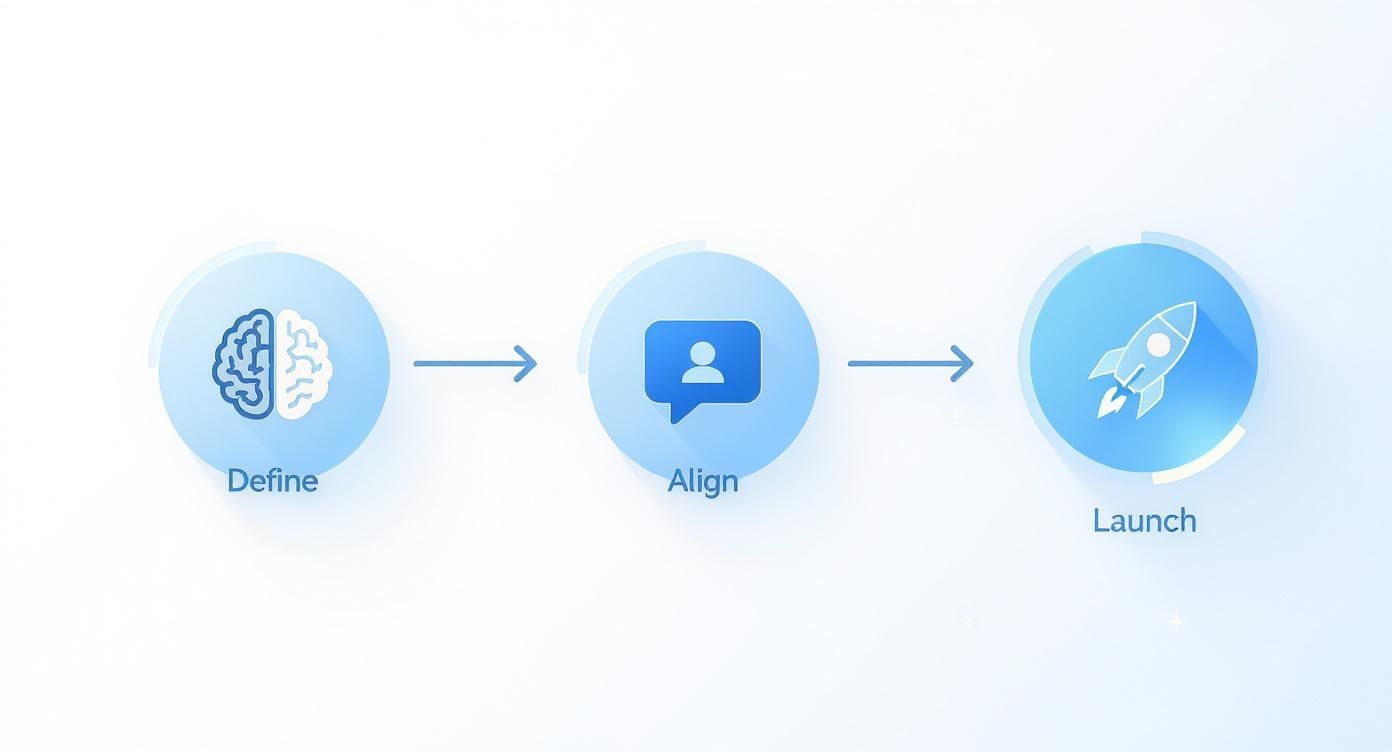
The key takeaway here is that each phase builds directly on the last. If your initial definition is fuzzy, your alignment efforts will be scattered, and your launch will fall flat. This guide will walk you through each step, making sure your rebrand is both authentic and incredibly effective.
Your Personal Rebrand Quick-Start Checklist
Here’s a high-level summary of the key phases involved in a successful personal rebrand, giving you a clear roadmap for the journey ahead.
| Phase | Key Action | Objective |
|---|---|---|
| 1. Define | Conduct deep self-assessment and market research. | Gain crystal-clear clarity on your goals, target audience, and unique value proposition. |
| 2. Align | Craft your narrative and update all professional assets. | Create a consistent, compelling story across your resume, LinkedIn, portfolio, and online presence. |
| 3. Launch | Execute your networking and content strategy. | Actively promote your new brand to the right people and build momentum in your target field. |
This checklist provides the foundational framework. Now, let's dive into the details of how to execute each phase successfully.
Laying the Foundation: Defining Your New Professional Identity
Before you write a single word of your new resume or update your LinkedIn profile, you need a blueprint. This is the most important part of the entire process—the honest, soul-searching work where you figure out who you are, what you stand for, and where you're headed next.
If you skip this, your rebrand will feel hollow. It'll be a fresh coat of paint on a shaky foundation. This isn't just about picking a new job title; it's about defining your professional "why." What's the core motivation that drives your best work? Answering that question gives you a north star for every decision you make from here on out.

Uncover Your Core Values and Strengths
The most powerful brands are authentic. They feel real because they are. So, we're going to start by looking inward to figure out your non-negotiables. These aren't just corporate buzzwords; they're the principles that guide you when no one's watching.
Think back to a time you felt completely energized and engaged at work. What were you doing? Who were you working with? What about that experience made it so fulfilling? The answers almost always point to your core values, whether it's innovation, collaboration, autonomy, or making a social impact.
Next, let’s inventory your strengths—and I mean the real ones, not just the skills you list on a resume.
- What problems do you solve without thinking? Are you the person who brings order to chaos, makes complex ideas simple, or gets divided teams to agree?
- What do people constantly ask for your help with? This is a huge clue. It's where others already see your value.
- What work gives you energy, instead of draining it? The things you're passionate about are often where your greatest talents lie.
Jot all of this down without filtering it. The idea is to get a raw, honest list of what makes you uniquely you.
Research Your Target Roles and Companies
Once you have a better handle on yourself, it's time to look outward. A great rebrand bridges the gap between your authentic self and a real-world need. That means you have to do your homework on the companies and roles you're targeting.
Don't just skim job descriptions. Go deeper. You need to understand the culture, the unspoken challenges, and even the language your target industry uses.
Your goal is to understand the problems your target companies are trying to solve. Your new brand should position you as the person who can provide the solution.
Follow these companies on LinkedIn. Read their press releases. Look at the profiles of people who currently have the jobs you want. Pay close attention to the keywords and phrases they use to talk about their skills and accomplishments. This intel is pure gold—it tells you exactly how to frame your story so it connects with them.
If you're stuck on finding the right job title to aim for, this guide on how to use a free job title generator can help you explore different possibilities and find the language that fits.
Craft Your Personal Brand Statement
Okay, it's time to pull it all together. You're going to combine your internal reflection with your external research to create a single, powerful sentence. This isn't just a tagline for your resume; it's your personal mission statement that will guide everything else.
A strong Personal Brand Statement has three distinct parts:
- Your Value: What's the main thing you deliver? (e.g., "I simplify complex data…")
- Your Audience: Who do you do it for? (e.g., "…for non-technical marketing teams…")
- Your Outcome: What's the result? (e.g., "…so they can make smarter, data-driven decisions.")
Put it all together, and it looks like this: "My professional brand is about simplifying complex data for non-technical marketing teams so they can make smarter, data-driven decisions."
This statement is your anchor. When you're rewriting your LinkedIn summary, you'll ask, "Does this reflect my brand statement?" When you're prepping for an interview, you'll think, "How can I prove this value in my answers?" This simple sentence ensures every piece of your professional presence tells the same clear, compelling story.
Auditing and Aligning Your Digital Footprint
Your online presence is your digital handshake, and for many of us, it’s telling an outdated story. Before you can roll out your shiny new brand, you have to clean up the old one. That means doing a thorough, brutally honest audit of what the internet says about you right now.
Think like a recruiter for a moment. Open a private browsing window and Google your name. What pops up on that first page? Do the results reflect the professional you’re becoming, or do they showcase a past you’ve clearly outgrown? Keep an eye out for old blog posts, unflattering tagged photos, or forum comments that just don't fit your new direction.
This whole process is about taking back control of your narrative. Every single piece of your digital footprint should work together to send one clear, consistent message.

This isn’t just about deleting old content. It’s about strategically shaping every profile to support where you want to go next.
Your Practical Digital Audit Checklist
Let's get systematic. Go through each of your main online profiles—especially LinkedIn, but also any other public-facing social media—and ask yourself these questions:
- Tone and Voice: Does my language sound like the expert I want to be? Is it confident, professional, and in line with how people in my target industry communicate?
- Visuals: Is my headshot professional and recent? More importantly, is it the same one across all platforms? What about my LinkedIn banner—does it reinforce my brand statement?
- Job Descriptions: Do my past roles just list boring duties, or do they highlight achievements that build a case for my new career path?
- Skills & Endorsements: Are the skills featured on my profile actually relevant to my target roles, or are they just leftovers from a previous job?
Answering these will quickly show you the gaps between your brand today and the one you want tomorrow. This step is non-negotiable because consistency builds trust. In the corporate world, consistent branding can boost revenue by over 20%, because a whopping 90% of consumers prefer buying from brands they find authentic and trustworthy. The same logic applies to your career.
Rewriting Your Professional Narrative
With your audit done, it’s time to start aligning your digital assets. This is where you actively rewrite your story for the recruiters and hiring managers you want to impress.
Start with your LinkedIn headline and summary. These are the most valuable pieces of real estate on your entire profile. Your headline needs to be more than just your current job title; it should be your Personal Brand Statement in a nutshell. Ditch "Marketing Manager" for something like "Marketing Leader Driving Growth with Data-Driven Content Strategies." See the difference?
Your summary, or "About" section, is your chance to connect all the dots for anyone landing on your profile. Use it to:
- State your mission: Lead with that powerful brand statement.
- Show your wins: Mention 2-3 quantifiable results that prove you deliver value.
- Explain the pivot: If you're changing careers, briefly explain how your past experience uniquely prepared you for this new direction.
- End with a call to action: Gently nudge people to connect or check out your portfolio.
Your LinkedIn summary isn't a biography; it's a strategic sales pitch. It should immediately answer the reader's question: "Why should I care?" Make it compelling, concise, and focused on the future.
This new narrative needs to echo across your resume, too. Making sure your resume is optimized for both human eyeballs and recruiting software is critical. For those making a big career change, the right format can make or break your chances. Check out our guide on ATS-friendly resume templates for career changers to ensure your most important document is working for you, not against you.
The goal here is a seamless experience for anyone looking you up, creating a powerful and unified brand that opens doors.
Building Your Narrative with Proof Points
A strong personal brand isn't just something you declare; it's something you demonstrate with cold, hard evidence. This is where you graduate from saying you’ve changed to proving you have. You need to build a career story that connects the dots for recruiters, explaining your pivot in a way that feels deliberate, not desperate.
Your old brand tells the story of your past. Your new brand has to tell the story of your future, but it needs to be anchored in real, tangible proof. Without it, your claims about new skills are just words on a page. The goal is to make your transition feel like a natural, logical next step.

This means you need to start gathering testimonials, creating mini case studies from past projects, and maybe even building something new just to showcase your skills. It’s all about creating an arsenal of proof points that make your new brand impossible to ignore.
Weave Your Past into Your Future
Here’s a secret: your past experiences aren't baggage you need to hide. They're the foundation of your new story. The real trick is learning how to reframe them through the lens of your new career goal. You have to translate your old wins into the language your target industry speaks.
Imagine a project manager pivoting to a user experience (UX) design role. They wouldn't just list their old duties. Instead, they’d spotlight the times they fought for the end-user, gathered feedback to make a product better, or managed stakeholder expectations—all core skills in the UX world.
This reframing is everything. It shows a hiring manager you’ve been building the right skills all along, even if your job title didn't say so.
Your career narrative should be a bridge, not a wall. Use your past experiences to build a logical path that leads directly to your new professional identity, making your transition feel both credible and compelling.
To get started, pick three essential skills for your target role. Then, dig through your entire career—even the jobs that seem completely unrelated—and find examples where you used those skills. This little exercise will help you find the threads to weave your new story together.
Create Irrefutable Proof of Your Pivot
Sometimes, just reframing your past isn’t quite enough. If you’re making a major career leap, you need to create fresh evidence that you can do the work. This is about showing your skills before anyone even has to ask.
Think about a marketing manager who wants to become a data analyst. Their resume is packed with campaign management and content strategy. To prove they’re serious about the switch, they could:
- Get certified: Earn a certificate in a tool like SQL or Power BI.
- Launch a side project: Grab a public dataset and build an interactive dashboard analyzing marketing trends.
- Share their work: Write a blog post or a LinkedIn article explaining the insights they found.
Boom. Now they have a powerful proof point. Instead of just saying they have analytical skills, they have a real, shareable project that proves it. This kind of initiative shows passion and genuine ability, which is way more convincing than any bullet point on a resume.
Translating Old Roles to Your New Brand
How you frame your past experience can make or break your rebrand. This table shows you how to translate your old job descriptions into a language that speaks directly to recruiters in your new target field.
| Past Experience (Example) | Old Description | Rebranded Description (For Target Role) |
|---|---|---|
| Retail Store Manager | Managed daily operations, inventory, and staff schedules to meet sales targets. | (Pivoting to Project Management) Directed cross-functional teams, optimized resource allocation, and managed project timelines to deliver a 15% increase in store profitability. |
| Executive Assistant | Coordinated calendars, booked travel, and prepared documents for senior leadership. | (Pivoting to Event Planning) Managed complex logistics for executive off-sites, coordinating with multiple vendors and stakeholders to execute flawless events under tight deadlines. |
| Customer Service Rep | Answered customer inquiries and resolved product issues via phone and email. | (Pivoting to UX Research) Acted as the primary voice of the customer, gathering qualitative feedback and identifying user pain points to inform product improvements. |
When you master the art of storytelling and back it up with solid proof, you stop being someone asking for a chance and become a candidate offering a solution. This is how you rebrand yourself in a way that doesn't just get you noticed—it gets you hired.
All that hard work defining your brand and gathering your proof points? That was all happening behind the scenes. Now, it's time to go public.
Launching your new brand isn't a single, dramatic event. Think of it less like a firework show and more like a series of deliberate, strategic moves designed to introduce the "new you" to the professional world.
You're shifting from quiet planning to active engagement. The goal here is to start building real relationships and creating visibility within your target industry. It's time to stop being an outsider looking in and start becoming a recognized, knowledgeable voice in the conversations that matter.
Your rebrand is only as powerful as the people who see it. Purposeful networking is the engine that will drive this launch forward, turning your carefully crafted brand into tangible opportunities.
Move Beyond Collecting Contacts
Let's be honest: effective networking isn't a numbers game. Having 500+ connections on LinkedIn is meaningless if they aren't the right connections. The real goal is to build genuine relationships with people in your target field, not just collect digital business cards.
Focus on quality, not quantity. Start by identifying 10-15 key individuals in your desired industry. These could be hiring managers at your dream companies, thought leaders you admire, or professionals who currently hold the exact role you're aiming for. Your first move should always be about learning, not asking for a job.
Informational interviews are a fantastic way to do this. But please, ditch the generic "Can I pick your brain?" request. A specific and respectful approach works so much better.
"Hi [Name], I've been following your work on [specific project or topic] and was incredibly impressed by [specific detail]. As I'm exploring a transition into [your target field], your perspective would be invaluable. Would you have 15 minutes in the coming weeks to share a bit about your journey?"
This simple script shows you've done your homework and respect their time, making them far more likely to say yes.
Engage Where Your Industry Lives
The people you want to connect with are already gathering and talking somewhere online. Your job is to find those places and contribute in a way that adds value. This isn't about spamming your resume—it's about positioning yourself as a thoughtful, engaged peer.
- LinkedIn Groups: Join groups related to your new field. Don't just lurk in the background. Answer questions, share relevant articles, and comment intelligently on other people's posts.
- Industry Forums & Slack Communities: Niche communities can be absolute goldmines for building relationships. Your mantra should be: give, give, give before you ever think about asking for something.
- Virtual Events & Webinars: Attend events hosted by your target companies or industry leaders. Make a point to ask an insightful question during the Q&A to get on the presenters' radar.
By consistently showing up and adding to the conversation, you start building a reputation as an insider. For anyone making a big career pivot, this is a non-negotiable step to prove your commitment and knowledge. If you need a deeper dive into making that switch, our complete guide on how to switch careers lays out a detailed roadmap.
Develop a Simple Content Strategy
No, you don't need to become a full-time content creator. But sharing thoughtful content is one of the fastest ways to accelerate your rebrand. A simple strategy reinforces your new expertise and keeps you top-of-mind.
Every piece of content you share should tie directly back to your Personal Brand Statement. If you're rebranding as a specialist in sustainable supply chains, your posts should reflect that expertise.
A Manageable Weekly Content Mix:
- Share an Insight: Post one original thought or key takeaway from a recent industry trend or an article you read.
- Amplify an Expert: Reshare a post from a leader in your field but add your own two cents. This shows you're not just consuming information—you're engaging with it critically.
- Highlight a Skill: Briefly talk about a project you're working on (even a personal one!) that demonstrates one of your core skills.
This approach is both doable and incredibly effective. Each post is another brick in the foundation of your new professional identity, proving that your rebrand is more than just a new LinkedIn headline—it's a whole new way of thinking and contributing.
Measuring and Refining Your Rebrand's Impact
Launching your new brand is a huge step, but it's the start of a marathon, not the finish line. Think of your personal rebrand less like a static project and more like a living, breathing strategy. It needs data and real-world feedback to truly work for you. Now, let's get into how to track what’s working, what isn’t, and how to adjust your approach for maximum effect.
This isn’t about chasing vanity metrics like a sudden spike in followers. The goal is to focus on Key Performance Indicators (KPIs) that directly connect to your career goals. You need to know if your efforts are attracting the right kind of attention from the right people.
Tracking What Truly Matters
The only way to measure success is to define what it looks like from the very beginning. Your rebranding efforts should lead to tangible outcomes that pull you closer to your target role. The good news is, you don't need expensive software; free tools can give you a ton of insight if you know where to look.
Here are the specific data points you should be watching like a hawk:
- LinkedIn Profile Views: Jump into your LinkedIn Analytics. Who's viewing your profile? Are you seeing more people from your target companies or in your desired roles? This is a direct signal that your new brand is hitting the mark.
- Inbound Messages: Are you getting more connection requests or messages from recruiters and professionals in your target industry? This is a great sign that your new narrative is compelling enough to make people reach out.
- Application Response Rate: As you send out applications, keep a simple log of your response rate. If you see a noticeable increase, it means your rebranded resume and cover letter are getting past the applicant tracking systems and catching the eyes of hiring managers.
A rebrand needs a methodical approach grounded in measurable data. If you have a personal website or portfolio, a tool like Google Analytics is non-negotiable. It lets you see who's visiting, how they're engaging, and whether you’re attracting new types of opportunities. You can learn more about the link between personal branding and analytics on Copy Posse.
Gathering Qualitative Feedback
Numbers tell an important part of the story, but they don't tell the whole thing. The human element—qualitative feedback—is just as critical. You need to know how your new brand feels to other people to make sure it's landing exactly as you intended.
This is where your network of trusted mentors and peers comes in. Don't be shy about asking for their honest take.
Your rebrand's success hinges on perception. You can't see your own blind spots, so you must actively seek outside perspectives to understand if your message is clear, authentic, and compelling to your target audience.
Reach out to a few trusted contacts with a simple, direct request. You could say something like:
"Hey, I've recently updated my LinkedIn profile to better reflect my pivot into [Your New Field]. Would you have a few minutes to look it over and give me your first impression? I’d love to know if my expertise in [Key Skill] comes across clearly."
This kind of targeted feedback is pure gold. It helps you catch awkward phrasing, identify confusing parts, and sharpen your messaging until it’s perfectly aligned with your goals. By combining hard data with human insight, you can continuously tweak and improve your professional brand, ensuring it remains a powerful tool in your career journey.
Got Questions About Your Rebrand?
Embarking on a rebrand naturally brings up a lot of questions. Getting clear on the common hurdles is the best way to keep your momentum going and move forward with confidence.
How Long Does a Personal Rebrand Actually Take?
Let's be realistic: a proper professional rebrand is a marathon, not a sprint. You should plan to dedicate anywhere from 1 to 3 months of consistent effort. This isn't just about updating a few documents; it's a deep process that includes defining your new identity, overhauling your digital footprint, building real proof, and firing up your network.
The secret here isn't speed—it's consistency. Small, steady actions taken over this period build a far stronger foundation than any rushed, overnight makeover ever could.
Do I Really Need a Personal Website?
While it's not a deal-breaker for everyone, a personal website is an incredibly powerful tool in your rebranding arsenal. Think of it as your own central hub where you control 100% of the narrative. It's the perfect place to showcase a portfolio, write about your expertise, or go deep with detailed case studies.
If you're targeting a role in a creative field, consulting, or leadership, a personal website is almost non-negotiable. For many other professionals, a masterfully optimized LinkedIn profile can absolutely do the trick and tell your new story effectively.
What if My Past Experience Seems Totally Unrelated?
This is probably the most common fear I hear, but it's completely unfounded. Just about every job you've ever had is packed with valuable, transferable skills. The trick isn't to hide your past but to reframe it. You need to shift the focus from what you did to the universal skills you demonstrated.
It's all about translation.
- Managed a retail team? You've got experience in project management and resource allocation.
- Worked as an executive assistant? You have deep skills in logistics coordination and stakeholder management.
- Handled customer service? You have direct experience with qualitative feedback and user pain point analysis.
Your past doesn't limit you; it gives you the building blocks for your future. When you learn to translate your history into the language of your target role, you build a logical and compelling bridge that recruiters can easily follow.
Ready to build a resume that perfectly matches your new brand? ResumeShaperAI uses smart technology to create polished, ATS-friendly applications in minutes, helping you stand out and land more interviews. Start building your future-focused resume today.