At its core, listing your education is pretty simple: you just need your degree, school name, its location, and your graduation date, listed in reverse chronological order. If you’re a recent grad, you’ll also want to add your GPA (if it’s over 3.5) and some relevant coursework to really show off your new skills.
A Quick Reference for Your Education Section
How you list your education on a resume really depends on where you are in your career. What a recent graduate needs to highlight is worlds away from what a seasoned pro with a decade of experience should include. The goal is always the same, though: present the information that makes you the strongest candidate for this specific role.
If you’re just stepping into the workforce, your academic achievements are your heavy hitters. Things like a strong GPA, Dean’s List honors, or specific, relevant coursework can help fill the space where work history might be thin. For a deeper dive on this, check out our guide on how to write a resume with no work experience for college students.
But as you start racking up professional wins, your work history naturally takes center stage. Your education section shrinks a bit, becoming more of a foundational credential than the main event.
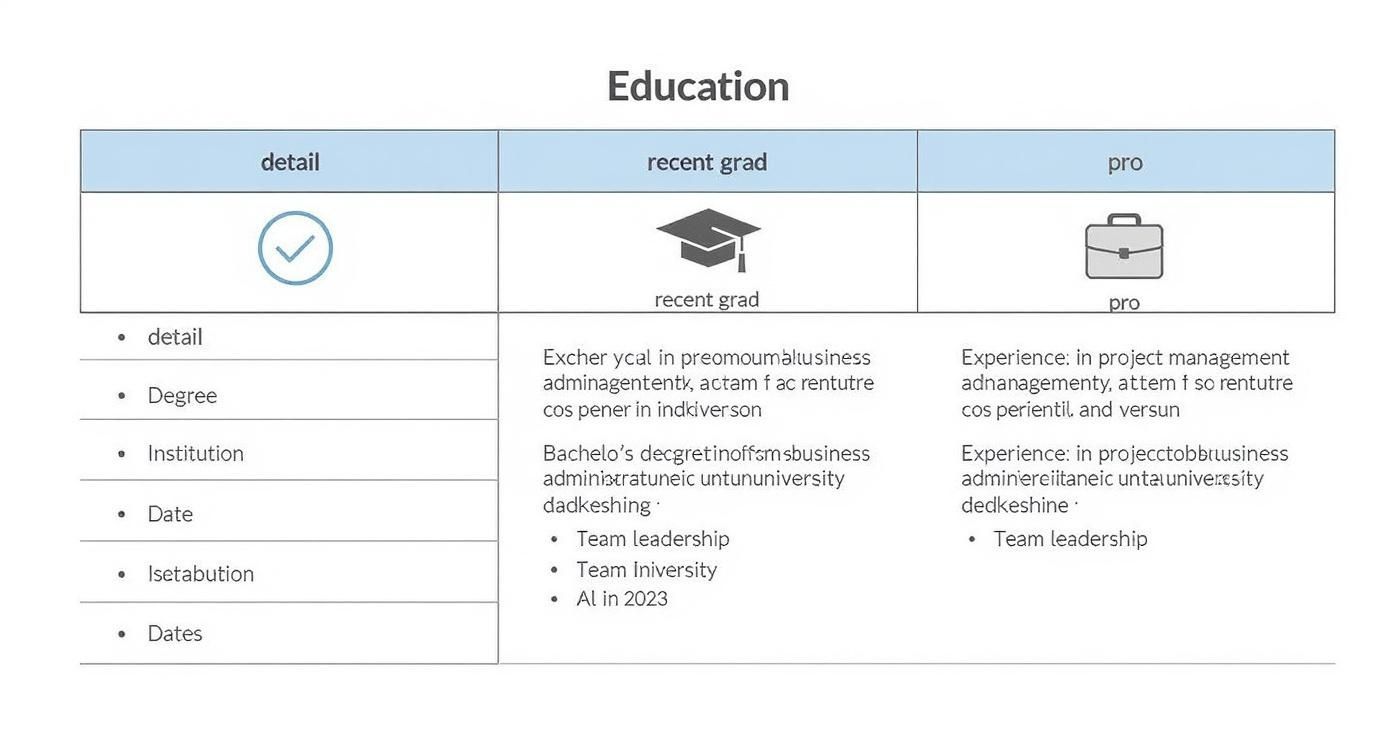
This infographic breaks it all down, showing what matters most for new grads versus established professionals.
The big takeaway here is that details like your GPA and specific classes fade in importance as your career grows. Your degree and the school you went to, however, remain standard. This natural shift ensures your resume is always showcasing your most impressive and relevant qualifications at any given time.
What to Include in Your Education Section
To make it even clearer, here’s a quick reference table showing what to include based on your experience level.
Detail
Recent Graduate (0-2 Yrs Exp)
Mid-Career (2-5+ Yrs Exp)
Experienced Pro (10+ Yrs Exp)
Degree & Major
Always
Always
Always
University Name & Location
Always
Always
Always
Graduation Date
Yes (or Expected Date)
Yes
Optional
GPA
Yes (if 3.5+)
No (unless requested)
No
Honors/Awards
Yes (e.g., Dean’s List)
Optional
No
Relevant Coursework
Yes (2-4 key courses)
No
No
Study Abroad
Yes
No
No
Thesis/Dissertation
Yes (if relevant)
Optional
No
As you can see, the further you get into your career, the more streamlined your education section becomes. Your impressive work history starts speaking for itself.
Where to Place Your Education Section for Maximum Impact
Deciding where to put your education on a resume isn’t just about formatting. It’s a strategic move that signals to recruiters what you consider your most important qualifications. Get it right, and you ensure your biggest strengths get noticed first.
The golden rule here is pretty simple: lead with your most compelling qualification. The placement of your education section should adapt as your career evolves, telling hiring managers what part of your story is most relevant to them right now.
For Students and Recent Graduates
If you’re still in school, a recent grad, or have less than five years of professional experience, your education section belongs near the top of your resume. It should come right after your contact info or resume summary.
This approach makes your academic background the star of the show. Since your degree is probably your most significant and recent accomplishment, putting it front and center immediately validates your knowledge and training for the role you’re targeting.
Think of your resume as your career highlight reel. As a new graduate, your degree and academic wins are the main event, so give them top billing to grab a recruiter’s attention from the get-go.
For Experienced Professionals
Once you’ve built up a solid track record of professional wins, your work history becomes your main selling point. For professionals with five or more years of experience, the education section should move to the bottom of the resume, usually after your professional experience.
This structure puts the spotlight on your proven skills and real-world impact—which is exactly what recruiters are looking for in experienced hires. Your degree then acts as a foundational credential that supports your career journey, rather than defining it. You can find more expert career advice on resume structure that confirms this standard practice and why it works.
Formatting Your Education Section for Clarity and ATS
How you format your education section matters just as much as what you put in it. A clean, consistent layout makes it incredibly easy for a busy hiring manager to grasp your qualifications at a glance. It also ensures your resume sails smoothly through any Applicant Tracking Systems (ATS) it encounters.
The key is to keep things predictable and scannable. Always start with your most recent degree and work your way backward. Since over 60% of hiring managers consider the education section important, a clear presentation is non-negotiable. A consistent structure for each entry is the way to go. You can read more about how these resume statistics impact hiring to see why a small detail like formatting can make such a big difference.
Essential Formatting Components
Your format should be simple—no need to get fancy here. For the best clarity and ATS compatibility, I recommend sticking to this standard hierarchy for every entry:
Degree Title and Major: Write out the full degree name (Bachelor of Science) and your major (in Computer Science). Try to avoid abbreviations, as some ATS software can stumble over them.
University Name and Location: List the official name of the school, followed by its city and state.
Graduation Date: All you need is the month and year you graduated (like May 2023). If you’re still studying, just use an expected date (e.g., Expected June 2025).
Pro Tip: Consistency is king. If you use “May 2023” for one degree, don’t switch to “05/23” for another. Little details like this signal professionalism and a sharp eye for detail.
Adding Optional Details
While those three components are the core of it, you can add a few optional details to strengthen your entry. This is especially helpful if you’re a recent graduate with less professional experience to show.
GPA: Only include your GPA if it’s a 3.5 or higher. Anything lower doesn’t add much value.
Academic Honors: Absolutely list any significant honors like Summa Cum Laude, Magna Cum Laude, or being on the Dean’s List. These are great achievements.
Relevant Coursework: Add a short, punchy list of 2-4 key courses that speak directly to the job you’re applying for.
For more tips on getting your whole document in shape, check out our ultimate guide to ATS-friendly resumes. It’ll help you make sure every section is formatted for success.
Example for a Recent Graduate:
Bachelor of Arts in Communication University of California, Los Angeles, CA | May 2024 GPA: 3.8 | Graduated Magna Cum Laude Relevant Coursework: Digital Media Strategy, Public Relations Campaigns, Intercultural Communication
How to Handle Unfinished Degrees and Certifications
Let’s be real: not everyone’s career path is a straight line from high school to a four-year degree. Life happens. Priorities shift. The key to listing an incomplete degree or other credentials is to be upfront about it while spinning it to your advantage. It’s all about framing the value you gained.
An unfinished degree is not a failure—it’s experience. Instead of hiding it, showcase the knowledge you walked away with. You can do this by focusing on the number of credits you earned or pointing to specific, relevant classes that line up with the job you’re after.
Presenting an Incomplete Degree
When you’re listing a degree you didn’t finish, honesty is your best friend. Never, ever list a degree as if it’s complete or just leave off the graduation date, hoping no one will notice. They will. Instead, own it and focus on what you did get done.
This approach lets you highlight your academic drive and the skills you picked up without misrepresenting yourself.
List the school, the program you were in, and the dates you attended.
Clearly state how many credits you completed toward the degree.
Call out relevant coursework that proves you have applicable knowledge.
Here’s a simple, honest way to format it:
University of Texas, Austin, TX (2019 – 2021) Completed 90 credits toward a Bachelor of Science in Marketing Relevant Coursework: Consumer Behavior, Digital Marketing Analytics, Market Research
Listing Certifications and Online Courses
Professional certifications, online courses, and bootcamps are gold on a resume. They show you’re proactive and committed to keeping your skills sharp. Since they aren’t formal degrees, they need their own space to shine.
Pro tip: Create a separate section called “Certifications” or “Professional Development.” This keeps your main Education section clean and makes it super easy for a recruiter to spot your extra qualifications.
For each entry, just list the name of the certification, who issued it, and when you got it. This gives recruiters all the info they need in a quick, scannable format.
For example:
PMP Certification, Project Management Institute, 2023
Google UX Design Certificate, Coursera, 2024
Enhancing Your Education Section with Key Achievements
Simply listing your degree is the bare minimum. If you really want to get noticed, you need to transform your education section from a simple fact sheet into a showcase of your actual abilities. Go beyond the basics by adding achievements that prove you have practical skills and a proactive mindset—that’s what turns a standard entry into compelling evidence of what you can do.
Think about what makes your academic journey stand out. Did you write a thesis on a topic that’s directly relevant to your target industry? Did you take the lead on a major academic project? These details offer a hiring manager a valuable glimpse into the kind of employee you’ll be.
Connecting Achievements to Job Requirements
The real trick is to tie every achievement back to what the employer is looking for in the job description. Companies are focusing more on skills than just credentials. In fact, the emphasis on GPA is fading fast, with only 38% of employers using it as a screening tool today—a huge drop from 73% just five years ago. Hiring managers now prioritize practical experience and soft skills. You can dig into more of these hiring trends and resume statistics to get a feel for what recruiters are looking for right now.
Here are a few ways you can highlight academic accomplishments that matter:
Thesis or Capstone Project: Briefly describe the topic and, more importantly, its relevance. For example: “Thesis on consumer behavior in e-commerce, analyzing data from 500+ user surveys to identify purchasing triggers.”
Academic Projects: Mention a significant project, what your role was, and what happened as a result. For instance: “Led a four-person team to develop a mobile app prototype for a local nonprofit, presenting the final design to community stakeholders.”
Study Abroad Experience: Don’t just list it. Frame it as proof of your adaptability and cross-cultural communication skills. For example: “Completed a semester abroad in Berlin, Germany, improving cross-cultural communication and problem-solving skills.”
When you frame your academic work in terms of professional skills—like research, project management, and data analysis—you make it much easier for a hiring manager to see your immediate value.
Examples of Enhanced Education Entries
Let’s look at how this plays out in practice. A standard entry just lists the facts, but an enhanced one tells a story of your achievements. If you’re struggling to phrase these accomplishments, a tool like our resume achievement generator can help you craft bullet points that make an impact.
Standard Entry:
Bachelor of Science in Environmental Science Greenwood University, Seattle, WA | May 2023
Enhanced Entry:
Bachelor of Science in Environmental Science Greenwood University, Seattle, WA | May 2023
Authored an 80-page honors thesis on urban water conservation, which was awarded the university’s prize for outstanding undergraduate research.
Presented research findings at the National Conference on Environmental Studies.
Common Mistakes to Avoid When Listing Your Education
It’s just as important to know what to leave out of your education section as it is to know what to put in. Simple, avoidable errors can easily undermine an otherwise polished resume, creating a negative impression or just plain confusing a busy recruiter.
By sidestepping a few common pitfalls, you can make sure this section strengthens your professional story instead of distracting from it. These small tweaks are all it takes to maintain a professional look and keep the focus squarely on your most relevant qualifications.
Including Outdated or Irrelevant Information
One of the most frequent mistakes I see is cluttering the education section with details that just don’t matter anymore. Once you’ve attended college or earned a degree, your high school diploma is redundant. It’s time to take it off. The only exception here is if you’re a current high school student or the application specifically asks for it.
The same rule applies to your GPA—only include it if it’s a 3.5 or higher. A lower GPA adds zero value and, frankly, can work against you. The goal is to be strategic and showcase only the information that makes you a stronger candidate.
Recruiters spend mere seconds on each resume. Including outdated details like high school or a low GPA forces them to sift through clutter, diluting the impact of your more impressive qualifications.
Misrepresenting Your Credentials
This one is non-negotiable: you have to be honest on your resume. Never, ever list a degree as complete if you haven’t actually graduated. If you’re still a student, that’s great—just make it clear by including an expected graduation date, like “Expected May 2025.” Leaving the date off can look like you’re trying to mislead an employer, which is a major red flag.
And if you have an unfinished degree, don’t hide it. Focus on what you did accomplish by listing the number of credits you completed. That approach is transparent and still highlights the academic experience you gained.
Using Inconsistent Formatting
Your resume’s formatting is a direct reflection of your attention to detail. Make sure every single entry in your education section follows the exact same structure.
Wrong: Using “May 2023” for one degree and then “05/23” for another.
Right: Sticking to one consistent format, like “May 2023,” for all your dates.
This kind of consistency makes your resume far easier to scan and shows a level of professionalism that recruiters definitely notice and appreciate.
Frequently Asked Questions About the Education Section
When it comes to the education section, the same handful of questions pop up again and again. Let’s clear up these common sticking points so you can finalize your resume and feel good about it.
Should I Include My Graduation Year if I Am Worried About Age Discrimination?
You can, but sometimes leaving it off draws more attention than just putting it there. Here’s the reality: if you have a strong, relevant work history, recruiters are going to focus on your proven skills and accomplishments. Your graduation date becomes a minor detail.
The best strategy isn’t hiding your graduation date; it’s building a professional experience section so compelling that no one cares when you graduated. Focus on showcasing your value with real, quantifiable achievements.
Key Takeaway: A powerful work history is your best defense against potential ageism. Recruiters are far more interested in what you can do for them now than when you earned your degree.
How Do I List a Double Major on My Resume?
If you earned a single degree with two majors, list the degree once and then specify both fields of study. You can put them on the same line or break them out onto separate lines for readability.
Example:
Bachelor of Arts in Economics and Political Science
Northwestern University, Evanston, IL
However, if you earned two completely separate degrees—like a Bachelor of Arts and a Bachelor of Science—list them as two distinct entries. Always put the degree that’s most relevant to the job you’re targeting first. That’s what will catch the recruiter’s eye.
Do I Need to Include My High School Education on My Resume?
Nope. If you’ve attended college or earned a degree, your high school diploma is implied. Including it is redundant and just adds clutter to your resume.
The only exceptions are if you’re a current high school student or if a specific job application explicitly asks for it. Otherwise, leave it off.
What Is the Best Way to List a Study Abroad Program?
Your study abroad experience should be nested directly under the university that granted your degree. This keeps your education section clean and shows the program was an integrated part of your formal education.
You can list it as a simple bullet point or a sub-entry.
Example:
Bachelor of Science in International Business
University of Southern California, Los Angeles, CA
Study Abroad Program, Bocconi University, Milan, Italy | Spring 2023
This format neatly highlights valuable international experience without creating a separate, confusing entry on your resume.
Feeling confident about your education section but still wrestling with the rest of your resume? ResumeShaperAI uses smart technology to build a polished, ATS-friendly document in minutes. Stop staring at a blank page and let our AI-powered tools craft a resume that gets you noticed. Build your winning resume for free at resumeshaperai.com.
Your resume summary is often the first thing recruiters read—and sometimes the only thing. A clear, focused summary quickly communicates who you are, what you offer, and why you’re a strong fit for the role. Read more to learn how to write a resume summary that instantly grabs attention and sets the tone for the rest of your resume. Read more about your resume summary here.
Starting your career can feel overwhelming, but your resume doesn’t have to be. Recent graduates can stand out by focusing on skills, internships, projects, and academic achievements—without needing years of experience. Read more to learn how to build a strong, confident resume that opens doors right after graduation.
If you're stuck, underpaid, overlooked, or just burned out — your next job could be one resume away.
Most people stay in a job they hate simply because their resume isn't strong enough to open new doors.
Ask yourself:
Are you applying but hearing nothing?
Are you underpaid for your experience?
Do you feel stuck in your current role?
Is your resume outdated or bland?
You deserve a better job — and a better resume to get there.
ResumeShaperAI is your all-in-one AI-powered career tool designed to help job seekers create professional, ATS-friendly resumes and cover letters in minutes. Our mission is to simplify the job search process with smart automation and beautifully designed templates.