
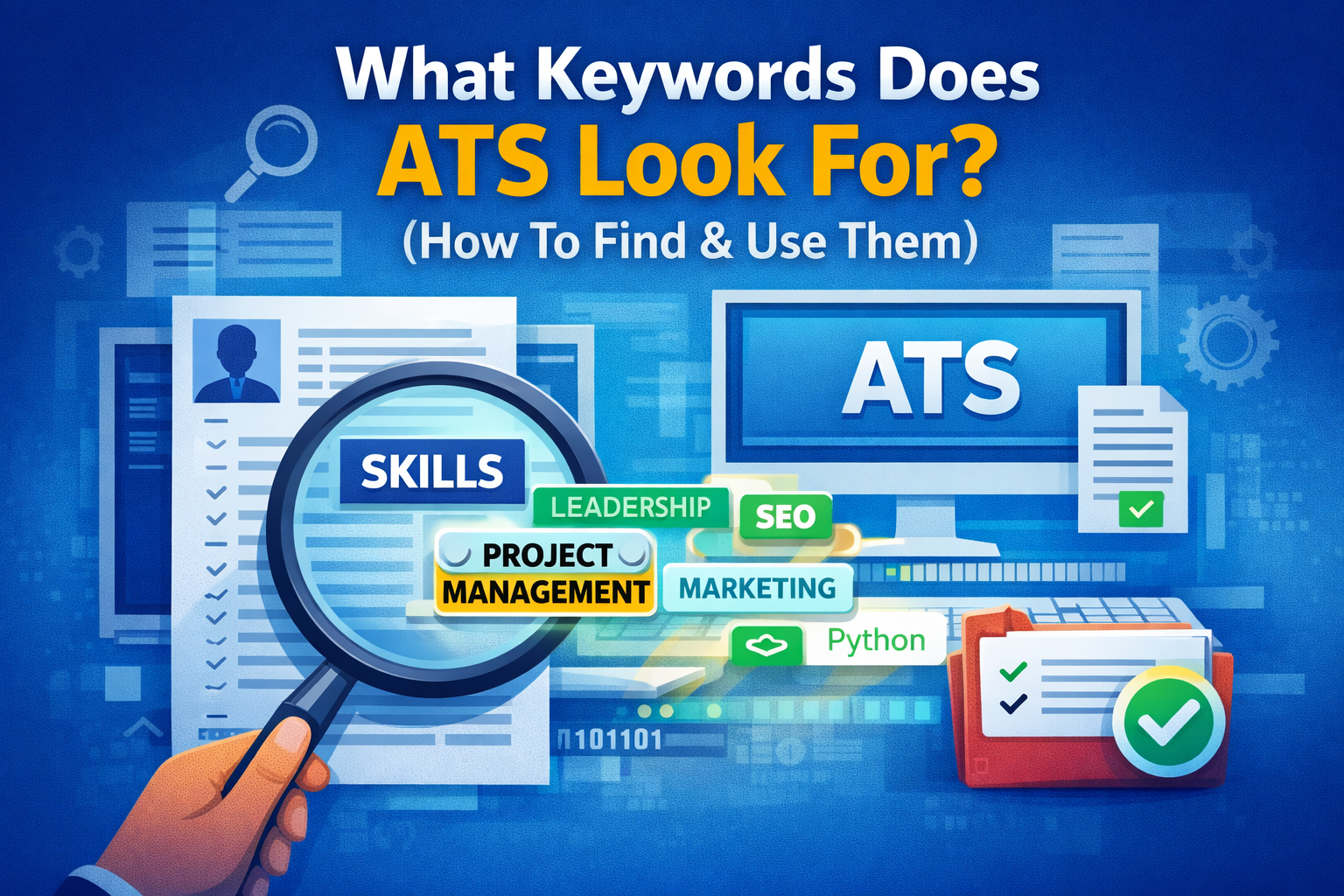
What Keywords Does ATS Look For? A Complete Guide to Beating Applicant Tracking Systems
If you’ve been applying to jobs online and hearing nothing back, you’re not alone. Here’s what might be happening: your resume never actually reached a human recruiter. Instead, it was filtered out by an Applicant Tracking System (ATS) before anyone could see your qualifications.
Understanding what keywords ATS software looks for can be the difference between landing an interview and having your application disappear into a digital black hole. Let’s break down exactly how these systems work and what you need to do to get past them.
What Is an ATS and Why Does It Matter?
An Applicant Tracking System is software that companies use to collect, scan, and rank job applications. Over 98% of Fortune 500 companies use ATS software, and the technology has trickled down to small and medium-sized businesses too.
When you submit your resume, the ATS scans it for specific keywords and phrases that match the job description. It then ranks your application based on how well your resume aligns with what the employer is looking for. Only the top-ranking candidates typically make it to a human recruiter’s desk.
The Five Main Categories of ATS Keywords
1. Hard Skills and Technical Competencies
These are the specific, measurable abilities required to do the job. The ATS searches for exact matches or close variations of skills mentioned in the job posting.
Examples include:
- Software programs (Microsoft Excel, Adobe Photoshop, Salesforce)
- Programming languages (Python, Java, SQL)
- Technical certifications (PMP, CPA, AWS Certified)
- Specialized techniques (SEO optimization, data analysis, project management)
When you see a skill listed in the job description, include it word-for-word in your resume if you genuinely possess that skill. If the posting mentions “social media marketing,” don’t just write “marketing experience.” Be specific.
2. Industry-Specific Terminology and Jargon
Every industry has its own language. An ATS programmed for healthcare jobs will look for different terms than one screening marketing applications.
Healthcare examples: Electronic Health Records (EHR), HIPAA compliance, patient care coordination
Marketing examples: conversion rate optimization, A/B testing, content management systems
Finance examples: financial modeling, GAAP, budget forecasting
Use the exact terminology from your industry and from the specific job posting. This shows you speak the language and understand the field.
3. Job Titles and Role-Specific Experience
ATS software scans for relevant job titles to verify you have appropriate experience. If you’re applying for a “Senior Project Manager” position, having “Project Manager” or “Assistant Project Manager” in your work history helps your ranking.
However, don’t lie about titles. Instead, if your official title was vague (like “Specialist II”), you can clarify in parentheses: “Marketing Specialist II (Digital Marketing Coordinator).”
4. Education, Certifications, and Credentials
Educational requirements are often deal-breakers programmed into ATS systems. The software looks for:
- Degree types (Bachelor of Science, MBA, Associate Degree)
- Fields of study (Computer Science, Business Administration)
- Certifications (Google Analytics Certified, Six Sigma Green Belt)
- Licenses (RN, CPA, Real Estate License)
Always spell out acronyms at least once. Write “Bachelor of Science (BS)” or “Certified Public Accountant (CPA)” to ensure the ATS catches both versions.
5. Action Verbs and Accomplishments
Modern ATS systems are getting smarter. They don’t just look for keywords, but for context around them. Strong action verbs combined with measurable results help your resume rank higher.
Powerful action verbs include: managed, developed, implemented, increased, reduced, optimized, designed, analyzed, coordinated, launched
Pair these with specific achievements: “Increased sales revenue by 35%” or “Managed a team of 12 customer service representatives.”
How to Find the Right Keywords for Your Application
Mirror the Job Description
This is the golden rule. The job posting itself is your blueprint for ATS success. Read it carefully and identify:
- Required and preferred skills
- Specific software or tools mentioned
- Repeated phrases and terminology
- Qualifications and certifications needed
If a term appears multiple times in the job description, it’s probably weighted heavily in the ATS algorithm.
Research Similar Job Postings
Look at 5-10 similar positions at different companies. Notice which keywords appear consistently across all of them. These are industry-standard terms that will likely help your resume in any ATS.
Use LinkedIn and Industry Resources
Search LinkedIn for people who currently hold the job title you’re targeting. Look at their profiles to see which skills and keywords they emphasize. Industry publications and professional associations can also reveal trending terminology in your field.
Common ATS Mistakes to Avoid
Using images or graphics: ATS software can’t read text embedded in images. Keep your resume text-based and simple.
Fancy formatting: Headers, footers, tables, and text boxes can confuse older ATS systems. Stick to standard fonts like Arial, Calibri, or Times New Roman.
Keyword stuffing: Loading your resume with keywords out of context looks suspicious to both ATS and human readers. Use keywords naturally within your actual experience.
Wrong file format: Most ATS systems prefer .docx or PDF files. Check the application instructions for the preferred format.
Ignoring the exact wording: If the job description says “customer service,” don’t just write “client relations.” Include both if they’re relevant to your experience.
Optimizing Your Resume for ATS Success
Create a dedicated “Skills” or “Core Competencies” section near the top of your resume. This gives the ATS an easy-to-scan area packed with relevant keywords.
Customize your resume for each application. Yes, this takes more time, but a tailored resume that matches the specific job description will always outperform a generic one.
Include a mix of hard and soft skills, but remember that ATS systems prioritize hard skills because they’re easier to measure and verify.
Finally, always proofread. Spelling errors in keywords mean the ATS won’t recognize them. “Excell” won’t match “Excel,” and “project management” won’t match “project management.”
The Bottom Line
Understanding ATS keywords isn’t about gaming the system. It’s about presenting your genuine qualifications in a format that automated systems can recognize and that hiring managers can quickly understand.
When you align your resume with what employers are actually searching for, you increase your chances of getting noticed.
Remember, the goal is to get past the ATS and in front of a real person who can appreciate the full scope of your experience. Use these keyword strategies to open that door, then let your accomplishments speak for themselves.
Discover step‑by‑step how to transform a generic resume into one that speaks directly to what employers and ATS systems are looking for by decoding job descriptions and strategically aligning your skills and experience. From weaving in keywords to showcasing measurable results that match specific role requirements, this guide shows you how tailored resumes significantly boost your chances of getting noticed and landing interviews.
Learn what happens behind the scenes when your resume enters an ATS and how parsing software scans, extracts, and organizes your experience, skills, and education.
Understanding resume parsing can help you optimize formatting and keywords so your application gets seen by real hiring managers instead of getting lost in the system.
Build a professional, ATS‑friendly resume in minutes using our smart resume builder, designed to highlight your skills and experience in the best possible way. From templates to automated formatting and keyword optimization, it makes creating a standout resume fast, easy, and effective.
Summary
Applicant Tracking Systems (ATS) scan resumes for five main keyword categories: hard skills and technical competencies, industry-specific terminology, relevant job titles, education and certifications, and action verbs paired with accomplishments.
To optimize your resume, mirror the exact wording from job descriptions, create a dedicated skills section, avoid fancy formatting that confuses ATS software, and customize your application for each position.
The key is using keywords naturally within your actual experience rather than stuffing them artificially. Research shows 98% of Fortune 500 companies use ATS, making keyword optimization essential for job seekers who want their resumes to reach human recruiters.
Frequently Asked Questions
How many keywords should I include in my resume?
There’s no magic number, but focus on quality over quantity. Include 15-25 highly relevant keywords that genuinely reflect your skills and experience. Every keyword should appear naturally within the context of your actual accomplishments and qualifications.
Can I use the same resume for every job application?
While it’s tempting to save time, customizing your resume for each position significantly increases your chances of passing ATS screening. Even small adjustments to include specific keywords from each job description can make a major difference in your ranking.
Do ATS systems reject resumes automatically?
Not exactly. ATS systems rank and score resumes based on keyword matches and relevance. Lower-scoring resumes may never reach a human recruiter because hiring managers typically review only the top candidates. However, the system doesn’t technically “reject” you—it just prioritizes other applications.
Should I include keywords in my cover letter too?
Absolutely. Many ATS systems scan cover letters along with resumes. Your cover letter is another opportunity to naturally incorporate relevant keywords while explaining how your experience aligns with the role. Just make sure it reads naturally and tells your story, not just a list of keywords.
What if I don’t have all the keywords listed in the job description?
Apply anyway if you meet most of the qualifications. Focus on the keywords for required skills and prioritize those that appear multiple times in the posting. Be honest about your experience and emphasize transferable skills that relate to missing requirements. Many job descriptions represent an ideal candidate that may not exist.