
How to Showcase Your Achievements on Your Resume: The Ultimate Guide
Most resumes fail to make an impression because they all look the same. They list responsibilities, repeat job descriptions, and never clearly show what makes the candidate valuable. When everything blends together, hiring managers move on quickly.
This guide will teach you how to replace generic duties with powerful, results-focused achievements that highlight your impact, showcase your strengths, and help your resume stand out in a crowded job market—so you can start getting more interviews.
Why Achievements Matter More Than Responsibilities in 2026
Recent research reveals a striking truth: 58% of recruiters say measurable achievements are what make a resume stand out most. The difference between getting filtered out and securing an interview often comes down to this critical distinction.
Understanding the Fundamental Difference
Job Responsibilities describe what you were hired to do—the daily tasks assigned to your position. For example: “Managed social media accounts” or “Answered customer inquiries.”
Achievements demonstrate how well you performed those tasks and the impact you created. For example: “Grew Instagram engagement by 145% in six months, generating 3,200 new leads” or “Resolved 95% of customer complaints on first contact, improving satisfaction scores by 28%.”
Think of it this way: responsibilities show what you did; achievements show why you mattered.
The Resume Achievement Formula: Turn Duties into Impact Statements
Transforming basic job duties into compelling achievement statements follows a proven formula. Here’s how to structure each bullet point for maximum impact:
The XYZ Method
“Accomplished [X] by doing [Y], resulting in [Z]”
This framework forces you to focus on outcomes rather than activities. Let’s see it in action:
Before (Duty-Based): “Responsible for training new employees”
After (Achievement-Based): “Developed comprehensive onboarding program that reduced new hire ramp-up time by 40%, saving the company $75,000 annually in training costs”
The CAR Technique (Challenge-Action-Result)
This approach works especially well for complex accomplishments:
- Challenge: What problem did you face?
- Action: What specific steps did you take?
- Result: What measurable outcome did you achieve?
Example: “Faced declining customer retention (Challenge), implemented personalized follow-up system using CRM automation (Action), resulting in 32% increase in repeat purchases over 18 months (Result).”
How to Quantify Your Achievements (Even Without Obvious Numbers)
One of the biggest obstacles job seekers face is believing they don’t have measurable results. The truth? Almost every achievement can be quantified with the right approach.
Key Metrics to Track
Look for opportunities to include:
- Percentages: Growth rates, improvement percentages, efficiency gains
- Dollar amounts: Revenue generated, costs saved, budget managed
- Time saved: Reduced processing time, faster turnaround, efficiency improvements
- Scale indicators: Team size managed, customers served, projects completed
- Frequency: Daily, weekly, monthly volume of work
When You Don’t Have Exact Numbers
If precise data isn’t available, use these strategies:
- Estimate conservatively: “Saved approximately 15 hours weekly” or “Generated ~$50,000 in new business”
- Use comparative language: “Reduced processing time by more than half” or “Increased productivity substantially”
- Focus on scope: “Managed inventory for 3 retail locations serving 500+ customers daily”
Industry-Specific Achievement Examples
Different industries value different types of accomplishments. Here’s how to showcase achievements in various fields:
Sales & Marketing
- “Exceeded quarterly sales targets by average of 23% for 6 consecutive quarters”
- “Launched email campaign that generated 30 million impressions and $1.2M in revenue”
- “Expanded client base from 45 to 127 accounts within 18 months”
Technology & IT
- “Implemented automated testing system that reduced deployment errors by 67%”
- “Led migration to cloud infrastructure, cutting operational costs by $180,000 annually”
- “Developed Python script that automated data processing, saving 12 hours weekly”
Education & Training
- “Designed curriculum that improved student test scores by average of 18%”
- “Created behavior management program reducing disciplinary incidents by 40%”
- “Mentored 15 new teachers, with 93% retention rate over two years”
Healthcare & Medical
- “Managed quality assurance program decreasing medical errors by 35%”
- “Implemented patient scheduling system reducing wait times from 45 to 12 minutes”
- “Coordinated care for 200+ patients monthly while maintaining 98% satisfaction rating”
Administrative & Operations
- “Streamlined invoice processing, reducing approval time from 5 days to 24 hours”
- “Managed $2.5M budget with zero overruns across 3 consecutive fiscal years”
- “Organized company-wide event for 300+ attendees, staying 15% under budget”
Strategic Placement: Where to Showcase Your Achievements
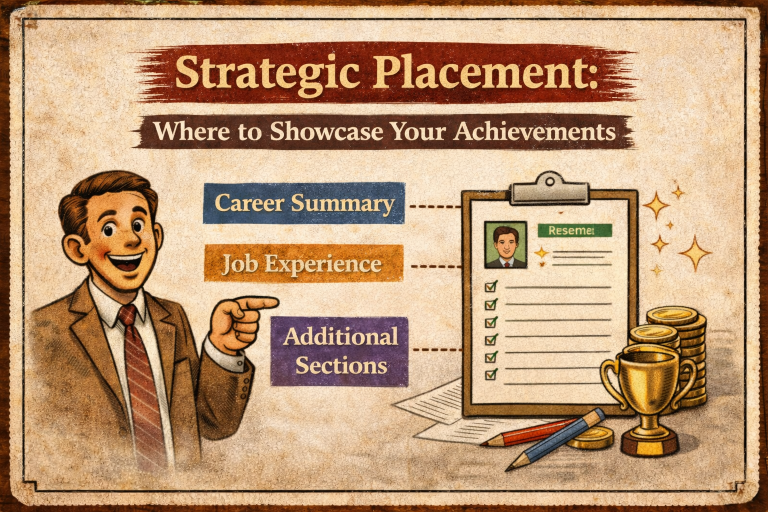
Maximize the impact of your accomplishments by placing them strategically throughout your resume:
1. Professional Summary
Lead with your most impressive achievement to immediately capture attention:
“Results-driven Sales Manager with proven track record of exceeding targets by 30%+ annually. Recently led team that generated $4.5M in new revenue, the highest in company history.”
2. Work Experience Section
Structure each position with 3-5 achievement-focused bullet points rather than lengthy responsibility lists. Prioritize accomplishments that align with the job you’re targeting.
3. Skills Section Integration
Modern ATS systems use semantic matching—they look for skills demonstrated in context. Don’t just list “Project Management”; show it: “Project Management: Successfully delivered 15 cross-functional projects on time and 12% under budget.”
4. Additional Accomplishments Section
For senior professionals with extensive experience, consider adding a “Career Highlights” section at the top featuring your most impressive metrics across different roles.
Tailoring Achievements for ATS Optimization in 2026
With 84% of large enterprises using ATS software, your achievements must be both impressive to humans and readable by machines:
ATS-Friendly Achievement Writing
- Use keywords naturally: Extract terms from the job description and weave them into your achievement statements
- Avoid over-optimization: Keyword stuffing triggers low readability scores and turns off recruiters
- Match exact phrasing: If the posting says “customer support,” use that instead of “customer assistance”
- Include context: Ensure every major skill listed appears at least once in your experience section in a real-world application
The 2-3 Rule
Aim for 2-3 natural occurrences of critical keywords across your summary, skills, and experience sections. More than this appears forced; less may not register with the system.
Common Mistakes to Avoid
Even experienced job seekers make these critical errors when showcasing achievements:
1. Treating All Bullets as Achievements
Not every bullet point needs to be an achievement. It’s acceptable to include 1-2 responsibility statements if they provide necessary context, but the majority should focus on results.
2. Being Too Vague
“Improved efficiency” means nothing. “Reduced report generation time from 3 hours to 45 minutes through Excel macro automation” tells a complete story.
3. Forgetting Volunteer and Project Work
Achievements from volunteer work, freelance projects, or academic experiences count—especially for recent graduates or career changers. Frame them with the same authority as traditional employment.
4. Using the Same Resume for Every Application
Generic resumes don’t work in 2026. According to recent surveys, 55% of recruiters say tailored resumes are more impressive than even perfectly quantified generic ones. Customize your achievement statements to align with each specific job posting.
5. Neglecting Soft Skills Impact
While hard skills and metrics matter, don’t ignore achievements that demonstrate leadership, communication, or problem-solving. Frame them with outcomes: “Mediated conflict between departments, restoring collaboration and preventing $200,000 project delay.”
AI Resume Builders: Leveraging Technology for Achievement-Based Resumes

Modern AI resume builders can help transform your duties into achievements, but use them strategically:
What AI Tools Do Well
- Identify missing keywords from job descriptions
- Suggest achievement-focused phrasing
- Check ATS compatibility
- Provide match scores against job postings
Where Human Judgment Matters
- Selecting which achievements to highlight
- Ensuring numbers are accurate and honest
- Adding personal voice and authenticity
- Choosing industry-specific language
The most effective approach combines AI efficiency with human authenticity. Use AI to optimize structure and keywords, but ensure your resume sounds genuinely like you.
Your Action Plan: Transforming Your Resume Today
Ready to turn your resume into an achievement showcase? Follow this step-by-step process:
- Audit your current resume: Highlight every statement that’s just a duty or responsibility
- For each position, ask: What did I accomplish? What improved because of my work? What praise did I receive?
- Quantify everything possible: Review old performance reviews, emails, and reports for specific data
- Apply the XYZ formula: Rewrite each duty-based bullet using the achievement structure
- Tailor to your target role: Prioritize achievements that align with your desired position’s requirements
- Test with ATS scanners: Use free tools to check your achievement-based resume scores well
- Get feedback: Have a colleague or mentor review your achievements for clarity and impact
Conclusion: From Job Descriptions to Career Highlights
The difference between a resume that gets interviews and one that gets ignored often comes down to a single shift: from listing what you were hired to do to proving what you actually accomplished.
By focusing on quantifiable achievements, using strategic formulas like XYZ and CAR, and optimizing for both ATS systems and human readers, you transform your resume from a generic job description into a compelling career highlight reel.
Remember: hiring managers aren’t choosing you for what you might do—they’re choosing you for what you’ve proven you can deliver. Make sure your resume shows them exactly that.
Start today by rewriting just three of your bullet points using the techniques in this guide. You’ll immediately see—and feel—the difference in how powerfully your resume represents your professional value.
Frequently Asked Questions
How many achievements should I include per job on my resume?
Aim for 3-5 achievement-focused bullet points per position. For your most recent or relevant roles, lean toward 5; for older positions, 2-3 is sufficient. Quality always trumps quantity—one powerful, quantified achievement beats three vague statements.
What if I’m entry-level and don’t have major accomplishments?
Entry-level candidates absolutely have achievements—you just need to look beyond traditional employment. Draw from internships, academic projects, volunteer work, part-time jobs, or extracurricular activities. Did you organize an event? Lead a group project? Exceed sales targets at your retail job? These all count. Focus on growth, initiative, and any measurable impact you created.
Should I include achievements that aren’t directly related to the job I’m applying for?
Yes, but strategically. If an achievement demonstrates transferable skills like leadership, problem-solving, or communication, it’s relevant. For example, “Organized fundraiser that raised $15,000” shows project management and stakeholder engagement—valuable in many roles. Just prioritize achievements that align most closely with the target position.
How do I write achievements if my company doesn’t track metrics?
Get creative with quantification. Think about scope (how many people/projects), frequency (daily volume), comparisons (before/after improvements), or recognition received. You can also estimate conservatively: “Handled approximately 50+ customer inquiries daily” or “Reduced processing errors by roughly 30%.” Even without hard data, you can demonstrate impact.
Can I use the same achievement statements for multiple job applications?
You can reuse the core accomplishments, but you should tailor the emphasis and wording for each application. Review the job description and adjust your achievement statements to highlight the aspects most relevant to that specific role. This might mean reordering bullets, adjusting keywords, or emphasizing different outcomes from the same project.
Do achievements work for creative fields like design or writing?
Absolutely. Creative professionals should blend qualitative and quantitative achievements. Examples: “Designed brand identity adopted by 50+ partner organizations,” “Wrote content that increased website traffic by 85%,” or “Directed campaign featured in 3 industry publications.” Portfolio pieces provide visual proof, but achievement statements provide context and impact.
How far back should I include achievements on my resume?
Generally, focus your achievement-heavy descriptions on the past 10-15 years of experience. For positions beyond that, you can include just the job title, company, and dates, or condense into a brief “Earlier Career” section. Your most recent 2-3 positions should have the most detailed achievements, as they’re most relevant to current opportunities.
Conclusion: From Job Descriptions to Career Highlights
The difference between a resume that gets interviews and one that gets ignored often comes down to a single shift: from listing what you were hired to do to proving what you actually accomplished.
By focusing on quantifiable achievements, using strategic formulas like XYZ and CAR, and optimizing for both ATS systems and human readers, you transform your resume from a generic job description into a compelling career highlight reel.
Remember: hiring managers aren’t choosing you for what you might do—they’re choosing you for what you’ve proven you can deliver. Make sure your resume shows them exactly that.
Start today by rewriting just three of your bullet points using the techniques in this guide. You’ll immediately see—and feel—the difference in how powerfully your resume represents your professional value.