

How To Know If A Resume Is Bad: The Complete 2026 Guide for Job Seekers and AI Resume Optimization
Your resume opens doors or slams them shut before you even realize.
With AI now screening 95% of resumes before human eyes ever see them, understanding what makes a resume ineffective has never been more critical.
Whether you’re crafting your first resume, using an AI resume builder, or updating an existing document, this comprehensive guide will help you identify fatal flaws that cost job seekers countless opportunities.
Understanding the Modern Resume Screening Process
The job search landscape has fundamentally shifted. When you submit an application, your resume enters a multi-stage evaluation system.
First, Applicant Tracking Systems (ATS) parse and score your document based on keyword matching and formatting compatibility.
Nearly 98% of Fortune 500 companies use ATS systems to filter resumes before human review, making ATS optimization a non-negotiable requirement rather than an optional enhancement.
According to recent industry data, up to 75% of resumes never make it past the initial ATS scan. This staggering statistic means three out of four qualified candidates are eliminated before a recruiter even glances at their application.
The problem isn’t necessarily a lack of qualifications—it’s poor resume construction that triggers automatic rejection.
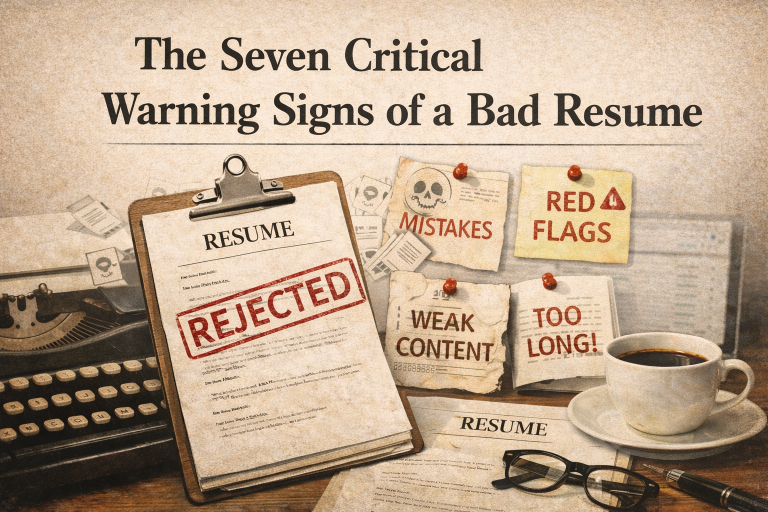
The Seven Critical Warning Signs of a Bad Resume
1. ATS-Incompatible Formatting That Gets Your Resume Rejected
One of the fastest ways to identify a problematic resume is to examine its formatting. Complex formatting causes parsing errors that make your information unreadable to screening algorithms. If your resume includes multiple columns, text boxes, tables, or embedded graphics, ATS software cannot properly extract your information.
Career experts recommend testing your resume’s ATS compatibility by converting it to plain text. Copy your resume text into a plain .txt file—if it looks garbled or missing information, that’s exactly what the ATS sees. Headers and footers pose particular problems, with research confirming the ATS was unable to identify a portion of the job seeker’s contact information 25% of the time when information was stored in headers or footers.
For optimal ATS compatibility, stick to standard single-column layouts with simple section headers like “Work Experience,” “Skills,” and “Education.” Use traditional fonts such as Arial, Calibri, or Times New Roman. Save your resume as a .docx file unless the job posting specifically requests a PDF format.
2. Missing or Incorrect Keywords That Trigger Automatic Rejection
Keywords function as access codes to the interview process. A study by Harvard Business School found that 88% of employers say their hiring systems filter out qualified candidates who don’t precisely match the job description. Without the right terminology, even highly qualified candidates become invisible to recruiters.
The most effective approach involves analyzing target job descriptions to identify repeated terms, required tools, platforms, and industry-specific terminology. Recruiters search for specific keywords in applicant tracking systems—if your resume doesn’t include these keywords, it might not show up in the search results.
However, keyword optimization requires precision. ATS platforms often search for exact phrases rather than synonyms. If your resume says “Adobe Creative Cloud” but the job description says “Adobe Creative Suite,” your resume might not appear in search results, even though you have the exact skill set they’re looking for.
Modern ATS systems in 2025 have evolved beyond simple keyword matching. Semantic intelligence now lets ATS infer relationships, with context winning as terms embedded in quantified achievements carry more weight than isolated skills lists. This means merely listing skills isn’t enough—you must demonstrate their application through specific accomplishments.
3. Generic Content That Fails to Differentiate You
A critical indicator of a weak resume is generic, responsibility-focused content. Many people use their resume to simply list what they did day-to-day in each role, but when you apply for a job, chances are you’re competing with hundreds of other people whose past job titles and responsibilities are very similar to yours.
Instead of stating “Responsible for managing social media accounts,” effective resumes quantify impact: “Boosted Instagram engagement 340% in 6 months, driving 15,000+ new followers and $50K in direct sales through strategic content campaigns”. This transformation demonstrates value rather than merely describing tasks.
Career experts recommend the STAR (Situation, Task, Action, Result) or CAR (Challenge, Action, Result) frameworks for crafting achievement-oriented bullet points. The Laszlo Bock formula provides another effective structure: “Accomplished [X] as measured by [Y] by doing [Z]”.
4. One-Size-Fits-All Approach Instead of Tailored Applications
Submitting the same resume to every job opening represents a fundamental mistake. Most job-seekers create one general resume and apply to dozens of jobs with it—unfortunately, this is a very common resume mistake. Each position requires different skills and experiences, making customization essential.
Strategic tailoring involves more than surface-level adjustments. Analyze each job description carefully to identify what the employer values most. Use your base resume as a foundation, then create job-specific versions that highlight the most relevant experiences and skills.
Research demonstrates the effectiveness of this approach. Candidates who tailor their resumes with job description keywords can increase their interview chances significantly compared to those submitting generic documents.
5. Irrelevant Information That Wastes Valuable Space
Including outdated or unrelated experiences dilutes your resume’s impact. If you worked as a waiter in 2009 but are now applying for a data analyst role, that experience doesn’t really help your case—it just takes up space. Every line should bring you closer to an interview.
This includes removing obvious or outdated skills. It’s 2026—it’s pretty much implied that you can use a computer, Microsoft Office, Excel, and similar tools. By including such skills in your resume, you’re just wasting space. Focus instead on technical competencies that differentiate you from other candidates.
Other elements to eliminate include objective statements (replace with a professional summary), full home addresses (city and state suffice), “References available upon request” (recruiters already know this), and unprofessional email addresses.
6. Typos and Grammatical Errors That Destroy Credibility
Spelling and grammar mistakes are resume killers. Such mistakes tell the recruiter that you either don’t know the language very well, don’t have much attention to detail, or you don’t care much about the job you’re applying for. Even a single error can trigger immediate disqualification.
Always proofread multiple times, use grammar-checking tools, and have someone else review your resume. Reading aloud helps catch errors that your eyes might skip when reading silently. Consider the perspective shift: would you hire someone whose application contained obvious mistakes?
7. Missing Remote Work Skills and Modern Competencies
The professional landscape has evolved dramatically, yet many resumes fail to reflect contemporary work environments. With remote job postings up 357% since the pandemic, not showcasing remote capabilities immediately signals you’re unprepared for modern work environments.
Include specific remote work tools, time management approaches, and communication platforms you’ve mastered. Demonstrate your ability to thrive in hybrid and distributed team settings. These competencies have transitioned from nice-to-have bonuses to essential qualifications.
How AI Resume Builders Can Help—and Harm
AI-powered resume tools have become increasingly popular, with approximately 65% of candidates using AI at some point in the job application process according to the 2025 Market Trend Report from Career Group Companies. However, these tools require careful oversight.
Career coaches warn against over-reliance on AI. When AI is asked to rewrite a resume to coordinate with a job description, “it is going to start to lie if the title doesn’t 100% align”. The technology is prone to fabricating information or exaggerating experiences to fulfill user requests.
Recruiters can often identify AI-generated content. “You can totally tell when someone has used AI, because suddenly I have six applications that all have the same sort of structure and format”, notes one fractional recruiter. AI-generated resumes are frequently stuffed with keywords, creating awkward “word salad” that’s jarring to read.
The recommended approach involves using AI as a polishing tool rather than a content generator. Write your resume in your own words first, then use AI to refine language and optimize formatting. Always review AI-suggested changes carefully before submitting, as tools have been known to make major errors such as misnaming companies or inserting inaccurate information.
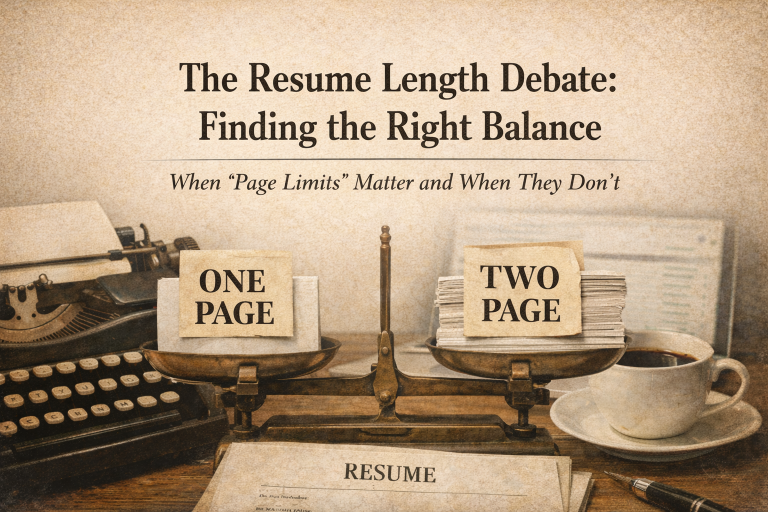
The Resume Length Debate: Finding the Right Balance
Resume length depends on your career stage and industry. A one-page resume is appropriate if you are a recent graduate, have had fewer than three jobs, or are pivoting into a new field without extensive relevant experience. A two-page resume is appropriate if you’ve worked 5+ jobs or have over 10 years of experience and are seeking a more senior role.
Career experts generally advise against three-page resumes for most positions. The exception involves CVs for academic or government work, where documents exceeding ten pages are common and expected.
Essential Elements Every Strong Resume Needs
Professional contact information should include your full name, phone number, professional email address, city and state, and LinkedIn profile URL. Avoid including your full street address, as this isn’t necessary and takes up valuable space.
Your professional summary serves as an elevator pitch. Craft a concise 2-3 sentence section highlighting your years of experience, key skills, and most significant achievements. This prime real estate at the top of your resume should contain your most important keywords.
The core skills section functions as a keyword hub for ATS optimization. Organize technical competencies, software proficiency, and industry terminology into 3-4 clear categories. Place the skills most relevant to your target position prominently.
Your experience section should list positions in reverse chronological order, with 3-5 bullet points per role. Each bullet should start with a strong action verb and include quantifiable achievements whenever possible. Focus on impact and results rather than responsibilities.
Testing and Optimizing Your Resume
Before submitting applications, test your resume using ATS simulation tools. Many platforms offer free scans that compare your resume against specific job descriptions. Career counselors recommend a match rate score of 75%, though many job seekers see success with just a 65% match rate.
Track your application success rate to gauge effectiveness. If you’re applying to numerous positions without receiving responses, your keyword optimization needs work. Consider A/B testing different approaches with varying keyword densities or placement strategies.
Industry terminology evolves constantly, particularly in technology-driven fields. Subscribe to industry publications and monitor job boards quarterly to spot emerging terms. Update your resume seasonally as different times of year may emphasize different skills or competencies.
The Bottom Line: Your Resume Is Your Marketing Document
In 2026’s competitive job market, your resume functions as a strategic marketing document rather than a comprehensive biography. Every word should serve the singular purpose of securing an interview. Understanding what makes a resume ineffective—and how to fix those problems—separates candidates who consistently land interviews from those who wonder why their applications disappear into black holes.
Start by auditing your current resume against the warning signs outlined in this guide. Check for ATS compatibility, keyword optimization, achievement-focused content, and modern relevance. Make targeted improvements rather than complete rewrites, testing different approaches to see what generates better response rates.
Remember that the job application process has become technology-driven, but human validation remains the ultimate goal. Your resume needs to speak both languages fluently satisfying algorithmic requirements while compelling human readers to invite you for an interview. Master this balance, and you’ll immediately stand out in even the most crowded job markets.
Your resume opens doors—or slams them shut before you even realize. With AI now screening 95% of resumes before human eyes ever see them, understanding what makes a resume ineffective has never been more critical. Whether you’re crafting your first resume, using an AI resume builder, or updating an existing document, this comprehensive guide will help you identify fatal flaws that cost job seekers countless opportunities.
Understanding the Modern Resume Screening Process
The job search landscape has fundamentally shifted. When you submit an application, your resume enters a multi-stage evaluation system. First, Applicant Tracking Systems (ATS) parse and score your document based on keyword matching and formatting compatibility. Nearly 98% of Fortune 500 companies use ATS systems to filter resumes before human review, making ATS optimization a non-negotiable requirement rather than an optional enhancement.
According to recent industry data, up to 75% of resumes never make it past the initial ATS scan. This staggering statistic means three out of four qualified candidates are eliminated before a recruiter even glances at their application. The problem isn’t necessarily a lack of qualifications—it’s poor resume construction that triggers automatic rejection.
The Seven Critical Warning Signs of a Bad Resume
1. ATS-Incompatible Formatting That Gets Your Resume Rejected
One of the fastest ways to identify a problematic resume is to examine its formatting. Complex formatting causes parsing errors that make your information unreadable to screening algorithms. If your resume includes multiple columns, text boxes, tables, or embedded graphics, ATS software cannot properly extract your information.
Career experts recommend testing your resume’s ATS compatibility by converting it to plain text. Copy your resume text into a plain .txt file—if it looks garbled or missing information, that’s exactly what the ATS sees. Headers and footers pose particular problems, with research confirming the ATS was unable to identify a portion of the job seeker’s contact information 25% of the time when information was stored in headers or footers.
For optimal ATS compatibility, stick to standard single-column layouts with simple section headers like “Work Experience,” “Skills,” and “Education.” Use traditional fonts such as Arial, Calibri, or Times New Roman. Save your resume as a .docx file unless the job posting specifically requests a PDF format.
2. Missing or Incorrect Keywords That Trigger Automatic Rejection
Keywords function as access codes to the interview process. A study by Harvard Business School found that 88% of employers say their hiring systems filter out qualified candidates who don’t precisely match the job description. Without the right terminology, even highly qualified candidates become invisible to recruiters.
The most effective approach involves analyzing target job descriptions to identify repeated terms, required tools, platforms, and industry-specific terminology. Recruiters search for specific keywords in applicant tracking systems—if your resume doesn’t include these keywords, it might not show up in the search results.
However, keyword optimization requires precision. ATS platforms often search for exact phrases rather than synonyms. If your resume says “Adobe Creative Cloud” but the job description says “Adobe Creative Suite,” your resume might not appear in search results, even though you have the exact skill set they’re looking for.
Modern ATS systems in 2025 have evolved beyond simple keyword matching. Semantic intelligence now lets ATS infer relationships, with context winning as terms embedded in quantified achievements carry more weight than isolated skills lists. This means merely listing skills isn’t enough—you must demonstrate their application through specific accomplishments.
3. Generic Content That Fails to Differentiate You
A critical indicator of a weak resume is generic, responsibility-focused content. Many people use their resume to simply list what they did day-to-day in each role, but when you apply for a job, chances are you’re competing with hundreds of other people whose past job titles and responsibilities are very similar to yours.
Instead of stating “Responsible for managing social media accounts,” effective resumes quantify impact: “Boosted Instagram engagement 340% in 6 months, driving 15,000+ new followers and $50K in direct sales through strategic content campaigns”. This transformation demonstrates value rather than merely describing tasks.
Career experts recommend the STAR (Situation, Task, Action, Result) or CAR (Challenge, Action, Result) frameworks for crafting achievement-oriented bullet points. The Laszlo Bock formula provides another effective structure: “Accomplished [X] as measured by [Y] by doing [Z]”.
4. One-Size-Fits-All Approach Instead of Tailored Applications
Submitting the same resume to every job opening represents a fundamental mistake. Most job-seekers create one general resume and apply to dozens of jobs with it—unfortunately, this is a very common resume mistake. Each position requires different skills and experiences, making customization essential.
Strategic tailoring involves more than surface-level adjustments. Analyze each job description carefully to identify what the employer values most. Use your base resume as a foundation, then create job-specific versions that highlight the most relevant experiences and skills.
Research demonstrates the effectiveness of this approach. Candidates who tailor their resumes with job description keywords can increase their interview chances significantly compared to those submitting generic documents.
5. Irrelevant Information That Wastes Valuable Space
Including outdated or unrelated experiences dilutes your resume’s impact. If you worked as a waiter in 2009 but are now applying for a data analyst role, that experience doesn’t really help your case—it just takes up space. Every line should bring you closer to an interview.
This includes removing obvious or outdated skills. It’s 2025—it’s pretty much implied that you can use a computer, Microsoft Office, Excel, and similar tools. By including such skills in your resume, you’re just wasting space. Focus instead on technical competencies that differentiate you from other candidates.
Other elements to eliminate include objective statements (replace with a professional summary), full home addresses (city and state suffice), “References available upon request” (recruiters already know this), and unprofessional email addresses.
6. Typos and Grammatical Errors That Destroy Credibility
Spelling and grammar mistakes are resume killers. Such mistakes tell the recruiter that you either don’t know the language very well, don’t have much attention to detail, or you don’t care much about the job you’re applying for. Even a single error can trigger immediate disqualification.
Always proofread multiple times, use grammar-checking tools, and have someone else review your resume. Reading aloud helps catch errors that your eyes might skip when reading silently. Consider the perspective shift: would you hire someone whose application contained obvious mistakes?
7. Missing Remote Work Skills and Modern Competencies
The professional landscape has evolved dramatically, yet many resumes fail to reflect contemporary work environments. With remote job postings up 357% since the pandemic, not showcasing remote capabilities immediately signals you’re unprepared for modern work environments.
Include specific remote work tools, time management approaches, and communication platforms you’ve mastered. Demonstrate your ability to thrive in hybrid and distributed team settings. These competencies have transitioned from nice-to-have bonuses to essential qualifications.
How AI Resume Builders Can Help—and Harm
AI-powered resume tools have become increasingly popular, with approximately 65% of candidates using AI at some point in the job application process according to the 2025 Market Trend Report from Career Group Companies. However, these tools require careful oversight.
Career coaches warn against over-reliance on AI. When AI is asked to rewrite a resume to coordinate with a job description, “it is going to start to lie if the title doesn’t 100% align”. The technology is prone to fabricating information or exaggerating experiences to fulfill user requests.
Recruiters can often identify AI-generated content. “You can totally tell when someone has used AI, because suddenly I have six applications that all have the same sort of structure and format”, notes one fractional recruiter. AI-generated resumes are frequently stuffed with keywords, creating awkward “word salad” that’s jarring to read.
The recommended approach involves using AI as a polishing tool rather than a content generator. Write your resume in your own words first, then use AI to refine language and optimize formatting. Always review AI-suggested changes carefully before submitting, as tools have been known to make major errors such as misnaming companies or inserting inaccurate information.
The Resume Length Debate: Finding the Right Balance
Resume length depends on your career stage and industry. A one-page resume is appropriate if you are a recent graduate, have had fewer than three jobs, or are pivoting into a new field without extensive relevant experience. A two-page resume is appropriate if you’ve worked 5+ jobs or have over 10 years of experience and are seeking a more senior role.
Career experts generally advise against three-page resumes for most positions. The exception involves CVs for academic or government work, where documents exceeding ten pages are common and expected.
Essential Elements Every Strong Resume Needs
Professional contact information should include your full name, phone number, professional email address, city and state, and LinkedIn profile URL. Avoid including your full street address, as this isn’t necessary and takes up valuable space.
Your professional summary serves as an elevator pitch. Craft a concise 2-3 sentence section highlighting your years of experience, key skills, and most significant achievements. This prime real estate at the top of your resume should contain your most important keywords.
The core skills section functions as a keyword hub for ATS optimization. Organize technical competencies, software proficiency, and industry terminology into 3-4 clear categories. Place the skills most relevant to your target position prominently.
Your experience section should list positions in reverse chronological order, with 3-5 bullet points per role. Each bullet should start with a strong action verb and include quantifiable achievements whenever possible. Focus on impact and results rather than responsibilities.
Testing and Optimizing Your Resume
Before submitting applications, test your resume using ATS simulation tools. Many platforms offer free scans that compare your resume against specific job descriptions. Career counselors recommend a match rate score of 75%, though many job seekers see success with just a 65% match rate.
Track your application success rate to gauge effectiveness. If you’re applying to numerous positions without receiving responses, your keyword optimization needs work. Consider A/B testing different approaches with varying keyword densities or placement strategies.
Industry terminology evolves constantly, particularly in technology-driven fields. Subscribe to industry publications and monitor job boards quarterly to spot emerging terms. Update your resume seasonally as different times of year may emphasize different skills or competencies.
The Bottom Line: Your Resume Is Your Marketing Document
In 2025’s competitive job market, your resume functions as a strategic marketing document rather than a comprehensive biography. Every word should serve the singular purpose of securing an interview. Understanding what makes a resume ineffective—and how to fix those problems—separates candidates who consistently land interviews from those who wonder why their applications disappear into black holes.
Start by auditing your current resume against the warning signs outlined in this guide. Check for ATS compatibility, keyword optimization, achievement-focused content, and modern relevance. Make targeted improvements rather than complete rewrites, testing different approaches to see what generates better response rates.
Remember that the job application process has become technology-driven, but human validation remains the ultimate goal. Your resume needs to speak both languages fluently—satisfying algorithmic requirements while compelling human readers to invite you for an interview. Master this balance, and you’ll immediately stand out in even the most crowded job markets.
Frequently Asked Questions About Resume Quality
How can I tell if my resume is ATS-friendly?
The simplest test involves copying your resume content into a plain text file. If the formatting looks jumbled, information is missing, or sections appear out of order, ATS systems will experience the same parsing problems. You can also use free ATS resume checker tools available online that scan your document and provide compatibility scores. Look for single-column layouts, standard fonts like Arial or Calibri, and simple section headers without graphics or text boxes.
What percentage of keywords from a job description should my resume include?
Career experts recommend achieving a 65-75% keyword match rate with target job descriptions. However, quality matters more than quantity—keywords should appear naturally within context rather than being force-fitted into lists. Focus on incorporating technical skills, required qualifications, and industry-specific terminology exactly as they appear in the posting. Semantic variations may not register with older ATS systems, so precision is essential.
Is it okay to use an AI resume builder?
AI resume builders can be helpful tools when used appropriately, but they shouldn’t write your resume from scratch. Use AI to refine language, suggest stronger action verbs, or optimize formatting—but always write the core content yourself. Recruiters can identify AI-generated resumes by their formulaic structure and keyword stuffing. Always fact-check AI suggestions carefully, as these tools have been known to fabricate information or misname companies to fulfill optimization requests.
How long should my resume be in 2025?
One page is appropriate for recent graduates, career changers, or professionals with fewer than 10 years of experience. Two pages work best for mid to senior-level candidates with extensive relevant experience spanning multiple positions. Three or more pages are generally unnecessary unless you’re in academia or applying for government positions where CVs are standard. Focus on relevance rather than completeness—quality beats quantity.
Should I include soft skills on my resume?
Yes, but demonstrate them through achievements rather than listing them. Instead of writing “strong communication skills,” show it: “Presented quarterly business reviews to C-suite executives, resulting in approval for $2M budget expansion.” Soft skills like leadership, problem-solving, and collaboration carry more weight when evidenced through specific accomplishments. Many ATS systems now recognize soft skill keywords, making them increasingly important for initial screening.
What’s the biggest mistake that gets resumes rejected immediately?
Typos and grammatical errors rank as the most damaging single mistake, with many recruiters eliminating candidates after spotting just one error. However, ATS-incompatible formatting causes the highest volume of rejections overall, as these resumes never reach human reviewers at all. Using complex layouts with columns, tables, or graphics results in parsing failures that make your information unreadable to screening software.
How often should I update my resume?
Update your resume quarterly even when not actively job searching. This ensures you capture recent achievements while details remain fresh and allows you to incorporate emerging industry keywords as they gain traction. Before each application, customize your resume specifically for that position by emphasizing the most relevant experiences and incorporating job-specific terminology from the posting.
Can I use the same resume for different job titles?
No—submitting identical resumes to different positions significantly reduces your interview chances. Each job requires different skill emphases and keyword optimization. Create a master resume containing all your experiences and achievements, then develop targeted versions for each role type. This approach takes more time but dramatically increases response rates by showing recruiters you’re specifically qualified for their exact opening.
What should I do if I have employment gaps?
Address employment gaps honestly but strategically. Use a functional or combination resume format that emphasizes skills over chronology. Include any productive activities during gaps—freelance work, volunteer positions, professional development courses, or caregiving responsibilities. If gaps are brief (under 6 months), consider using years only instead of months for dates. Never leave unexplained gaps, as these raise red flags for recruiters.
Most jobseekers create one general resume and apply to dozens of jobs with it. Unfortunately, this is a very common resume mistake. Read more here.
Candidates who tailor their resume with job description keywords can increase their interview chances significantly compared to those who submit generic resumes. Learn more about this hidden nugget here.