

Your resume isn't just a document; it's your personal marketing tool. It’s the very first impression you make, long before you ever shake a hand or answer a question. And in a job market this competitive, that first impression has to be a powerful one.
Crafting a Resume That Makes an Instant Impact

Before a real person even lays eyes on your application, it has to speak for you. The stakes are high.
Believe it or not, most hiring managers spend an average of just seven seconds scanning a resume before making a snap judgment. That’s an incredibly small window to prove you’re the right person for the job. Every word, every bullet point, and every formatting choice counts. If you're curious about the numbers behind the hiring game, diving into some key resume statistics can be a real eye-opener.
The Three Pillars of Success
So, how do you win in those seven seconds? It comes down to building your resume on three core principles. These pillars are designed to satisfy both the automated systems that screen you first and the human recruiters who make the final call. Get these right, and you'll go from getting seen to getting interviews.
To make this simple, here's a quick breakdown of what truly matters when building a resume that gets results.
| Pillar | Why It Matters | Quick Tip |
|---|---|---|
| Strategic Formatting | A clean, logical layout makes your value obvious at a glance. It guides the recruiter’s eye directly to your biggest wins without any friction. | Use a single, professional font and plenty of white space. Avoid dense blocks of text that are hard to scan quickly. |
| Keyword Optimization | Your resume will almost certainly be read by an Applicant Tracking System (ATS) first. Without the right keywords, it gets filtered out before a human ever sees it. | Scour the job description for key skills and responsibilities. Weave those exact terms naturally throughout your resume. |
| Quantifiable Achievements | Listing job duties is passive. Showing measurable results is powerful. Numbers prove your impact and tell a potential employer what you can deliver for them. | Instead of "Managed social media," try "Grew social media engagement by 45% in six months." |
Think of these three pillars as the foundation of your entire application strategy.
Your resume isn't a biography of your entire career. It's a targeted advertisement for a specific job, highlighting only the skills and accomplishments that prove you are the best candidate for this role.
Choosing the Right Format for Your Career Story
Your resume's format is so much more than just a layout—it's the frame for your professional story. The right choice can make your biggest strengths pop right off the page, while the wrong one can bury them. Think of it as the difference between a clear, easy-to-read map and one that sends a recruiter driving in circles.
Picking the right structure is all about controlling the narrative. You want to make a recruiter's job incredibly easy by showing them exactly why you’re the perfect fit, and fast.
The Classic Chronological Resume
The chronological format is the gold standard for a reason. It lists your work history in reverse-chronological order, starting with your most recent role and working backward. This structure is unbeatable for showing a clear, steady career progression.
Recruiters are big fans of this format because it’s familiar and lets them quickly trace your professional growth. No guesswork involved.
- Who should use it? Professionals with a solid work history and no major employment gaps. It’s perfect for demonstrating consistent advancement in your field.
- When to avoid it? If you're changing careers, have some noticeable gaps, or your most relevant experience happened a while ago, this format can put a spotlight on the things you'd rather downplay.
For instance, a marketing manager who climbed the ladder from coordinator to specialist to manager over seven years would be perfectly served by this format. It tells a clean story of promotion and growing responsibility.
The Skill-Focused Functional Resume
On the flip side, the functional format pushes your work history to the background and puts your skills front and center. It groups your accomplishments into skill-based buckets like "Project Management" or "Data Analysis," using bullet points to prove your expertise in each.
This format can be a secret weapon when your career timeline isn't your strongest selling point. It lets you lead with what you can do, not just where you've been. For a closer look at different layouts, our complete resume formatting guide has tons of visual examples and tips.
A functional resume answers the question, "What can you do for me?" before it answers, "Where have you worked?" This simple shift in focus can be a total game-changer for some people.
Take a military veteran transitioning into a civilian project management role. Their official titles might not mean much to a corporate recruiter, but a functional resume lets them showcase tangible skills like "Leadership," "Logistics," and "Strategic Planning." They can pull examples from their service, making their value instantly clear.
The Hybrid Combination Resume
Just like it sounds, the combination format cherry-picks the best elements from the other two. It usually kicks off with a powerful skills summary or professional profile right at the top, followed by a more condensed reverse-chronological work history.
This hybrid approach lets you highlight your most relevant skills immediately while still giving recruiters the timeline they're used to seeing. It's a fantastic option for seasoned pros or career changers who want to direct the reader's attention from the get-go.
- Who benefits most? Experienced professionals aiming for a job that requires a specific mix of skills. It's also a lifesaver for career changers who need to build a bridge between their past experience and their future goals.
Imagine a software developer trying to move into product management. They can use the top section to spotlight skills in "User Experience," "Market Analysis," and "Stakeholder Communication." Then, they can follow up with their chronological work history. This immediately frames their technical background in the context of their new career path.
Building Each Resume Section for Maximum Effect
Okay, you've picked a resume format. Now for the fun part: filling it in. This is where you move beyond just listing jobs and start telling a compelling story about your career. Think of each section not as a dusty historical record, but as a strategic sales pitch.
Your goal isn't just to say what you did. It's to show the value you created. Let's break down how to build out each part of your resume to grab—and hold—a recruiter's attention.
Your Professional Summary: The 30-Second Pitch
This is it—the first thing a recruiter reads. You have about three to four sentences to convince them you're worth a closer look. It's your elevator pitch, and it needs to be sharp, concise, and packed with value.
A powerful summary answers three quick questions:
- Who are you? (e.g., "Results-driven Digital Marketer…")
- What are your top 2-3 skills? (e.g., "…with 8+ years of experience in SEO, PPC, and content strategy…")
- What's your biggest win? (e.g., "…proven ability to increase organic traffic by 200% and slash cost-per-acquisition by 35%.")
This formula gives them a snapshot of your impact right away. Ditch the vague fluff like "hard-working team player." Instead, hit them with concrete skills and real numbers.
Revolutionize Your Experience Section
Here’s where you prove the claims you made in your summary. This is also where most people get it wrong. They list their job duties. Big mistake. A recruiter doesn't care what you were responsible for; they care what you accomplished.
It's time to shift your mindset. Transform every single bullet point from a passive duty into an active, achievement-driven statement. The goal is to show, not just tell.
A simple framework I love is: Action Verb + What You Did + Quantifiable Result. This structure forces you to focus on the outcome of your work.
Here’s what that looks like in action:
Before:
- Responsible for managing company social media accounts.
After:
- Managed and grew 5 corporate social media accounts, increasing overall audience engagement by 45% within six months through a targeted content strategy.
See the difference? The second version is specific, uses a strong verb, and provides a hard number that proves you know what you're doing. That’s what gets a recruiter to pick up the phone.
Transforming Responsibilities into Achievements
Let's look at a few more real-world examples of how to reframe common duties into impressive achievements. This is a game-changer for making your experience section pop.
| Common Responsibility (Before) | Achievement-Oriented Bullet (After) |
|---|---|
| Handled customer service inquiries. | Resolved an average of 50+ customer inquiries daily, maintaining a 95% satisfaction rating over 12 consecutive months. |
| Wrote blog posts for the company website. | Authored 20+ SEO-optimized blog posts, contributing to a 30% increase in organic search traffic in Q3. |
| Helped organize company events. | Coordinated logistics for a 300-attendee annual conference, negotiating with vendors to reduce event costs by 15% under budget. |
| Was part of the sales team. | Exceeded quarterly sales targets by an average of 25%, generating over $500,000 in new business revenue in 2023. |
Getting into this habit of quantifying your work will fundamentally change how hiring managers see your resume.
Making Education and Skills Count
Your Education and Skills sections are the supporting pillars of your resume. They might seem straightforward, but a little strategy here can make a big difference.
For your Education, list your degree, university, and graduation date. If you're a recent grad with a great GPA (3.5 or higher), feel free to include it. If you’ve been in the workforce for a while, keep this section short and place it after your professional experience.
The Skills section is where you need to be strategic. Break your skills into categories to make it easy for both scanners (human and machine) to find what they're looking for.
- Hard Skills: These are your technical, teachable abilities. Think programming languages (Python, Java), software (Adobe Creative Suite, Salesforce), or certifications (PMP, Google Analytics).
- Soft Skills: These are your interpersonal traits—how you work with others. Think Leadership, Communication, Problem-Solving, and Collaboration.
Separating them makes it dead simple for a hiring manager to see you have the technical chops they need. With an average of 180 applicants vying for each role, you need every advantage. Highlighting the right skills is key, as 88% of employers actively seek out problem-solving abilities.
This infographic helps visualize which resume format best fits your career path, ensuring your skills and experience are showcased in the most effective way.
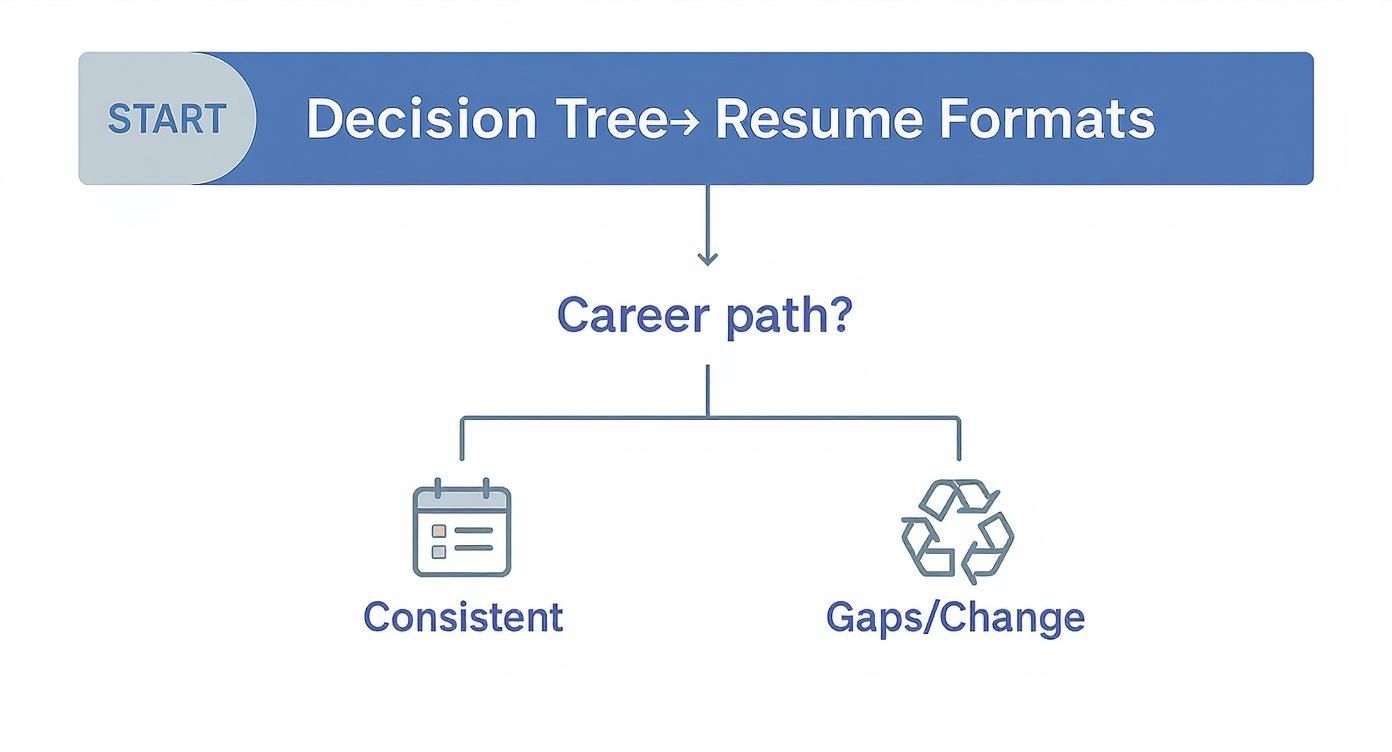
As you can see, a chronological format is perfect for a steady career progression, while a functional or hybrid approach can better serve those changing fields or navigating career gaps.
Adding Optional Sections for a Competitive Edge
Got relevant experience that doesn't fit neatly into the main sections? Don't leave it out. Optional sections can give your resume a serious boost, especially for students, career changers, or people in project-heavy fields.
A few powerful additions to consider:
- Projects: Detail any significant academic, personal, or freelance projects. Explain the goal, your role, the skills you used, and the final outcome.
- Certifications & Licenses: List industry-relevant certifications that boost your credibility. Include the certification name, the organization that issued it, and the date.
- Publications or Presentations: If you’ve written articles, spoken at conferences, or been published, this section positions you as an expert.
- Volunteer Experience: This is great for demonstrating key soft skills like leadership or community involvement, especially if it’s relevant to the job.
These bonus sections add another layer of proof and can be the detail that sets you apart from a stack of similar resumes. And don't forget to weave in relevant terms from the job description here, too. For a deeper dive, check out our guide on resume keywords that get you hired.
Getting Past the Robots and Wowing the Humans
Before a recruiter ever lays eyes on your resume, it has to get past a critical gatekeeper: the Applicant Tracking System (ATS). This is the software that scans your resume for keywords and qualifications that match the job description. If it doesn't find what it's looking for, your application gets tossed into a digital black hole. No human ever sees it.
That's the first half of the battle. The second half is actually impressing the person who finally reads your resume. They aren't just scanning for keywords; they're searching for proof that you can deliver real value. This is where quantifying your impact—using numbers to show what you can do—becomes your secret weapon.
The Job Description is Your Cheat Sheet
Seriously, think of the job description as the answer key to the test. It contains the exact phrases and skills the ATS is programmed to find. Your first job is to put on your detective hat and pull those keywords out.
Read the job posting carefully. Highlight every term that pops up more than once related to skills, software, responsibilities, and qualifications. Don't just skim it. For a deeper dive into this, check out our complete guide on how to create an ATS-friendly resume.
Let's imagine you're going for a "Digital Marketing Specialist" role. The description is likely full of gems like these:
- SEO and SEM strategies
- Google Analytics and Google Ads
- Content creation for social media
- Lead generation and conversion funnels
- A/B testing and campaign optimization
These are your golden keywords. Your mission is to weave them naturally into your summary, experience section, and skills list. This tells the ATS you're a perfect match before a recruiter even has to think about it.
Stop Listing Duties. Start Showing Impact.
Here’s one of the most common mistakes I see: resumes that just list job duties. A hiring manager already knows what a project manager does. What they need to know is what you accomplished as one. This is the critical shift from listing responsibilities to showcasing quantifiable achievements.
Every single bullet point on your resume should answer the question, "So what?"
You managed a project… so what? You ran a social media campaign… so what? The answer almost always comes down to a number.
Your resume should read less like a boring job description and more like a collection of your greatest hits. Each bullet point is a mini-story about a problem you solved, with a measurable outcome.
This simple change in perspective is what separates a good resume from a truly great one. It’s the difference between saying "I was part of the team" and "I drove the results."
The Simple Formula for Achievement-Driven Bullets
You don't need to be a data analyst to find the numbers that will make your resume pop. Just think about your work in terms of money, time, or volume. Did you make the company money? Did you save the company time? Did you handle a large volume of something efficiently?
Use this simple formula as your guide: Action Verb + What You Did + Measurable Result.
This structure forces you to focus on the outcome. For example, instead of a vague statement like, "Improved the reporting process," you can get specific about what that actually meant.
- Before: Improved the reporting process for the sales team.
- After: Automated the weekly sales reporting process using new software, reducing time spent on manual data entry by 10 hours per week.
See the difference? The "after" version is powerful. It uses a strong verb, explains the task, and delivers a hard metric (10 hours) that makes the accomplishment feel real and impressive.
Finding the Numbers in Any Role
"But my job isn't about sales! I don't have numbers." I hear this all the time, and it's a total myth. Every role, from creative designers to administrative assistants, has quantifiable aspects. You just have to know where to look.
- For a Graphic Designer: Instead of "Created marketing materials," try "Designed 25+ unique assets for a product launch campaign that contributed to a 15% lift in user engagement."
- For an Administrative Assistant: Don't just say "Managed calendars." Use "Coordinated complex travel and schedules for 8 executives across 4 time zones, ensuring 100% on-time meeting attendance."
- For a Customer Service Rep: Instead of "Handled customer calls," write "Resolved an average of 60+ customer tickets daily with a 97% satisfaction rating, consistently exceeding team targets."
This approach proves your value, no matter your title. A recent analysis of over 18 million resumes found a shocking gap here. Only 10% of resumes included quantifiable results like percentages or cost savings. That number drops to a mere 5% for entry-level candidates. While 57% used action verbs, pairing them with concrete numbers is the step most people miss. You can learn more from the full resume study.
By adding metrics to your achievements, you immediately leap into the top tier of applicants who know how to communicate their worth.
Adding the Final Polish to Your Resume

You've done the heavy lifting—you've built a powerful resume, packed it with achievements, and optimized it for the bots. But before you even think about hitting "send," it's time for one last, critical step: the final polish.
Don't rush this. The smallest mistake at this stage can undo all your hard work, screaming a lack of attention to detail to a recruiter. Think of this as the final quality check before your most important marketing document goes public.
Proofread Like Your Job Depends on It (Because It Does)
A single typo can be all it takes for a recruiter to toss your resume. It sounds harsh, but in their world, an error-free document is the bare minimum. Your resume is the very first sample of your professional work.
Don't just rely on spell-check. It won't catch everything, like using "manger" instead of "manager."
A killer trick is to read your entire resume out loud, word for word. This forces you to slow down and you’ll instantly hear awkward phrases or catch words your eyes would normally skim over. Even better? Send it to a trusted friend or mentor. A fresh set of eyes is your best defense against errors you’ve gone blind to after staring at the document for hours.
Keep It Clean: Visual Consistency and Readability
A resume’s design should be professional, clean, and ridiculously easy to read. Visual clutter is a killer. Recruiters spend just a few seconds on their first scan, and you can't afford to make them work for it.
Your only goal here is to guide their eyes effortlessly to your most important qualifications.
- Pick a Professional Font: Stick to the classics. Think Calibri, Arial, Garamond, or Verdana. Keep the font size between 10-12 points for the main text.
- Give It Breathing Room: Use margins between 0.75 and 1 inch on all sides. That white space is crucial—it keeps the page from feeling cramped and overwhelming.
- Check Your Spacing: Use single or 1.5 line spacing. This makes your bullet points and paragraphs easy to scan, not a dense wall of text.
A visually balanced resume isn't just about looking pretty. It’s a sign of professionalism and shows you respect the reader's time. It proves you know how to present information clearly and effectively.
Name and Save Your File Like a Pro
This is another one of those small details that says a lot about your professionalism. A file named "Resume.pdf" is a recipe for getting lost in a recruiter’s chaotic downloads folder.
Use a clear, standardized naming convention. It’s simple.
YourName-Resume-JobTitle.pdf. For example, JaneDoe-Resume-MarketingManager.pdf. This is perfect. It's instantly identifiable and helps the hiring manager stay organized.
And always—unless the application specifically says otherwise—save and send your resume as a PDF. This locks in your formatting, guaranteeing the document looks exactly how you intended on any device. No weird layout shifts, no font issues.
Settling the One-Page vs. Two-Page Debate
Ah, the age-old question of resume length. The answer is actually pretty straightforward and boils down to one thing: your experience.
- One Page Is the Gold Standard: For the vast majority of people—students, recent grads, and professionals with less than 10 years of experience—a single page is the rule. It forces you to be ruthless, concise, and focus only on your most impressive, relevant achievements.
- Two Pages Can Work, But Only If…: If you're a senior-level executive, a professional in a highly technical field (like academia or science) with a long list of publications and projects, or have over a decade of directly relevant experience, two pages can be okay. The key word here is value. Every single line on that second page must add something significant.
Never, ever add fluff just to fill space. A powerful, jam-packed one-page resume will always beat a watered-down two-page document.
Answering Your Toughest Resume Questions
As you get closer to finalizing your resume, a few tricky questions always seem to pop up. Should you use a template? How do you explain that gap in your work history? Getting these last details right is often what separates a resume that gets a passing glance from one that lands you an interview.
Let's walk through some of the most common dilemmas job seekers run into. Think of these as the final checkpoints to make sure every single part of your resume is working for you.
Should I Use a Resume Template or Build My Own?
This is the classic debate, and honestly, the best answer depends on your eye for design and how well you know what recruiters are looking for. Templates can be a fantastic starting point. They give you a clean, professional layout right out of the box, so you don't have to stress about building a structure from scratch.
But here’s a word of caution: stay away from the flashy templates. Anything with complicated columns, graphics, or funky fonts is a recipe for disaster with Applicant Tracking Systems (ATS). Those systems love simple, single-column layouts they can read easily. If you grab a template, make sure it’s minimal and modern.
Building your own resume from scratch gives you total control, letting you tailor every pixel to your personal brand. But this route requires a good sense of design—things like spacing, alignment, and font pairing are crucial. A custom resume that’s poorly designed can look unprofessional in a hurry.
My Advice: Don't reinvent the wheel. Start with a simple, proven ATS-friendly template. Use it as your foundation, but then make it your own by customizing the content, fonts, and maybe a few minor layout details. You get the best of both worlds: a structure that works and a personalized feel.
How Do I Handle Employment Gaps?
First off, employment gaps are far more common than you think. They don't have to be a deal-breaker if you know how to frame them. The key is to be proactive and shift the story from "I wasn't working" to "Here's what I was accomplishing."
Your resume format can be a huge help here. A functional or combination format can work wonders, as it puts the spotlight on your skills and abilities rather than a strict chronological timeline. This immediately gets the recruiter focused on what you can do for them.
Next, you want to fill that space on your resume with productive activities. You can even add a dedicated section like "Professional Development" or "Independent Projects" to showcase what you were up to.
- Courses and Certifications: Show you were actively learning and upskilling.
- Freelance or Consulting Work: Prove you were still in the game, applying your expertise.
- Volunteer Experience: Highlight transferable skills like leadership, project management, and teamwork.
- Personal Projects: Showcase your initiative and genuine passion for your field.
By framing your time off as a period of growth, you turn a potential red flag into proof of your drive and commitment.
How Often Should I Update My Resume?
Your resume should be a living document, not something you only dig up when you’re desperate for a new job. I tell everyone to give it a refresh every six months, even if you’re perfectly happy where you are.
Why? It’s surprisingly easy to forget the exact numbers from a big project or the specific outcome of a major win. By adding new achievements while they’re still fresh, you ensure your resume is always an accurate, powerful snapshot of what you bring to the table. Plus, you never know when a dream job will pop up or a recruiter will slide into your DMs. Being ready means you never miss an opportunity.
Is It Okay to Use AI Tools Like ChatGPT?
Absolutely—as long as you understand their proper role. Think of AI tools as a brilliant assistant, but a terrible boss. They're fantastic for brainstorming strong action verbs, rewording a clunky bullet point, or getting a rough first draft of a professional summary when you're staring at a blank page.
But—and this is a big one—you have to meticulously review, edit, and inject your own personality into everything the AI spits out. Recruiters are getting sharp at spotting generic, AI-generated text. Your resume needs to sound like you. It needs to reflect your unique experiences and accomplishments. The AI doesn’t know the inside story of your big project or the specific culture of the company you’re applying to.
Use AI as a partner to get past writer's block or find a better way to say something, but never let it do all the thinking. The final product has to be authentically yours.
Ready to build a resume that gets past the bots and wows recruiters? ResumeShaperAI uses smart technology to help you write and format a professional, ATS-friendly resume in minutes. Get tailored content, optimized keywords, and a polished design so you can focus on landing your next interview. Create your winning resume today.
Article created using Outrank