
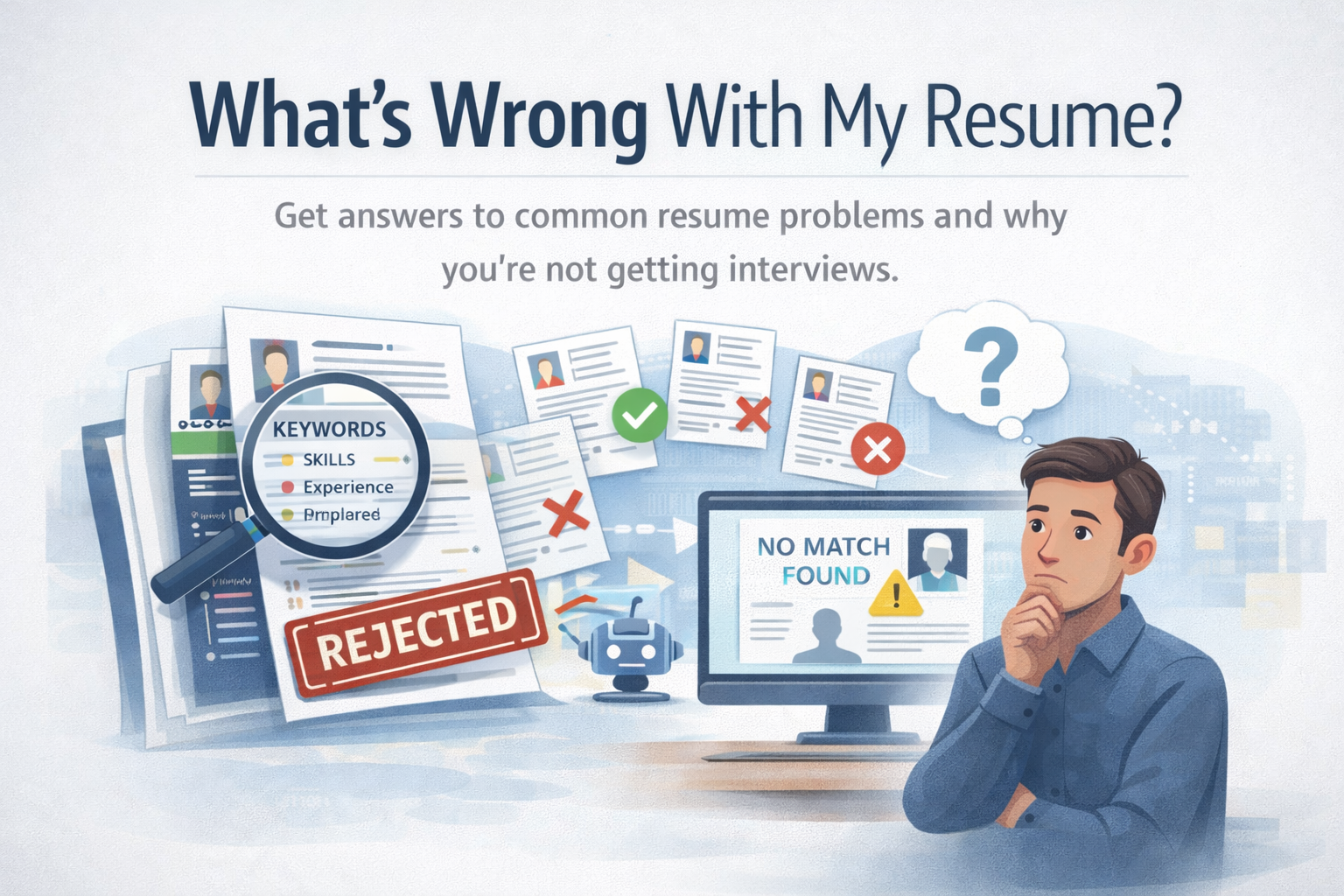
What’s Wrong With My Resume?
If you’ve ever stared at your resume and thought, “What’s wrong with my resume?” — you’re not alone.
This is one of the most common questions job seekers type into Google, often after dozens of applications and zero responses. And the frustrating part? Most resumes that don’t get interviews aren’t “bad” in the traditional sense. They’re usually misaligned, misunderstood, or structured in a way that hiring systems and recruiters don’t reward.
Let’s break down what’s actually going wrong — and why small, invisible issues often matter more than experience, education, or design.
“My Resume Looks Fine — So Why Am I Not Getting Interviews?”
This is the most misunderstood part of the hiring process.
Recruiters are not reading resumes the way candidates expect them to. They’re scanning for clarity, alignment, and immediate relevance — often in seconds. If those signals don’t show up quickly, the resume is skipped, even if the candidate is qualified.
Common reasons this happens include:
The resume doesn’t clearly match a specific role
Job titles don’t align with what employers are searching for
Experience is listed, but value isn’t obvious
The structure confuses both systems and humans
None of these mean you’re unqualified. They mean your resume isn’t being understood fast enough.
One of the Biggest Resume Problems: Role Confusion
One of the most common — and least talked about — reasons resumes get rejected is role ambiguity.
Most job seekers assume the goal of a resume is to show versatility. In reality, modern hiring works the opposite way.
Hiring systems and recruiters don’t evaluate resumes in isolation. They compare every resume against a specific job definition. That definition includes:
A clear job title
A known skill set
Expected experience patterns
Familiar language and structure
When a resume tries to appeal to multiple roles at once, it often fails to align strongly with any single one. As a result, it doesn’t rank well, doesn’t scan cleanly, and doesn’t feel immediately relevant.
Role ambiguity isn’t always obvious to the person writing the resume. It usually shows up in subtle but costly ways:
Vague headlines or summaries
Phrases like “Results-driven professional” or “Experienced team player” don’t signal what role you’re targeting. They delay clarity instead of creating it.Mixed or rotating job titles
Combining titles such as “Operations / Marketing / Administrative Lead” forces the reviewer to guess where you actually fit.Skills that span unrelated roles
When technical, creative, analytical, and managerial skills are all presented equally, none stand out as core.Experience that reads like a general work history
Listing everything you’ve ever done instead of highlighting what matters for this role makes the resume harder to evaluate quickly.
Recruiters and hiring managers work under time pressure. They skim before they read.
When a resume lacks a clear role signal, it creates friction. Instead of quickly answering:
“Can this person do this job?”
The resume forces the reviewer to stop and think:
“What role is this person actually going for?”
That moment of hesitation is often enough for the resume to be set aside — not because the candidate is unqualified, but because the fit isn’t immediately obvious.
Why Applicant Tracking Systems (ATS) Struggle With Many Resumes

A very common Google search from frustrated job seekers is:
“Is my resume being rejected by ATS?”
In many cases, the answer is yes — but not for the reasons most people assume.
Applicant Tracking Systems (ATS) don’t wake up and randomly reject resumes. They don’t have opinions, emotions, or personal bias. What they do have is a ranking system.
Most ATS platforms work by comparing your resume to a specific job posting. They analyze how closely your resume matches the role based on structure, language, and relevance.
If your resume doesn’t rank high enough, it simply never surfaces to a recruiter.
No notification. No feedback. Just silence.
From the candidate’s perspective, this feels like rejection.
From the system’s perspective, it’s just math.
Low ranking usually isn’t caused by a lack of experience. It’s caused by a translation problem — the resume and the job posting aren’t speaking the same language.
This typically happens when:
Keywords don’t match how the role is defined
You may have the skills, but if they’re described differently than the posting, the system struggles to recognize the fit.Experience is written in generic language
Phrases like “responsible for” or “worked on” don’t clearly map to role-specific outcomes or responsibilities.Job titles don’t align cleanly with the posting
Internal or creative titles can confuse systems that expect standardized role names.Important skills are buried or implied
If a key skill is hidden in a paragraph or assumed rather than stated directly, it may never be counted.
Many job seekers respond by cramming keywords into their resumes. This often backfires.
ATS systems look for relevance and alignment, not repetition. Overloading a resume with disconnected keywords can actually reduce clarity and hurt rankings.
The goal isn’t to trick the system.
It’s to mirror the role’s language in a natural, structured way.
Strong resumes don’t fight ATS systems — they work with them.
When your resume uses the same terminology, phrasing, and structure as the job posting, it becomes easier for the system to understand and easier for a recruiter to trust.
The issue usually isn’t that your resume is bad.
It’s that it’s not being interpreted correctly.
Once the language aligns, resumes stop disappearing — and start getting seen.
“My Experience Is Strong — Why Doesn’t It Show?”
What Job Seekers Often Miss
Another very common — and very frustrating — question job seekers ask is:
“Why doesn’t my resume reflect my experience?”
In most cases, the experience is there. The problem isn’t a lack of qualifications — it’s that the presentation is working against you.
Resumes aren’t read like biographies. They’re scanned quickly, often under time pressure, and compared against a mental (or system-driven) checklist of what the role should look like.
Even highly qualified candidates can appear underwhelming when their experience is framed the wrong way. This usually shows up in a few predictable patterns:
Tasks instead of outcomes
Listing what you were responsible for doesn’t show what changed because of your work. Recruiters look for results, not just activity.Responsibilities without impact
Saying you “managed,” “supported,” or “assisted” something doesn’t explain why it mattered or how well it was done.Internal company language
Many resumes rely on internal tools, acronyms, or role labels that make sense inside one organization — but mean nothing to an outside reader.Dense paragraphs instead of scannable sections
Long blocks of text slow the reader down. When information isn’t easy to scan, it’s often skipped.
Recruiters aren’t trying to decode or interpret your career. They’re trying to recognize it quickly.
Within the first few seconds, they’re asking:
What role is this person aligned with?
What level are they operating at?
What problems have they solved?
Do their results resemble what this role needs?
If the answers aren’t obvious right away, the resume feels risky — even if the candidate is capable.
A resume isn’t a complete record of your career. It’s a highlights reel.
If your accomplishments aren’t clear during a quick scan, they might as well not exist. Not because they lack value — but because they weren’t made visible in time.
The strongest resumes don’t hide experience inside explanations.
They surface it clearly, quickly, and in language others immediately understand.
That’s when experience finally shows up the way it should.
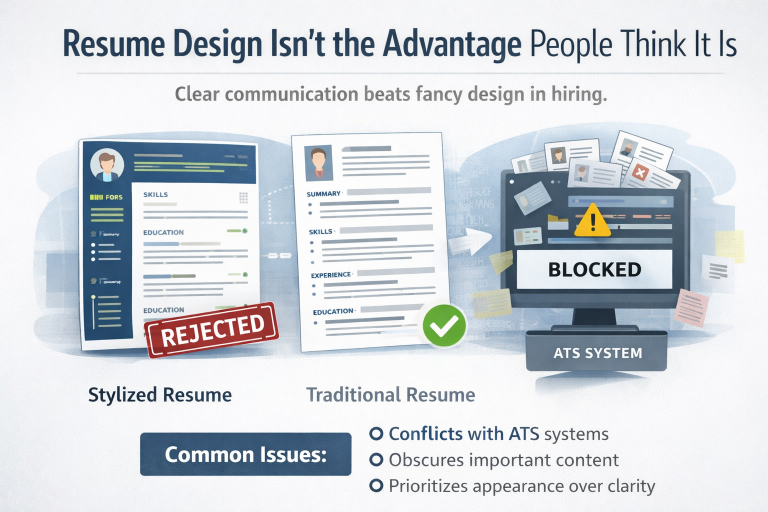
Resume Design Isn’t the Advantage People Think It Is
Many candidates worry about whether their resume looks good enough.
Fonts. Colors. Layout. Visual polish.
But in reality, design rarely improves interview chances — and in some cases, it actively works against them.
Modern hiring isn’t driven by aesthetics. It’s driven by clarity, structure, and role alignment.
Highly designed resumes often introduce issues that job seekers don’t realize until it’s too late.
Common problems include:
ATS confusion
Complex layouts, columns, icons, and graphics can interfere with how applicant tracking systems read and interpret content.Hidden or fragmented information
Important skills or experience placed inside icons, sidebars, or visual blocks may never be parsed correctly.Distraction from relevance
Visual elements pull attention away from what recruiters actually scan for: titles, skills, outcomes, and alignment.Style over substance
A resume can look impressive while still failing to answer the most important question:
Is this person a clear fit for this role?
Most recruiters favor clean, predictable resume layouts.
Not because they’re boring — but because they’re efficient.
Simple formatting allows recruiters to:
Find key information quickly
Compare candidates consistently
Trust that nothing important is hidden
When information is easy to locate, decisions happen faster.
A resume’s job isn’t to impress visually.
It’s to communicate fit.
If a resume looks great but doesn’t clearly show how your experience aligns with the role, it won’t perform well — regardless of how polished it appears.
The strongest resumes feel familiar, readable, and role-focused.
That’s what gets them ranked, read, and remembered.
Why “One Resume for Every Job” Usually Fails
A very common — and very costly — resume mistake is relying on one resume for every job application.
Years ago, this approach made sense. Hiring was slower, applicant pools were smaller, and resumes were read more carefully by humans.
Today, that same strategy is one of the fastest ways to get ignored.
Modern hiring relies heavily on ATS ranking systems and fast recruiter scans. Both are designed to evaluate resumes against a specific job posting, not against your overall career.
Even when two roles share the same title, they are rarely defined in exactly the same way.
Each job posting emphasizes:
Different resume keywords
Tools, skills, and terminology vary from company to company.Different priorities
One employer may value leadership, another execution, another technical depth.Different interpretations of similar roles
A “Project Manager” at one company may look very different at another.
When a resume doesn’t reflect how that specific role is defined, ATS systems struggle to rank it accurately — and recruiters struggle to quickly see the fit.
When the same resume is sent everywhere, a few things typically happen:
Keyword alignment weakens
Role signals become diluted
Important experience blends into generic language
The resume may be accurate — but it doesn’t feel relevant.
As a result, ranking drops, visibility decreases, and the resume never reaches a human.
This is where many job seekers get discouraged.
Tailoring a resume does not mean starting from scratch each time.
It means restructuring and re-emphasizing what’s already there.
Effective tailoring focuses on:
Adjusting the headline and summary to match the role
Reordering skills so the most relevant ones appear first
Highlighting experience that mirrors the job posting’s priorities
Using the same language the role uses to describe similar work
The experience doesn’t change.
The signals do.
ATS systems and recruiters reward clarity.
When the right information is front and center, resumes rank higher, scan faster, and feel easier to trust.
A single, generic resume tries to speak to everyone — and ends up connecting with no one.
A role-aligned resume speaks clearly to one job at a time — and that’s what gets interviews.
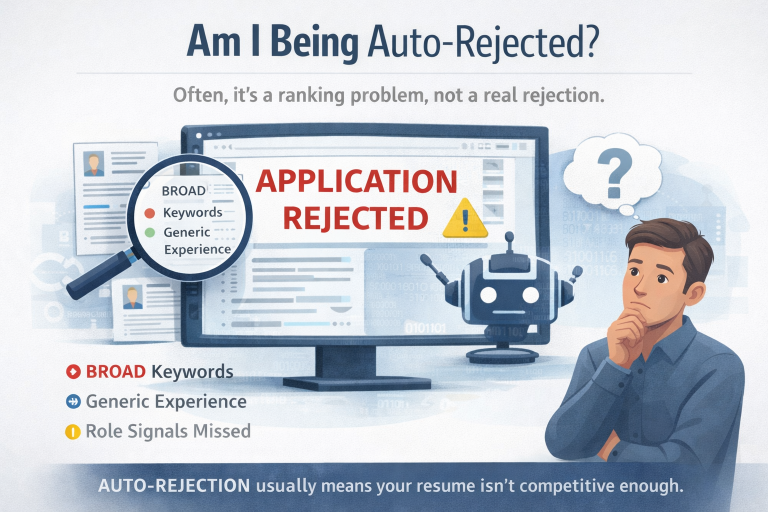
“Am I Being Auto-Rejected?”
Many job seekers ask this question after experiencing instant rejections — or worse, complete silence.
It’s easy to assume something is wrong with your background or experience.
In reality, that’s rarely the case.
Most resumes aren’t being actively rejected.
They’re simply not competitive enough in ATS ranking to be seen.
Applicant Tracking Systems don’t make emotional decisions. They rank resumes based on how closely they align with a specific job posting.
When a resume doesn’t rank high enough, it never reaches a human reviewer.
From the outside, it looks like rejection.
From the system’s perspective, it’s just filtering.
Low ranking often comes down to structure and clarity, not capability.
This typically happens when:
Role-specific signals are missing
The resume doesn’t clearly indicate which role it’s targeting.Keywords are too broad or generic
General terms don’t map well to how the job is defined.The first half of the resume doesn’t show fit
Recruiters and systems prioritize what they see first.The structure doesn’t match how resumes are scanned
Important information may be buried or ordered poorly.
Even strong experience can be overlooked when these elements aren’t aligned.
Auto-rejections feel personal — but they’re usually mechanical.
The system isn’t judging your worth or potential.
It’s comparing signals.
When those signals are unclear, incomplete, or misaligned, the resume loses visibility.
Most auto-rejections are structural problems, not personal ones.
Once a resume clearly communicates role alignment, uses the right language, and presents information in a predictable way, rankings improve — and resumes stop disappearing.
Visibility comes before evaluation.
And structure is what creates visibility.
The Question You Should Be Asking Instead
Many job seekers spend weeks asking:
“What’s wrong with my resume?”
That question feels natural — but it often leads people in the wrong direction. It encourages endless tweaking, over-editing, and self-doubt.
A more useful question is this:
“Does my resume clearly explain why I’m a fit for this specific role?”
That single shift changes everything.
Hiring systems and recruiters aren’t looking for perfect resumes.
They’re looking for clear matches.
When a resume is reshaped around one role, it becomes easier to:
Rank accurately in ATS systems
Scan quickly by recruiters
Trust as a realistic hire
The experience doesn’t have to change.
The clarity does.
When resumes are adjusted to answer the fit question directly, interview rates often improve — without adding new experience or credentials.
That’s because the resume stops trying to tell a full career story and starts doing its real job:
Showing relevance
Reducing uncertainty
Making alignment obvious
Recruiters don’t need every detail.
They need enough clarity to move forward.
Fixing a resume rarely requires rewriting your entire career.
Most improvements come from:
Adjusting headlines and summaries
Reordering skills and experience
Using role-specific language
Highlighting the most relevant accomplishments
The substance stays the same.
The framing changes.
Resumes that focus on role alignment feel easier to evaluate. They reduce friction, increase confidence, and help systems and humans reach the same conclusion faster.
It’s not about fixing what’s “wrong” with you or your background.
It’s about making the fit obvious.
And when fit is clear, interviews follow.
Final Thoughts: It’s Not You — It’s the Resume Signals
If your resume isn’t getting interviews, it doesn’t mean you’re unqualified, behind, or failing.
It usually means:
Your resume isn’t aligned tightly enough to the role
The structure hides your strengths
The language doesn’t match how hiring systems evaluate candidates
These are fixable problems.
When resumes are built around clarity, relevance, and role alignment, they stop getting silently skipped — and start getting noticed.
f you’re asking “What’s wrong with my resume?”, chances are you’re also wrestling with other questions most job seekers never get clear answers to.
That’s why we’ve broken this topic down further across related guides — each one tackling a different part of the hiring process that quietly blocks qualified candidates.
If your resume feels fine but interviews still aren’t happening, these next reads will help connect the dots 👇
🔍 Related Reads for Job Seekers
Why Is My Resume Getting Rejected?
A deeper look into the most common (and least explained) rejection triggers — from ATS ranking issues to recruiter skim behavior — and why many resumes fail without obvious errors.
Why Qualified Candidates Aren’t Getting Interviews
Explores how hiring systems, job volume, and role misalignment affect even experienced professionals — and why applying more often usually makes things worse, not better.
How Interviews Are Really Decided (What Job Seekers Rarely See)
An inside look at what actually happens after you apply — how resumes are sorted, how candidates are shortlisted, and what separates “reviewed” from “ignored.”
AI Resumes vs Traditional Resumes: What Actually Works Today
Breaks down when AI helps, when it hurts, and how modern resumes are being evaluated in today’s hiring environment.