How Interviews Are Really Decided (What Job Seekers Rarely See)
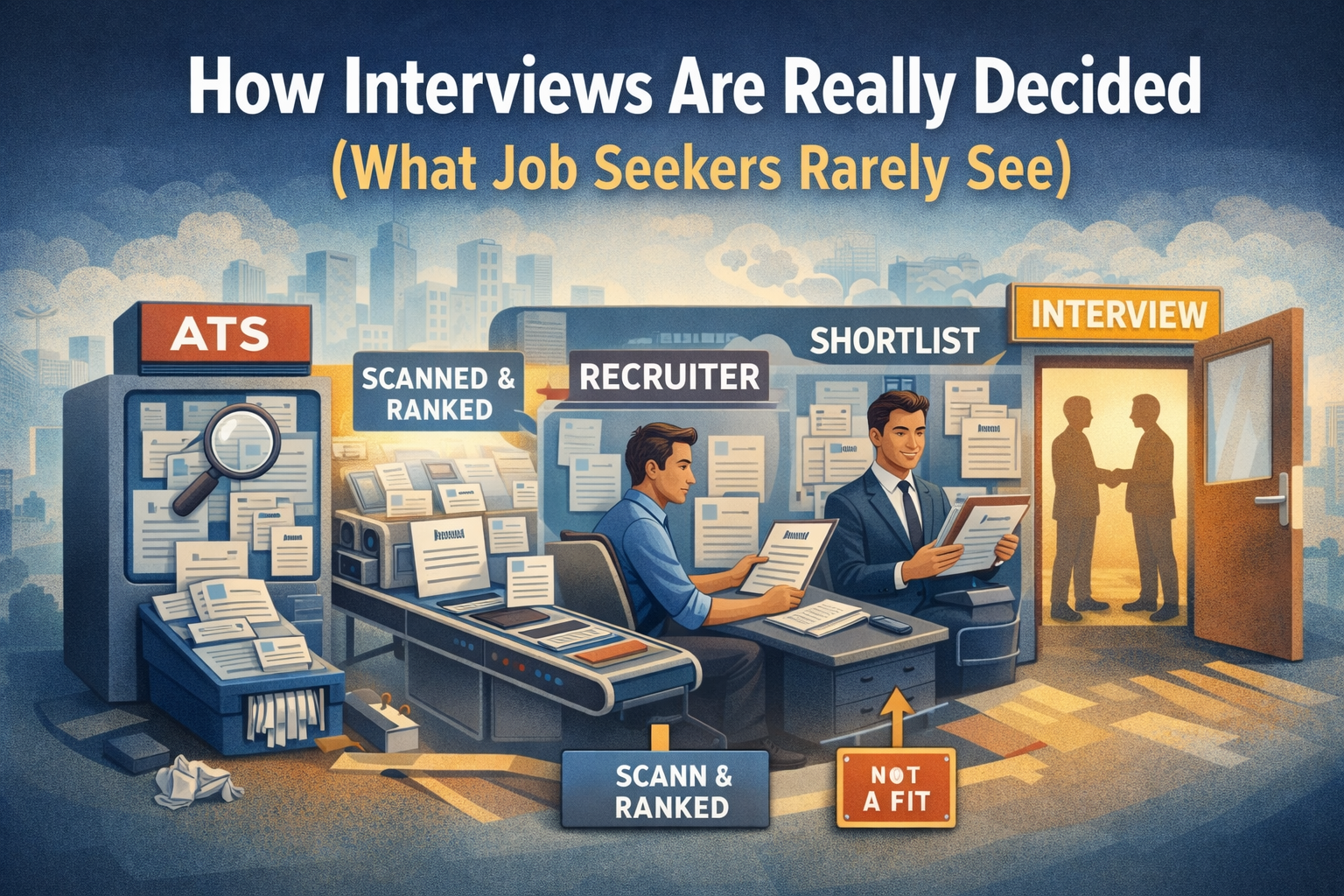
Illustration showing how interviews are decided, from ATS resume screening to recruiter review and final interview selection.

How Interviews Are Really Decided (What Job Seekers Rarely See)

If you’ve ever thought, “I’m qualified… so why didn’t I even get an interview?” — you’re not alone.

Most job seekers imagine interviews are decided after someone carefully reads every resume, compares candidates fairly, and selects the best people to talk to. That’s a comforting idea — but it’s not how the process usually works.

In reality, interviews are decided through a series of fast filters, shortcuts, and pattern-matching steps that happen long before a hiring manager ever considers who is “best.” Understanding how interviews are really decided can completely change how you view rejection — and how you approach your job search going forward.

Let’s pull the curtain back. 🎭

Interviews Aren’t Chosen — They’re Filtered

The first thing to understand is that interviews don’t start with selection. They start with elimination.

When a job opens, the hiring team isn’t asking, “Who should we interview?”
They’re asking, “How do we reduce this list as fast as possible?”

With hundreds of applications coming in, the goal becomes narrowing the pool down to something manageable. Interviews are simply what’s left after several rounds of filtering.

That means many candidates aren’t rejected because they’re unqualified — they’re rejected because they didn’t survive the filters.

If you’ve ever wondered what actually happens after you click apply, it helps to understand how interview decisions are really made. From ATS filters to recruiter shortlists, most choices happen long before a conversation ever starts.


f you’re wondering why being qualified still doesn’t lead to interviews, the answer often lies in how decisions are actually made. Understanding the filtering process helps explain why strong candidates are screened out early.


👉 Read next: Why Qualified Candidates Aren’t Getting Interviews

Illustration showing a qualified job seeker holding a resume while hiring filters reject applications based on fit, clarity, and perceived risk.

Step 1: The Application Flood 🌊

Once a job is posted, applications begin pouring in almost immediately. Within days — sometimes hours — recruiters are already overwhelmed.

At this stage:

  1. No one is deeply comparing candidates

  2. No one is ranking people by talent

  3. No one is reading resumes carefully

The focus is volume control.

This is why timing, clarity, and alignment matter more than people realize. By the time many candidates apply, the mental model of a “good fit” may already be forming.

Step 2: ATS Sorting (Before Any Human Looks)

Before a recruiter ever sees your resume, it’s usually reviewed by an applicant tracking system, often called an ATS.

This step plays a major role in how interviews are decided, yet many job seekers don’t realize it’s happening at all.

At this stage, the system isn’t evaluating your potential, experience depth, or work ethic — it’s simply organizing and sorting resume data so humans can manage the volume.

Applicant tracking systems scan for things like job titles that closely match the role, resume keywords that align with the job description, and clear work history with consistent dates.

They also rely heavily on resume formatting and structure, since poorly formatted resumes can be difficult for ATS software to read correctly.

If your resume doesn’t clearly fit into the categories the system expects, it may never reach a recruiter’s inbox — even if you’re fully qualified and capable of doing the job.

This behind-the-scenes filtering is one of the biggest reasons qualified candidates aren’t getting interviews and why so many people search for how interviews are really decided.

In many cases, the decision to move forward or filter a resume out happens automatically, without any human involvement at all 🤖 — which explains why the process can feel confusing, impersonal, and frustrating for job seekers.


Step 3: The Recruiter’s First Scan (Seconds, Not Minutes ⏱️)

When a recruiter opens a resume, the first review happens incredibly fast — often in just a few seconds. During this initial scan, they are not trying to figure out how smart you are, whether you could grow into the role, or how successful you might be long term.

Instead, recruiters are quickly checking a few key things:

  1. Does this resume look similar to candidates who have succeeded in this role before?
  2. Is the role alignment obvious without having to think too hard?
  3. Is there anything that immediately signals “no” or raises concern?

At this stage, job titles, recent experience, and overall clarity matter the most. If a resume requires interpretation or extra effort to understand, it’s at a disadvantage — not because it’s bad, but because recruiters are working under tight time constraints and heavy application volume.

Not getting interviews can feel personal, especially when you know you meet the requirements. Seeing the bigger picture of how candidates are filtered can make the process feel less confusing — and less discouraging.


👉 Continue reading: Why Qualified Candidates Aren’t Getting Interviews

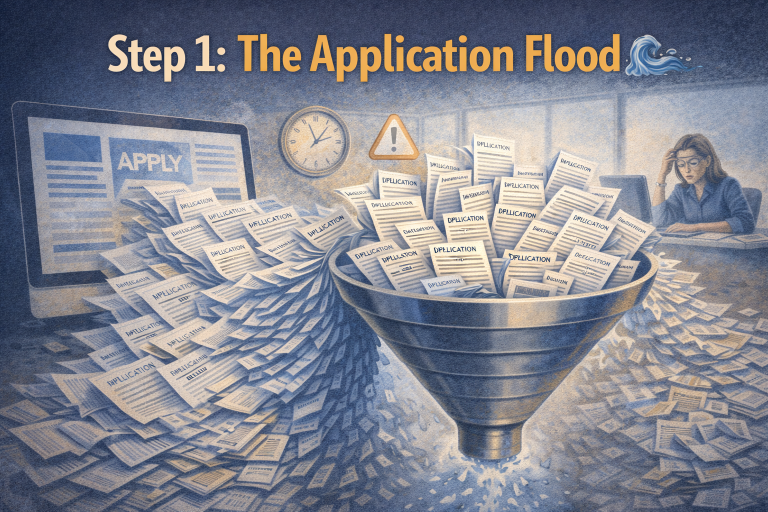
Illustration showing hundreds of job applications flooding into a hiring system, overwhelming recruiters before interviews are decided.

Step 4: Shortlisting Is About Familiarity

Contrary to popular belief, shortlisting candidates for interviews isn’t usually about identifying the single “best” person for the job.

In practice, interview decisions are often driven by familiarity — recruiters and hiring managers tend to gravitate toward resumes that look similar to previous hires or match the backgrounds they already expect.

This is an important reality many job seekers miss when searching for interview tips or trying to understand how interviews are decided.

Because of this, candidates with more traditional or predictable career paths often move forward more easily, while career switchers, cross-industry applicants, or those with unconventional experience may be overlooked — even when they’re fully qualified.

This helps explain why candidates don’t get interviews despite strong experience, and why interviews frequently go to resumes that feel safe and familiar rather than those that are truly exceptional.

Step 5: Hiring Managers Narrow Further 🧠

Once resumes reach a hiring manager, the filtering process doesn’t stop — it actually becomes more selective. At this point, the main question isn’t “Who is the most talented?” but “Who do I want to spend time interviewing?”

This is an important part of how interviews are really decided, and it often surprises job seekers.

Hiring managers usually have only a few interview slots available.

They aren’t trying to explore every possible option or take chances on unfamiliar backgrounds.

Instead, they’re focused on confirming a short list of candidates who already feel like a safe fit for the role.

Because of this, hiring managers tend to favor candidates who have done very similar jobs before, used familiar tools or systems, and followed a career path that’s easy to understand at a glance.

If your background needs extra explanation — even if you could perform just as well — your resume may be passed over.

This is one of the most common reasons qualified candidates don’t get interviews, and a key insight many people miss when looking for interview tips or trying to understand the hiring process.

Interviews Are About Risk Reduction, Not Curiosity

This is an uncomfortable truth for many job seekers.

Interviews are not invitations to discover your full potential. They are risk-reduction steps.

Hiring teams ask:

  • Will this person meet expectations quickly?

  • Does this hire feel safe and defensible?

  • Will this choice be easy to explain internally?

That’s why interviews often go to candidates who already look like they belong, rather than those who might grow into the role.

Illustration of a recruiter shortlisting resumes that look familiar while rejecting others that don’t match expected backgrounds.

Why “Qualified” Isn’t Enough 😕

Many job seekers struggle because they believe being qualified should automatically lead to job interviews. It’s a common assumption — but in reality, qualification alone is only a small part of how interviews are decided.

When it comes to getting job interviews, hiring teams and systems are looking for more than ability. Your resume needs to check several boxes quickly:

  • Fit expected patterns: Your background should resemble what recruiters and hiring managers are used to seeing for that role.

  • Be easy to categorize: Applicant tracking systems and recruiters need to instantly understand where you fit.

  • Match how the role is defined: Your experience should line up closely with the job description’s language and focus.

  • Reduce perceived hiring risk: Clear, familiar experience feels safer than something that requires extra explanation.

If any of these pieces are unclear, the interview decision may never happen — even if you’re fully capable of doing the job. This is one of the main reasons qualified candidates don’t get interviews, and an important insight for anyone searching for practical interview tips or trying to understand why the hiring process works the way it does.

Why Rejection Feels So Personal (But Isn’t)

When interviews don’t come, it’s easy to internalize rejection.

But most interview decisions are not judgments of intelligence, work ethic, or value. They are decisions made under time pressure, uncertainty, and imperfect information.

You’re often being filtered out by:

  1. Systems trying to manage volume

  2. Humans making fast decisions

  3. Processes designed for efficiency, not fairness

Understanding how interviews are really decided doesn’t make rejection fun — but it does make it less personal.

The Big Picture: Interviews Are a Byproduct

Interviews aren’t actually the main goal of the hiring process — they’re the result of making it through multiple filters. Once you understand that, the entire job search starts to make more sense.

Here’s what changes when you see interviews this way:

  • Rejection feels less confusing because you realize many decisions happen before a human truly evaluates you.

  • The process feels less random when you understand how systems and screeners narrow candidates quickly.

  • You stop blaming yourself as much because filtering is often about efficiency, not ability.

Getting job interviews isn’t about proving how impressive you are. It’s about making your fit clear, obvious, and easy to recognize — as quickly as possible.

If you’re qualified but not getting interviews, it doesn’t mean you’re doing everything wrong.

It means you’re navigating a system that rewards clarity, familiarity, and alignment over nuance and potential.

Understanding how interviews are decided gives you something powerful — perspective. And perspective is the first step toward navigating the process without burning out or losing confidence.

Interviews don’t happen by accident — they’re the result of surviving multiple filters. If you’re qualified but still not getting interviews, understanding the full process can change how you approach your job search.


👉 Read next: Why Qualified Candidates Aren’t Getting Interviews

Visit our Free AI Tools Here!

Leave A Comment

Your email address will not be published. Required fields are marked *

ResumeShaperAI is your all-in-one AI-powered career tool designed to help job seekers create professional, ATS-friendly resumes and cover letters in minutes. Our mission is to simplify the job search process with smart automation and beautifully designed templates.

Made by ResumeShaperAI. All Rights Reserved 2026.