
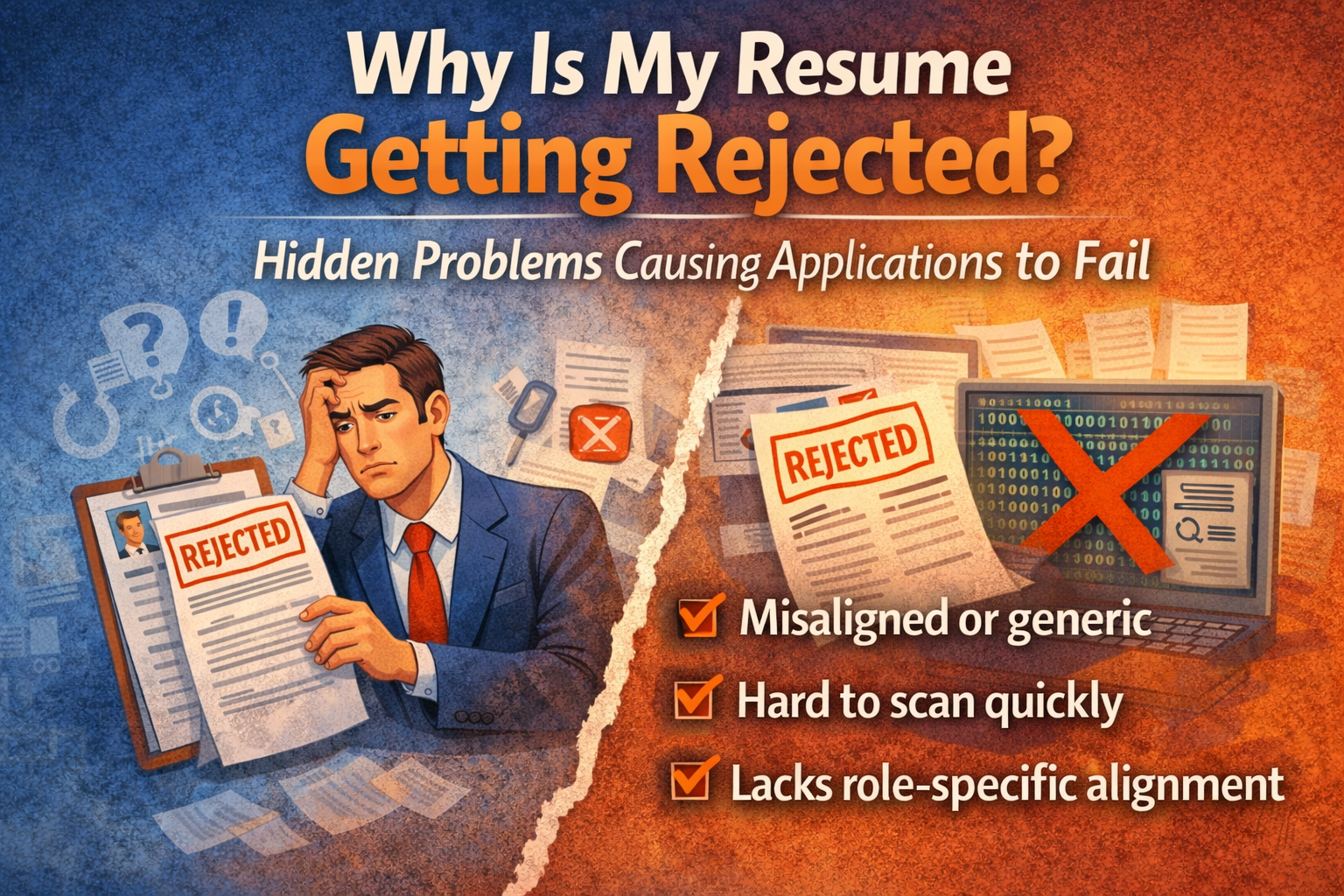
Why Is My Resume Getting Rejected?
Over 75% of resumes never make it to a recruiter’s desk.”
This is based on multiple recruiting and ATS usage analyses showing that the majority of job applications are filtered out early in the process, often before a human reviewer sees them.
If you’re applying to jobs you’re qualified for — sometimes overqualified for — and still not getting interviews, it can feel confusing, discouraging, and personal.
But here’s the truth most hiring advice doesn’t say clearly enough:
Resume rejection is rarely about your ability.
It’s almost always about how your resume is being interpreted — by systems, by recruiters under pressure, and by processes designed for speed, not fairness.
This article explains why resumes get rejected, how the process actually works, and what’s most likely happening when your application disappears into silence.
A rejected resume is not a judgment of your intelligence, work ethic, or potential.
It’s a snapshot of how well a document matched:
A specific job definition
A specific screening system
A specific recruiter’s expectations
A specific moment in a crowded pipeline
Two equally strong candidates can submit resumes on the same day — and only one gets an interview. Not because one is better, but because one was easier to rank, scan, and categorize. For most candidates, the real challenge isn’t performing in a job interview — it’s getting invited to one in the first place.
Understanding why that happens is the first step to fixing it.
If you’ve ever wondered what actually happens after your resume is submitted, this process is broken down step by step in How Interviews Are Actually Decided.
Is my resume being rejected by a human or a system?
This is one of the most common questions job seekers ask — and the answer is usually:
Both, but not in the order you think.
In most hiring processes today:
Your resume is parsed and categorized by an ATS (Applicant Tracking System)
It’s ranked or filtered based on role alignment
Only a small percentage are ever seen by a recruiter
Recruiters then skim, not read, for fast confirmation
Many candidates prepare extensively for the job interview without realizing their resume never passed the screening process required to get there. If your resume doesn’t pass the system stage, no human ever evaluates your experience.
If it does pass the system but fails the skim stage, it’s often because the role match wasn’t immediately obvious.
Why do I keep getting rejected even though I meet the requirements?
Meeting the requirements and looking like the right match are not the same thing.
Hiring systems and recruiters don’t ask:
“Can this person do the job?”
They ask:
“Does this resume clearly match how this job is defined?”
Here’s where many strong candidates get filtered out:
1. The resume is too broad
Applying broadly feels productive, but it often backfires.
When your resume tries to speak to:
Multiple roles
Multiple industries
Multiple seniority levels
…it stops signaling a clear match for any one role.
Hiring systems struggle to categorize it. Recruiters struggle to quickly understand where you fit. And unclear resumes lose to precise ones — even when the candidate is more capable.
2. The job title mismatch problem
Job titles act as shorthand in hiring.
Even when two roles are functionally similar, titles help systems and recruiters infer:
Seniority level
Career progression
Role alignment
For example:
“Operations Coordinator” vs “Business Operations Analyst”
“Customer Support Specialist” vs “Customer Success Manager”
If your resume doesn’t reflect the language of the role you’re applying to, it may be filtered out before your experience is fully considered.

Is my resume failing ATS scans?
Possibly — but not for the reasons most people think.
ATS systems don’t reject resumes because:
They aren’t “optimized enough”
They lack buzzwords everywhere
They weren’t built by a specific tool
They do struggle when resumes:
Lack clear role signals
Mix unrelated responsibilities
Use vague or generic phrasing
Don’t align with the job’s core competencies
Think of ATS systems less as “robots” and more as categorization engines. If your resume can’t be confidently categorized, it’s often excluded.
Why do recruiters skim my resume but don’t call me back?
One of the biggest misunderstandings jobseekers have is assuming recruiters carefully read resumes from top to bottom.
They don’t.
In most hiring workflows, resumes are scanned, not studied—especially in the early stages. Recruiters are often reviewing dozens or even hundreds of applications for a single role. That reality changes how resumes are evaluated.
Instead of reading every line, recruiters are scanning for a few critical signals within the first 5–10 seconds.
The most common resume rejection triggers:
Generic summaries
Phrases like “results-driven professional” don’t help systems or humans understand your role.
• One resume for every job
Efficiency feels smart. In hiring, precision wins.
• Skills without context
Lists of skills mean less than where and how they were used.
• Career pivots without framing
Changing roles isn’t a problem. Not explaining the transition clearly is.
• Overloading achievements
More bullet points don’t equal more clarity.
Should I apply more to increase my chances?
This is another common question jobseekers ask—and one of the most painful.
When rejections pile up, the natural response is to apply more.
More roles.
More industries.
More variations of the same job.
It feels productive. It feels logical. And emotionally, it feels like taking control.
But in practice, this approach often reduces interview rates, not improves them.
Most candidates don’t realize that applying broadly changes how their resume is interpreted.
When one resume is used across many different roles, subtle but important signals disappear.
Resumes become more generic, because they’re trying to fit too many job descriptions at once.
Role-specific alignment fades, making it harder for hiring systems and recruiters to understand what position you’re actually targeting.
Behind the scenes, ATS systems struggle to rank the profile, because the resume no longer closely matches a single job definition.
And when a recruiter opens the application, they often don’t see a clear fit quickly enough to move forward.
None of this means the candidate lacks experience.
It means the resume lacks focus.
Is my resume rejected because I’m underqualified or overqualified?
Sometimes. But more often, it’s because the resume doesn’t signal the right level clearly.
If your resume:
Shows senior responsibilities for a mid-level role
Or entry-level framing for a senior role
…it may be filtered out automatically.
Hiring teams want clarity:
“Is this person exactly at the level we’re hiring for?”
Ambiguity often leads to rejection, even when capability is there.

The part no one says out loud
You can do everything “right” and still be rejected.
You can be talented and still be overlooked.
That doesn’t mean you stop trying.
It means you stop blaming yourself — and start adjusting to how the system actually works.
A resume isn’t a biography.
It’s a positioning document.
And once you see it that way, rejection becomes feedback, not failure.
If your resume keeps getting rejected:
It’s not proof you’re unqualified
It’s a signal that alignment is missing.
It’s an invitation to refine, not give up.
Related Reading: Understand the Hiring Process Better
If you’re trying to figure out why applications keep going nowhere, these articles break down what’s really happening behind the scenes:
Why Candidates Aren’t Getting Interviews
A deep dive into how hiring systems and recruiters decide who moves forward — and why many qualified applicants never hear back.How Interviews Are Actually Decided
What happens after your resume is submitted, how candidates are compared, and why timing and clarity matter more than most people realize.