

Deciding how many jobs to put on your resume can feel like a tricky balancing act. You want to show enough experience to be credible, but you don't want to overwhelm a hiring manager with a novel about your entire work history.
So, what's the magic number? For most people, the sweet spot is focusing on the last 10 to 15 years of experience, or your 3 to 5 most relevant positions. Think of your resume as a highlight reel, not a complete archive of every job you've ever had.
How Many Jobs Should Your Resume List?
The real goal here is to prioritize relevance over sheer quantity. Your resume is a marketing document, plain and simple. Its job is to convince a hiring manager—in just a few seconds—that you have the exact skills and background they're looking for.
Recent data backs this up. A 2024 analysis of resume trends found that the average resume listed about five jobs. One-page resumes typically had around four, while two-pagers included closer to six. That number also scales with experience, with junior folks listing four roles and senior professionals listing six. You can dig deeper into these resume statistics and what they mean for your job search.
To land on the right number for you, the two biggest factors are your career stage and how long your resume is.
To make this super clear, here’s a quick breakdown of what we recommend based on where you are in your career.
Recommended Job Count by Career Stage
| Career Level | Recommended Number of Jobs | Typical Resume Length |
|---|---|---|
| Entry-Level | 2–4 (incl. internships) | One Page |
| Mid-Career | 3–5 | One Page |
| Senior/Executive | 4–6 | Two Pages |
| Career Changer | 3–4 (most relevant) | One Page |
Ultimately, this table gives you a solid starting point. The key is to always tailor your resume for the specific role you’re targeting, ensuring every job you list adds clear and compelling value.
The 10 to 15 Year Rule for Resumes
A solid rule of thumb for deciding what to include on your resume is the 10 to 15 year rule. This guideline suggests keeping your work history focused on the last decade or so. Why? Because relevance is everything. Technology, industry standards, and best practices change fast, which means older experience often carries less weight with hiring managers.
Sticking to this timeframe helps you present a sharp, current skill set. It also serves a practical purpose: it cuts down on resume clutter and can subtly reduce the chances of age bias. Remember, recruiters spend just a few seconds on their initial scan, so every single entry needs to earn its spot by showing immediate value.
This decision tree shows how your strategy should shift depending on where you are in your career.
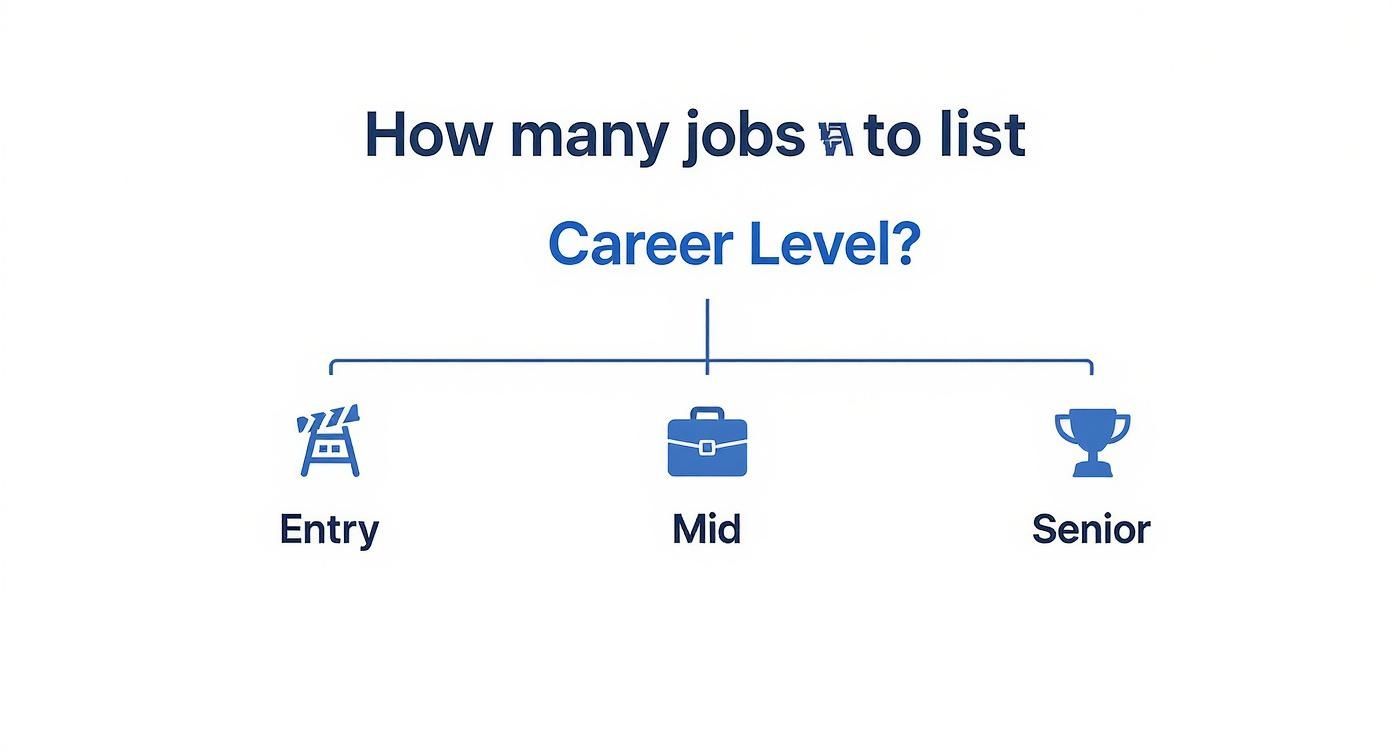
As you can see, the approach evolves. Early on, it’s about showcasing potential. Later, it’s all about proving sustained impact.
Of course, this rule isn't set in stone. If you have a game-changing accomplishment or a uniquely relevant role that falls just outside this window, it might be worth including. Still, the core principle holds true: keep the spotlight on your most recent and powerful contributions.
Why Job Relevance Beats Job Quantity
Let's get one thing straight: your resume isn't supposed to be your entire life story. Think of it as a highlight reel, a strategic marketing document designed to convince one person—the hiring manager—that you are the perfect fit for this specific job. This is where quality and relevance absolutely crush sheer quantity.
An overly long resume packed with every job you've ever had can actually do more harm than good. It buries your most impressive qualifications and signals that you haven't bothered to figure out what the employer actually needs. A tightly curated list, on the other hand, shows focus and a sharp understanding of the role.

Prioritize Roles That Align with The Job Description
The most effective way to decide how many jobs to list on your resume is to start with the job description itself. Read it, then read it again. Pinpoint the key skills, responsibilities, and qualifications they’re looking for. Now, go through your work history and pull out only the roles that directly prove you have that experience.
For example, if you're gunning for a project management position, you’ll want to showcase jobs where you:
- Led teams and owned project timelines.
- Managed budgets and allocated resources.
- Communicated with stakeholders to get things done.
That retail job you had in college? Unless you can spin it to show stakeholder communication, it's probably just cluttering up the page and weakening your main message.
This targeted approach isn't just a good idea; it's backed by data. Around 88% of hiring managers say work experience is the single most critical part of a resume, and they're looking for specific accomplishments, not a laundry list of past employers. What's more, 63% of recruiters prefer resumes that are obviously customized for the job. You can find more stats on what gets a resume noticed in this guide to resume statistics.
Key Takeaway: Every single entry on your resume needs to earn its spot. If a past role doesn't strengthen your case for the current opening, it's just noise. Your goal is to tell a compelling story that logically ends with you being the obvious choice for the role.
Tailoring Your Resume for Each Career Stage
Figuring out how many jobs to put on your resume isn't about hitting a magic number. The right answer changes dramatically depending on where you are in your professional journey. A recent grad’s resume has a totally different mission than a seasoned executive's, so your strategy needs to evolve right along with your experience.
An entry-level candidate is trying to prove potential and a solid work ethic. A senior leader, on the other hand, needs to showcase a long history of high-impact results. Deciding how many jobs to list on your resume is really about telling the most compelling story for your current career stage.
For Entry-Level and Recent Graduates
When you're just starting out, your goal is to showcase potential, drive, and any foundational skills you’ve picked up. You probably don't have a deep work history to pull from, and that’s perfectly fine. Here, it's all about quality over quantity.
- What to Include: Aim to list 2-4 relevant experiences. This can be a mix of internships, volunteer roles, part-time jobs, and even significant academic projects where you played a key role.
- Strategy: Don't just list what you did. Frame each role to highlight transferable skills that every employer wants—things like teamwork, problem-solving, and time management. Show what you accomplished, even if it feels small.
For Mid-Career Professionals
Once you're in the mid-career stage, your resume needs to tell a story of growth and increasing responsibility. Recruiters are looking for a clear pattern of progression and solid achievements.
- What to Include: Stick to your 3-5 most recent and relevant roles. Generally, this covers the last 10–15 years of your work history.
- Strategy: This is where you really want to emphasize promotions, major projects, and—most importantly—quantifiable results. Think: "Increased sales by 15% in six months." Older or less relevant jobs can be condensed or cut completely to keep the focus on your strongest, most recent contributions. This is a huge part of learning how to tailor a resume to a job description like a pro.
Pro Tip: Your mid-career resume should read like a highlight reel of your upward momentum. Each role should feel like it builds on the last, painting a clear picture of a professional who consistently takes on bigger challenges and delivers.
For Senior Leaders and Career Changers
For senior-level pros, the game changes again. The focus shifts entirely to leadership, big-picture strategy, and measurable business impact. Career changers, meanwhile, have the unique challenge of reframing past experiences to align with a brand-new industry.
- What to Include: List 4-6 high-impact roles that best define your leadership story. You can consolidate your earliest jobs into a brief "Early Career" section to save space.
- Strategy: Focus on executive-level achievements like P&L management, strategic planning, and team leadership. If you're changing careers, be ruthless about what you include—prioritize roles that demonstrate transferable skills directly relevant to your new target field.
Formatting Your Work History for Impact
How you present your work experience is just as crucial as what you decide to include. Think of your resume's format as the narrative structure of your career story—it guides the recruiter’s eyes and tells them what to focus on first. A smart layout makes your qualifications pop, while a confusing one can bury your biggest wins.
The question of how many jobs to list on your resume is directly tied to the format you choose. Each of the three main styles—chronological, hybrid, and functional—offers a unique way to frame your professional journey.
Chronological: The Industry Standard
This is the format everyone knows and most recruiters prefer. The reverse-chronological resume lists your jobs starting with the most recent one and going backward in time. It creates a simple, linear timeline of your career progression that’s incredibly easy to follow.
- Best For: Pretty much everyone, especially if you have a consistent career path without long or unexplained gaps.
- Why It Works: It's the layout hiring managers and Applicant Tracking Systems (ATS) are most familiar with. Your growth and recent contributions are front and center, making a clear case for your qualifications.
Hybrid: A Blend of Skills and History
A hybrid resume, sometimes called a combination resume, is a fantastic way to grab attention fast. It starts with a prominent skills summary or an "Areas of Expertise" section right at the top, immediately followed by a more streamlined chronological work history. This structure lets you showcase your most valuable abilities before a recruiter even glances at your job titles.
- Best For: Career changers, senior-level professionals, and anyone with specialized technical skills that need to be highlighted.
- Why It Works: It puts your most relevant qualifications first, giving the reader immediate context for the work experience that follows. You’re telling them what you can do before you show them where you did it. For a closer look, our complete resume formatting guide breaks down this structure with more examples.
Functional: A Cautionary Tale
The functional resume throws chronology out the window and organizes your experience entirely around skill sets. A very brief, often undated list of employers might appear at the bottom. While it might seem like a clever way to mask employment gaps or a non-traditional career path, it often backfires. Recruiters tend to be suspicious of this format because it can feel like you're hiding something.
Expert Tip: The functional resume almost always raises more questions than it answers. Unless you have a very specific reason and are working with a career coach who advises it, you're much better off sticking with a chronological or hybrid format to build trust with a hiring manager.
Choosing the right format is a strategic decision. Below is a quick comparison to help you decide which structure best aligns with your career story and the job you're targeting.
Resume Format Comparison for Listing Jobs
| Format Type | Best For Listing Jobs When… | Potential Drawbacks |
|---|---|---|
| Chronological | You have a steady, progressive work history and want to showcase your career growth. | Can highlight employment gaps or a lack of recent, relevant experience. |
| Hybrid | You're changing careers or have technical skills that are more important than your job titles. | Can become too long if both the skills and work history sections are overly detailed. |
| Functional | You have significant employment gaps or are re-entering the workforce after a long break. | Highly disliked by most recruiters; often raises red flags and gets screened out by ATS. |
Ultimately, the goal is to make a recruiter’s job as easy as possible. A clear, well-organized format shows respect for their time and lets your accomplishments speak for themselves. The chronological and hybrid formats are your safest and most effective bets for getting that interview.
Managing Older or Less Relevant Experience
If you're a seasoned professional, your biggest resume challenge might not be a lack of experience, but too much of it. Trying to list every single role from a 20+ year career can quickly turn your resume into a cluttered, unfocused document that overwhelms recruiters.
Instead of just deleting older positions, the smarter move is to condense them. Grouping them into a single, streamlined section validates your entire career path without distracting from your most recent and relevant accomplishments. The goal is to show a complete work history while keeping your resume sharp and concise.
Creating an Early Career Section
One of the easiest ways to do this is to create a dedicated subheading like "Previous Professional Experience" or "Early Career History." Under this heading, you'll list your older roles without the detailed, descriptive bullet points you use for recent jobs.
- Format: Simply list the Company Name, your Job Title, and the years you were there.
- Example: Acme Solutions, Regional Sales Manager, 2005–2010
- Result: This technique saves a ton of space and keeps the reader’s focus squarely on your most powerful and recent roles.
Keeping your resume focused is absolutely critical. Our research shows that resumes between 475 and 600 words get twice as many interview requests. And while 90% of recruiters in the U.S. are fine with two-page resumes for experienced candidates, they almost universally reject anything over four pages.
If you're at the opposite end of your career journey, check out our complete guide on how to make a resume with little experience.
Unpacking Common Questions About Your Work History
Sorting out your work history can feel like walking a tightrope. You want to be honest, but you also need to present the best version of yourself. Here are some straightforward answers to the tricky questions that come up when you’re deciding what to include on your resume.
Should I List a Job I Was Fired From?
The short answer is usually no. Your resume is a marketing document, not a legal confession. You're in complete control of the narrative, so there's no need to highlight a role that didn't end well.
If leaving that job off creates a major gap in your timeline, that's okay. Just be ready to address the gap if it comes up in an interview. You can frame it as a learning experience that helped you refocus your career goals.
Does My Resume Need to List Every Job for a Background Check?
Nope. These are two completely different things. Your resume is your highlight reel—a curated collection of your most relevant wins. A background check, on the other hand, requires a separate, formal application where you'll need to list your entire work history.
Think of it this way: your resume doesn't need to be an exhaustive list. Honesty is non-negotiable on the background check form, but your resume is where you get to be strategic and tell your best story.
What If My Most Relevant Experience Is Really Old?
This is a classic problem, especially for career changers or anyone returning to a previous field. If a fantastic role from 15+ years ago is the perfect fit for the job you want now, you have a couple of great options.
First, consider using a hybrid resume format. This lets you place a powerful skills summary right at the top, immediately showcasing your relevant abilities. Another smart move is to create a special section like "Early Career Highlights" or "Relevant Project Experience" to feature that specific role's achievements without messing up your main chronological timeline.