

How Long Should a Resume Be? The Complete Guide for Every Career Stage
Resume length advice has become increasingly contradictory. Some sources insist on one page regardless of experience.
Others claim two pages are acceptable after five years. Still others suggest different rules for different industries, geographies, or seniority levels.
The confusion stems from a real problem: conflicting hiring practices across organizations, combined with outdated guidance that refuses to die. Understanding what actually matters requires looking past rigid page counts and toward how resumes are evaluated in modern hiring workflows.
Why Resume Length Is So Confusing
The “one-page rule” originated in an era when resumes were physically mailed or hand-delivered.
Hiring managers reviewed stacks of paper documents, and brevity was a practical necessity. A single page demonstrated conciseness and respect for the reader’s time.
That context no longer applies. Most resumes today are submitted digitally, parsed by applicant tracking systems (ATS), and reviewed on screens where scrolling replaces page-turning. The physical constraints that once justified the one-page mandate have disappeared.
Yet the rule persists in career advice articles, university career centers, and well-meaning guidance from people who last job-hunted decades ago. Meanwhile, recruiters and hiring managers operate under different expectations—expectations that vary by industry, company size, and role level.
This creates a mismatch. Job seekers compress relevant experience to fit arbitrary length limits while recruiters scan for specific signals that may have been edited out.
What Recruiters Actually Care About (Length vs Signal)
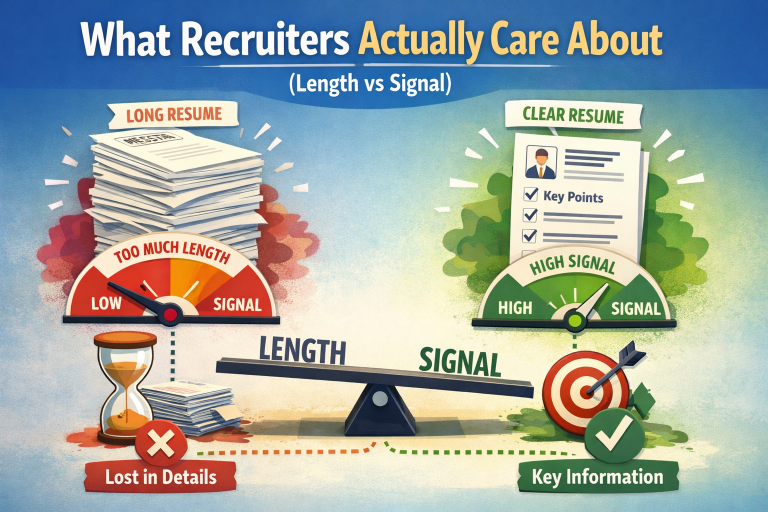
Recruiters spend an average of six to eight seconds on an initial resume scan.
During that time, they’re not counting pages. They’re looking for pattern matches: relevant titles, recognizable companies, required skills, measurable outcomes.
Applicant tracking systems rank resumes based on keyword relevance, contextual matches, and structural parsing—not document length.
A two-page resume with strong signal strength will rank higher than a one-page resume that omits critical keywords or compresses achievements into vague statements.
The real evaluation criteria are signal clarity and relevance density.
Does the resume quickly communicate fit for the role? Are the most important qualifications immediately visible?
Is the formatting clean enough for both ATS parsing and human readability?
Length becomes a problem only when it dilutes signal—either by including irrelevant information or by compressing relevant details so tightly that achievements become generic bullets.
Resume Length Guidelines by Career Stage
Resume length expectations shift based on accumulated experience, not arbitrary rules. The goal is to provide enough context for evaluation without padding or irrelevance.
Entry-Level (0–5 Years)
One page is typically sufficient for early-career candidates. With limited professional history, most relevant information fits comfortably within this constraint.
The exception occurs when internships, research projects, publications, or technical portfolios are directly relevant to the target role. In these cases, extending to a second page is acceptable if the additional content strengthens the application.
Early-career candidates should prioritize recent experience and avoid filling space with unrelated part-time jobs, extensive coursework descriptions, or generic skill lists that add volume without signal.
Mid-Career (5–15 Years)
Two pages become standard for mid-career professionals. A decade of experience cannot be meaningfully summarized in one page without sacrificing the specificity that hiring managers need to assess fit.
Attempting to compress ten years into one page typically results in shallow bullet points that list responsibilities rather than outcomes. “Managed projects” and “collaborated with teams” provide no differentiation and no evidence of impact.
Mid-career resumes should focus on the most recent 10–12 years, with earlier roles condensed or removed entirely unless they contain unique qualifications relevant to the target position.
Senior-Level (15+ Years)
Two pages remain appropriate for senior individual contributors and managers. The focus shifts toward strategic contributions, leadership scope, and business impact rather than exhaustive role histories.
Senior-level resumes should emphasize recent experience while summarizing or omitting early-career positions. A job from 20 years ago rarely influences a hiring decision unless it represents a rare specialization or major achievement that defines the candidate’s expertise.
The key distinction at this level is depth of impact. Vague leadership claims don’t differentiate senior candidates. Specific outcomes—revenue growth, process transformations, team development—create hiring conviction.
Executive and Leadership Roles
Executive resumes (C-suite, VP, senior director) are almost always two pages. At this level, hiring decisions rest on strategic vision, organizational impact, and proven leadership at scale.
These resumes require space to detail P&L responsibility, board interactions, M&A involvement, market expansion, or enterprise-wide transformations. Compressing this context into one page removes the evidence executives need to demonstrate their value.
Executive resumes also face different evaluation processes. They’re rarely filtered by standard ATS systems and are typically reviewed by executive recruiters, board members, or senior leadership who expect substantive detail.
When a One-Page Resume Works — And When It Hurts
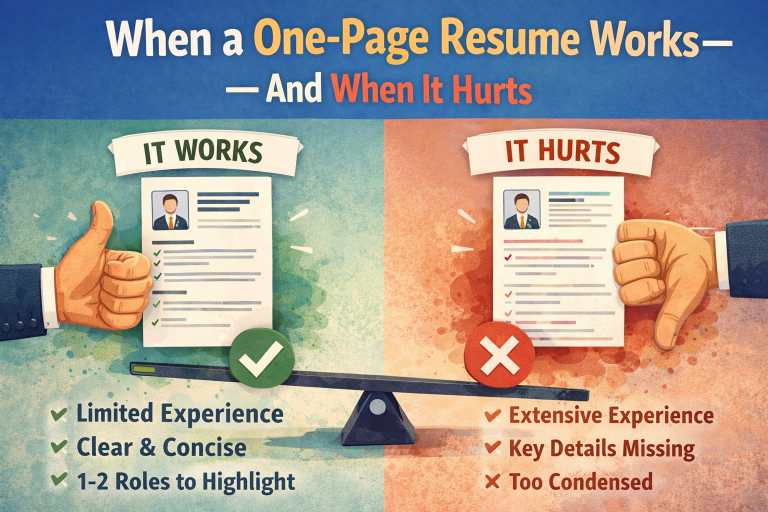
A one-page resume works when experience and qualifications naturally fit within that space without sacrificing clarity or impact. This applies primarily to recent graduates, career changers with limited relevant experience, or professionals with fewer than five years in their field.
It also works when applying to roles that explicitly request one page, though this requirement is becoming increasingly rare outside of certain consulting firms or highly competitive graduate programs.
A one-page resume becomes harmful when it forces the removal of relevant achievements, obscures career progression, or compresses accomplishments into generic statements. Recruiters don’t reward brevity when it eliminates the information they need to make decisions.
The worst outcome occurs when candidates delete concrete evidence—metrics, project outcomes, technical proficiencies—to meet an arbitrary length target. This removes exactly what hiring managers scan for during initial review.
When Two Pages Are Not Only Acceptable — But Expected
Two-page resumes are expected for anyone with more than seven years of professional experience in their field. Modern hiring workflows accommodate this length without penalty.
The myth that recruiters penalize two-page resumes persists despite evidence to the contrary. Recruiters penalize poor organization, irrelevant content, and weak signal—not document length itself.
In technical fields, finance, healthcare, academia, and senior management, two pages are standard. These domains require detailed evidence of specialized skills, certifications, complex project work, or leadership scope that cannot be credibly summarized in one page.
Two pages also become necessary when a career includes multiple relevant role transitions, significant accomplishments across different organizations, or specialized certifications and technical skills that require space to list properly.
The critical factor is content density. Two pages of strong, relevant information will always outperform one page of compressed, generic bullets.
Common Resume Length Mistakes That Quietly Kill Interviews
Including Irrelevant Early Career Roles
Many resumes list every position ever held, including entry-level jobs from 15 years ago that no longer influence hiring decisions. This pushes recent, relevant experience below the fold and dilutes the resume’s focus.
Early career roles should be condensed or removed once they stop adding meaningful signal. A software engineer with ten years of experience doesn’t need to detail their college help desk job unless it demonstrates a rare technical specialization.
Listing Job Duties Instead of Achievements
Describing what a role entailed rather than what was accomplished is the fastest way to inflate resume length without adding value. “Responsible for managing customer accounts” occupies space without differentiating the candidate.
Resumes that focus on outcomes—”Expanded enterprise accounts by 40% through strategic upselling and relationship management”—communicate more with fewer words. This approach naturally controls length while increasing signal strength.
Poor Formatting That Inflates Length
Excessive white space, oversized margins, large fonts, and inefficient section layouts can push a resume to two pages when the actual content would fit on one. This creates length without substance.
Conversely, cramming text with narrow margins and tiny fonts to force one page creates readability problems for both ATS parsing and human review. Neither extreme serves the candidate.
Over-Compression That Removes Critical Signals
Aggressive editing to meet a one-page target often removes the specific keywords, metrics, and context that ATS systems and recruiters scan for. This is particularly damaging in technical roles where tool proficiencies, methodologies, and certifications drive initial screening.
Resumes should be as long as necessary to communicate fit and as short as possible without sacrificing clarity. This is a balancing act, not a rigid formula.
How to Decide the Right Length for Your Resume
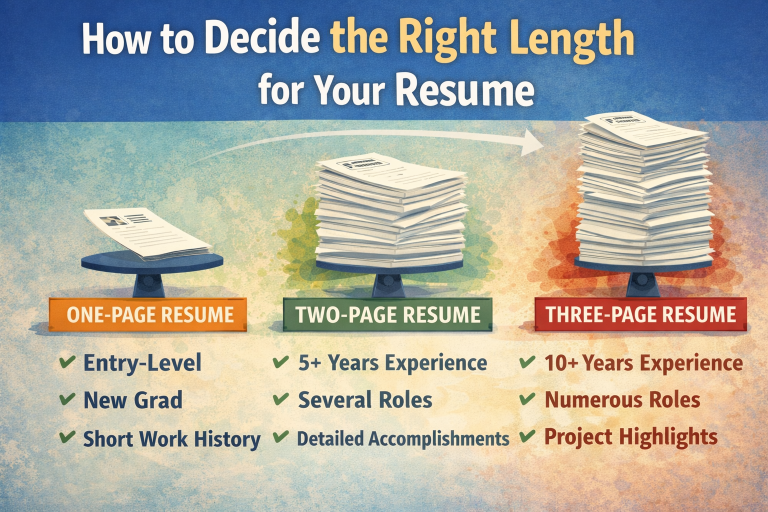
The decision framework for resume length involves three questions:
Does every section and bullet point directly support the target role? If content doesn’t strengthen the application, it should be removed regardless of current length.
Are achievements specific enough to demonstrate impact? Generic responsibilities can always be shortened. Concrete outcomes require space to detail properly.
Is the formatting optimized for both ATS parsing and human readability? Poor structure creates length problems in both directions—either by forcing compression or by wasting space on inefficient layouts.
Most professionals with 7–15 years of experience will land naturally on two pages when applying this framework. Those with less experience will often fit comfortably on one page. Senior leaders and executives will consistently require two pages.
The length should emerge from the content, not the other way around.
Why Resume Structure Matters More Than Page Count
A well-structured two-page resume outperforms a poorly organized one-page resume in every evaluation scenario.
Structure determines whether key qualifications appear in the initial scan area, whether ATS systems parse content correctly, and whether hiring managers can quickly assess fit.
The most important information—recent experience, relevant skills, measurable outcomes—should appear in the top half of the first page.
This is where both ATS algorithms and human readers focus attention during initial review.
Section prioritization varies by role type. Technical resumes often benefit from a skills section near the top.
Sales and business development resumes should lead with metrics. Leadership resumes require early evidence of scope and organizational impact.
Formatting consistency—standardized date formats, clear section headers, readable fonts, adequate white space—affects both ATS parsing accuracy and human readability.
Poor structure can cause qualified candidates to rank lower in applicant tracking systems or be dismissed during human review.
Length decisions should follow structure decisions, not precede them.
Final Takeaway: Stop Chasing Page Counts — Start Communicating Fit
Resume length is not a hiring factor. Signal strength is.
Recruiters don’t reject resumes for being two pages. They reject resumes that don’t quickly communicate relevant qualifications, provide evidence of impact, or match the requirements of the open role.
The goal is to create a document that allows evaluators—both automated systems and human readers—to quickly determine whether a candidate should advance.
This requires enough detail to demonstrate fit without padding or irrelevance.
For most professionals, this means one page for early career roles and two pages once experience accumulates past the five-to-seven-year mark.
Executives and senior leaders should expect two pages as standard.
The shift in mindset from “How do I fit this on one page?” to “How do I best communicate my qualifications?” resolves most length anxiety.
A resume is a marketing document, not an autobiography. It should include exactly what strengthens the case for an interview—nothing more, nothing less.
Modern tools like ResumeShaperAI help optimize this balance by analyzing content relevance, structural formatting, and ATS compatibility without forcing artificial length constraints.
The focus shifts from arbitrary rules to strategic communication.
Stop measuring success by page count.
Start measuring it by interview invitations.