

Firing off the same generic resume for every job might feel efficient, but it’s probably the biggest reason you’re not hearing back. Let’s be honest, we’ve all done it. But the real key to getting noticed is to tailor your resume to each specific job description, aligning your skills and experience with exactly what the employer is looking for. This one simple shift can turn your application from a hopeful long shot into a high-priority document.
Why Your Generic Resume Isn’t Working
You’ve spent hours perfecting your resume, making sure every bullet point is just right. You hit “apply,” and then… crickets. It’s a frustrating experience, but it’s not a reflection of your qualifications. It’s a symptom of a mismatched strategy. In today’s hiring world, a one-size-fits-all approach is a fast track to the rejection pile.
The main culprit here is the Applicant Tracking System (ATS). These are the automated gatekeepers recruiters use to filter applications before a human ever lays eyes on them. Their job is brutally simple: find resumes that match the keywords and qualifications from the job description and toss the rest.
The Numbers Don’t Lie
The stats are pretty sobering. Recent data shows that a staggering 76.4% of resumes are rejected by ATS software before they even get a chance. On top of that, 59.7% of hiring managers prefer tailored resumes, showing a clear bias for candidates who put in the extra effort. If your resume isn’t loaded with the right phrases pulled directly from the job posting, it’s almost certainly getting filtered out. You can read more about these resume statistics to get the full picture.
This means your beautifully crafted, generic resume is likely invisible to the very people you want to impress. And it’s not just about beating the bots; it’s about signaling that you’re genuinely interested.
When a recruiter sees a resume that perfectly mirrors the language and requirements of their job post, it says more than just “I’m qualified.” It shows attention to detail, a strong interest in this specific role, and respect for their time.
Thinking Like a Recruiter
Put yourself in a recruiter’s shoes for a second. They’re sifting through hundreds of applications for one open position. Most are generic, clearly part of a mass-application blast. Then, they see yours. It’s a document that speaks their language, highlights the exact skills they need, and directly addresses the responsibilities of the role.
That immediately sets you apart. A customized resume proves you’ve done your homework and are invested in this opportunity, not just any job. It makes the recruiter’s job easier and instantly frames you as a serious, thoughtful candidate.
To consistently get past these systems, you need to master the art of the ATS-friendly resume. For a deep dive, check out our ultimate guide to ATS-friendly resumes. Now that we’ve diagnosed the problem, let’s get into the solution.
How to Decode Any Job Description Like a Pro
Think of a job description as less of a wish list and more of a detailed cheat sheet from the employer. It contains every single clue you need to build a resume that grabs attention. Learning how to properly decode it is the first and most critical step in tailoring your resume for a specific role. This isn’t about a quick scan for obvious keywords; it’s about analyzing it the way a hiring manager would.
This process goes deeper than just picking out technical terms. You’re trying to understand the role’s true priorities, get a feel for the company culture, and pinpoint the exact problems they need someone to solve. When you break it down methodically, you create a blueprint for a resume that speaks their language.
A generic resume fired off into an Applicant Tracking System (ATS) without this analysis is almost always dead on arrival. The image below shows what usually happens—it rarely makes it past the initial software filter.
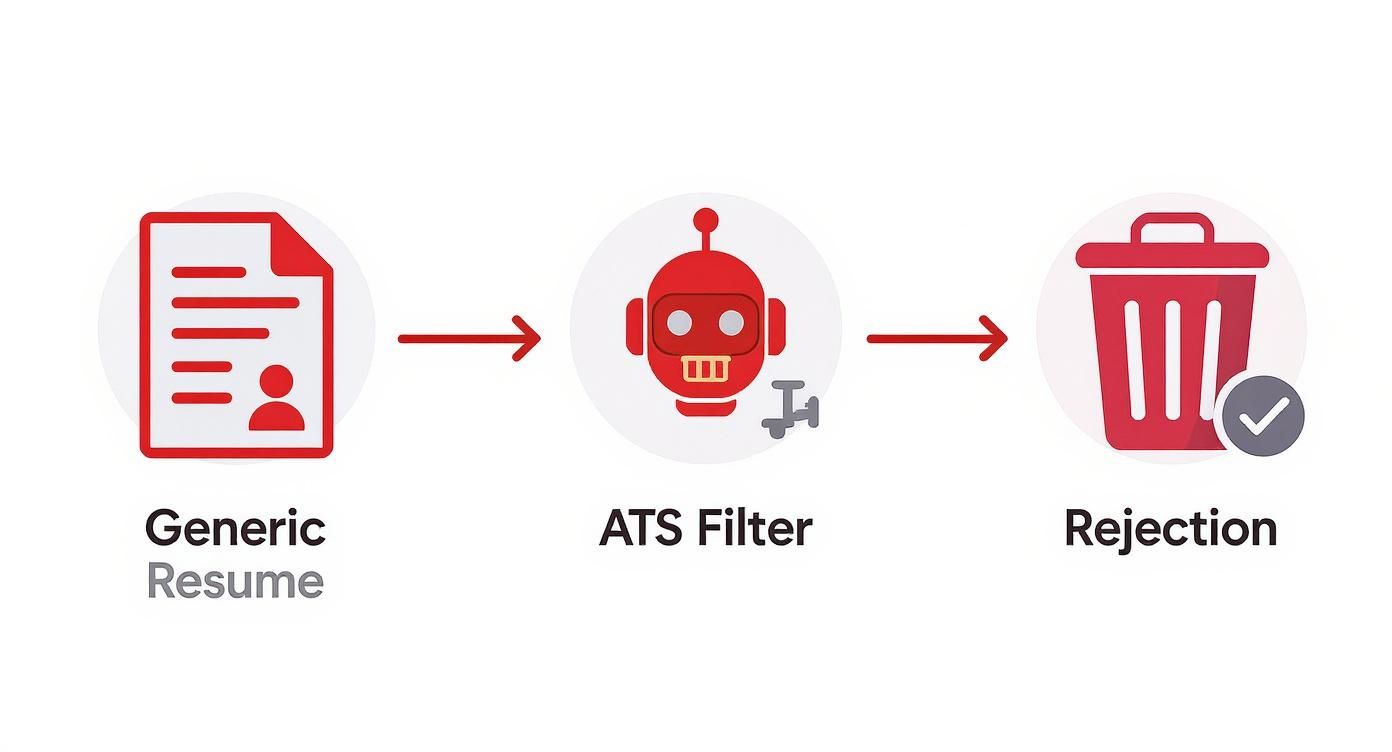
This really drives home the point that having the right experience isn’t enough. Your resume has to explicitly mirror the job’s key requirements to even get a foot in the door.
Differentiating Between Must-Haves and Nice-to-Haves
Every job description is a blend of core requirements and preferred qualifications. Your first job is to tell them apart. “Must-haves” are the non-negotiables—the skills, software knowledge, or years of experience that are absolute deal-breakers. You’ll usually find these under headings like “Required Qualifications” or “Basic Qualifications.”
“Nice-to-haves” pop up under “Preferred Qualifications” or “Bonus Skills.” While not strictly necessary, checking these boxes can give you a serious leg up on other qualified candidates. Start by highlighting every skill, tool, and responsibility you see.
Let’s look at a real-world example for a Digital Marketing Manager role.
- Must-Have: “5+ years of experience in SEO/SEM”
- Nice-to-Have: “Experience with HubSpot or Marketo”
In this case, your resume must clearly show five years of SEO/SEM experience. If you also happen to know HubSpot, that becomes a key selling point to feature prominently.
Identifying Hard Skills and Soft Skills
Once you’ve sorted the requirements, the next step is to categorize them into hard and soft skills. This helps you figure out where to place them in different sections of your resume.
- Hard Skills are your technical, teachable abilities. For our Digital Marketing Manager, this would be things like
Google Analytics,PPC Campaigns,SEO strategy,A/B testing, andcontent marketing. - Soft Skills are the interpersonal traits that describe how you work. The job description might use phrases like
strong communication skills,team collaboration,problem-solving abilities, andstakeholder management.
Key Takeaway: Don’t just make a list of these skills. Your work experience bullet points need to provide hard evidence of you using these skills to get results. Instead of just saying “team collaboration,” describe a project where you “Collaborated with sales and product teams to increase lead generation by 30%.”
Building Your Keyword Map
Now, let’s pull all your findings together into a simple but incredibly effective tool: a keyword map. This is really just a way to track the most important terms from the job description and make sure you’ve included them. This simple step can make a massive difference.
Consider this: the average resume only includes about 51% of the relevant keywords from a job post. With only 32.9% of applicants bothering to tailor their resumes consistently, this gives you a huge competitive advantage. You can discover more insights about resume optimization and see how the data backs this strategy up.
A quick keyword map helps you organize the terms you’ve identified so you can strategically place them throughout your resume. Here’s what that might look like for our Digital Marketing Manager role.
Keyword Extraction from a Sample Job Description
| Category | Keyword/Phrase Example | Where to Add It in Your Resume |
|---|---|---|
| Hard Skills | “SEO strategy”, “PPC campaigns” | Skills section, work experience bullets |
| Soft Skills | “cross-functional collaboration” | Summary, work experience descriptions |
| Responsibilities | “manage digital marketing budget” | Work experience demonstrating budget oversight |
| Tools/Software | “Google Analytics”, “SEMrush” | Skills section, or within a specific project description |
| Company Cues | “fast-paced environment” | Use action verbs like “accelerated,” “drove,” “launched” |
This map now serves as your guide for rewriting and refining your resume. By systematically identifying and mapping these elements, you’re no longer guessing what a recruiter wants to see—you know exactly what to show them. You’ve stopped just applying for a job and started providing a direct solution to their hiring needs.
Weaving Your Keywords into Each Resume Section
Alright, you’ve done the detective work. You’ve dissected the job description and mapped out the keywords that matter. Now for the fun part: strategically weaving those words and phrases into your resume. This isn’t about awkward keyword-stuffing; it’s about seamlessly integrating them to tell a story that screams, “I’m the one you’ve been looking for.”
We’ll go through this section by section, using some clear “Before & After” examples to show you just how powerful this transformation can be. This is where your analysis turns into an application that gets past the bots and impresses the humans.
Upgrading Your Professional Summary
Think of your professional summary as the headline of your career. It’s the first thing a hiring manager sees, making it prime real estate for a custom touch. A generic summary is a wasted opportunity. Your mission is to rewrite it so it directly mirrors the core needs of the job, signaling your value in seconds.
Let’s stick with our Digital Marketing Manager example. Remember, the job description was all about “SEO strategy,” “PPC campaigns,” and “data-driven decision making.”
Before (The Generic Summary):
Experienced marketing professional with a proven track record of managing successful campaigns. Skilled in various digital marketing channels and looking for a challenging new role.
Honestly, this could be anyone. It’s vague and uses none of the specific language from the job ad. It’s forgettable.
After (The Tailored Summary):
Data-driven Digital Marketing Manager with 5+ years of experience developing and executing comprehensive SEO strategies that increased organic traffic by 45%. Expert in managing large-scale PPC campaigns with budgets exceeding $500K and leveraging analytics to optimize performance.
See the difference? This version is specific, packed with numbers, and hits every keyword the employer cares about. It immediately tells the recruiter you have the exact experience they need.
Rewriting Your Work Experience Bullet Points
Your work experience section is where you deliver the proof. Every bullet point is a golden opportunity to connect your past achievements to the future responsibilities of the role you’re targeting. This means you need to stop listing duties and start showcasing results—using their language.
The trick is to rephrase your accomplishments to directly answer the job requirements. If they want “cross-functional collaboration,” you better have a bullet point that shows you doing just that. Research from Jobscan found that matching the job title exactly can boost your interview chances by more than 10 times, which just goes to show how much precise wording matters.
Let’s bring this to life. The job ad asks for someone who can “manage digital marketing budgets” and “optimize campaign ROI.”
Before (The Passive Bullet Point):
Responsible for handling the marketing budget and running online ads.
This is a snooze-fest. It’s a passive description of a task and lacks any real punch or specific terminology.
After (The Powerful Bullet Point):
Managed a $250K quarterly digital marketing budget, reallocating funds to high-performing channels to improve overall campaign ROI by 22%.
This bullet point works so much better. Here’s why:
- It uses the exact phrases “digital marketing budget” and “campaign ROI.”
- It quantifies the achievement with hard numbers ($250K, 22%), giving them concrete proof of your impact.
- It kicks off with a strong action verb (“Managed”), showing you took charge.
Customizing Your Skills Section
Your skills section is a goldmine for ATS optimization. It’s the perfect spot to list specific hard skills, software, and certifications that don’t fit neatly into your bullet points. This is where you can be a bit more direct and make sure every relevant technical term from the job description is included.
Don’t settle for one static, generic list. Organize it to put the most important skills for this specific job front and center. If you want to dig deeper into what terms carry the most weight, check out this guide on high-impact resume keywords that get you hired.
Before (The Vague Skills Section):
- Skills: Marketing, Social Media, Microsoft Office, Communication
This list is too broad to be useful. It completely misses the technical skills the employer is searching for.
After (The Targeted Skills Section):
- Digital Marketing: SEO Strategy, PPC Campaign Management, A/B Testing, Content Marketing
- Marketing Analytics: Google Analytics, SEMrush, HubSpot, Data Visualization
- Project Management: Agile Methodologies, Stakeholder Management, Budget Oversight
Pro Tip: If the job description lists both an acronym and the full term (like “Search Engine Optimization (SEO)”), it’s smart to include both on your resume. You never know which version a recruiter will use to search their database, so this covers your bases.
Aligning Education and Certifications
Last but not least, don’t forget your education and certifications. This section might be short, but it’s another chance for some smart keyword placement. If the job description mentions a specific degree or certification as a “plus,” you need to make sure it’s impossible to miss.
For example, if that Digital Marketing Manager role listed “Google Analytics Certification preferred,” you need to make it pop.
Before (The Simple Listing):
B.S. in Marketing, State University
After (The Optimized Section):
Education
B.S. in Marketing – State UniversityCertifications
Google Analytics Certified Professional (2023)
HubSpot Inbound Marketing Certified (2022)
By creating a separate “Certifications” heading, you spotlight these qualifications. It shows the recruiter, at a quick glance, that you’ve invested in the exact skills they value. This methodical, section-by-section approach is how you turn a generic resume into a targeted application that truly stands out.
Advanced Strategies to Outshine Other Applicants
Alright, so you’ve nailed the basics of tweaking your resume to match the job description. That’s a huge first step. But stopping at simple keyword matching is what most people do—and that’s exactly why you have a chance to pull ahead of the pack.
This is where you move from just being qualified on paper to being the candidate they have to talk to. These next-level techniques are what create a genuine connection with the hiring manager, showing them you’re not just another applicant, but a thoughtful professional who truly gets what they need.
The reality is, most job seekers don’t customize their resumes at all. It’s a shocking statistic, but data shows that 54% of candidates fail to modify their resumes for the specific role they’re applying for. This oversight tanks their chances. By taking these extra steps, you’re not just gaming the ATS; you’re building real rapport before you even speak to a recruiter. Want to see more data on what works and what doesn’t? You can find more resume statistics on Skillademia.
Adopt Their Language and Tone
This is one of the most powerful—and subtle—ways to connect with a reader. It’s called language mirroring. You’re essentially adopting the specific phrasing and tone from the job description to build a subconscious link with the person reading your resume. It sends a clear signal: you’re not just a good fit skill-wise, you’re a cultural fit who understands how they talk.
Pay attention to their word choice. Is the job post full of high-energy, punchy words like “drive,” “accelerate,” and “launch”? If so, your resume should echo that same dynamic vibe with strong, similar action verbs.
On the other hand, if the tone is more corporate and process-focused, using words like “standardized,” “optimized,” and “maintained,” you should mirror that language. It shows you understand and can thrive in their structured environment.
- Job Ad Phrase: “We’re looking for a self-starter to drive new sales initiatives in a fast-paced environment.”
- Your Resume Bullet: “Drove a new lead generation strategy that accelerated the sales cycle by 15% in a competitive market.”
See the difference? It’s not just about keywords; it’s about showing you speak their language.
Quantify Your Achievements to Match Company Goals
Here’s another pro-level move: frame your accomplishments so they directly solve the company’s stated problems. A generic metric is good, but a relevant metric is unforgettable.
Comb through the job description to figure out what success looks like in their world. Are they obsessed with revenue growth, cutting costs, boosting user engagement, or streamlining operations? Whatever their main goal is, make it your goal.
Once you know what they value, frame your wins to speak directly to it. This proves you’re not just results-oriented in general—you’re focused on the right results for them.
For example, if the role emphasizes a need to “increase market share,” a generic bullet like “Increased sales by 20%” is fine. But a tailored one is far more powerful: “Captured a 5% increase in regional market share by launching a targeted competitor displacement campaign, contributing to a 20% overall sales lift.”
This simple reframe connects what you’ve done in the past directly to what they need in the future, making your value impossible to ignore.
Frame Transferable Skills for Career Changes
Making a career pivot? This is non-negotiable. You can’t just list what you did in your old job and expect a hiring manager in a new field to connect the dots. Your job is to translate your experience into the language of your target industry.
First, identify the core skills needed in the new role—things like project management, data analysis, or client relations. Then, look at your past experience through that new lens and rephrase it.
- A teacher’s experience: “Developed lesson plans and managed a classroom of 30 students.”
- Becomes a project manager’s skill: “Managed timelines and resources for 30 stakeholders, designing and executing a comprehensive training curriculum to meet specific learning objectives.”
You’re not making anything up; you’re simply translating. By speaking their professional language, you build a bridge from where you’ve been to where you want to go. This blend of keyword science and the art of human storytelling is what gives you a true competitive advantage.
Use AI Tools to Tailor Your Resume in Minutes
So, you’ve gone through the manual process. You know what it takes to dissect a job description and tweak every line of your resume. But let’s be honest—doing that for every single application can feel like a full-time job. It’s effective, but it’s exhausting.
The good news? There’s a much faster way. Modern technology gives you a powerful shortcut, helping you tailor your resume with incredible speed and accuracy.
This is where AI-powered resume builders come in. Think of them as your personal career assistant, built to do all the heavy lifting. They scan a job description and your resume in seconds, pinpointing keyword gaps, suggesting powerful edits, and ensuring your resume is primed for both ATS bots and human recruiters.
How AI Speeds Up the Tailoring Process
At their core, these tools automate the exact analysis you were just doing by hand. Instead of you highlighting keywords and cross-referencing them one by one, the AI does it all in a flash. It flags missing skills, suggests stronger action verbs, and helps you rephrase your achievements using the employer’s own language.
The goal isn’t to let a robot write your resume from scratch. It’s to have a smart assistant handle the tedious parts so you can focus on the bigger picture—strategy and storytelling. This combination of AI efficiency and your human judgment is what creates a truly killer application.
It’s a surprisingly simple process:
- Upload your current resume to give the tool a starting point.
- Paste in the job description you’re targeting.
- Review the AI-generated suggestions. The tool will often give you a “match score” along with specific, actionable recommendations to improve it.
This approach turns what could easily be an hour of manual work into just a few minutes of focused editing. Here’s a peek at what this looks like in action.

As you can see, the interface lays out the keyword analysis and suggests clear edits, making the whole process incredibly efficient.
From Smart Suggestions to a Polished Resume
Once the AI gives you its feedback, your job is to review and implement the changes that make sense for you. A good tool won’t just give you a vague score; it will offer concrete suggestions for every part of your resume.
- Professional Summary: It might suggest rewriting your summary to include the exact job title and 2-3 of the most critical skills mentioned in the ad.
- Work Experience: You’ll likely get ideas for rephrasing bullet points with stronger verbs or quantifying achievements that speak directly to the company’s goals.
- Skills Section: The AI is great at spotting hard and soft skills from the job description that you missed, letting you add them with a single click.
By automating the most time-consuming parts of resume customization, these tools empower you to apply to more high-quality, relevant roles without burning out. This dramatically increases your odds of landing an interview.
For anyone looking to take advantage of this, an AI resume builder based on the job description can tailor your resume like a pro. These platforms are designed to walk you through each optimization, making sure no opportunity gets missed.
Ultimately, using an AI tool isn’t about cutting corners—it’s about working smarter. It gives you the analytical power of an expert recruiter and the speed of a machine, all while leaving you in the driver’s seat. This tech-savvy approach ensures every application you send is a top contender, boosting both your efficiency and your confidence.
Frequently Asked Questions About Tailoring Your Resume
Of course, even when you get the hang of tailoring your resume, a few nagging questions always pop up. Let’s clear the air on some of the most common worries job seekers have when they’re trying to get this right.
Think of this as your quick-reference guide for those “am I doing this right?” moments.
How Much Do I Really Need to Change for Each Job?
This is probably the number one question I hear. The answer isn’t about hitting a specific word count; it’s all about impact. Your goal is to make meaningful changes to your professional summary, the most relevant work experience bullet points, and your skills section.
A good rule of thumb is to aim for 40-60% of the most visible parts of your resume to directly reflect the language and priorities in the job ad. This is the sweet spot—enough to catch a recruiter’s eye and pass an ATS scan without you having to reinvent your entire career history every time you hit “apply.”
Seriously, How Long Should This Take?
Time is another big concern. “How long am I supposed to spend tweaking my resume for just one job?” The good news is, once you have a solid master resume and get into a rhythm, this shouldn’t take you more than 15 to 30 minutes per application.
That timeframe covers scanning the job description, spotting the key requirements, and making those targeted edits to your summary and experience. If you find it’s taking longer, you might be overthinking it or trying to customize too much. Efficiency and impact are the name of the game, not a complete rewrite every single time.
Key Insight: Don’t mistake more time spent for better quality. A focused, 20-minute edit that nails the most critical requirements will always beat an hour of aimless tweaking. Think surgical precision, not a total overhaul.
Will Recruiters Think I’m Just Keyword Stuffing?
This is a totally valid fear. You don’t want your carefully chosen keywords to make you sound like a robot. “Will recruiters roll their eyes and think I just stuffed my resume?” The secret to avoiding this is context.
Don’t just dump a list of keywords into your skills section and call it a day. The real pro move is to weave them into your accomplishment-driven bullet points. This shows you don’t just know the buzzword; you’ve actually used that skill to get real results.
- Don’t just list: “SEO”
- Instead, integrate it like this: “Launched a new SEO strategy that boosted organic search traffic by 35% in just six months.”
See the difference? This approach proves your expertise and makes the keyword feel completely natural and earned.
Is This Really Worth It for Every Single Job?
Finally, people always ask if they need to go through this process for every single job they find online. The short answer is no—but you absolutely should for every job you actually want.
If you’re applying for a role that genuinely excites you and lines up perfectly with where you want your career to go, taking that extra time is non-negotiable. It’s what separates a casual applicant from a serious contender.
For applications that are more exploratory or maybe a bit of a long shot? A lighter touch-up might be fine. Just be sure to focus your best efforts on the opportunities that truly matter.
Ready to stop guessing and start getting noticed? ResumeShaperAI uses intelligent automation to analyze any job description and instantly suggests the exact keywords and phrases you need to get past applicant tracking systems and impress recruiters. Stop spending hours on manual edits and create a perfectly tailored resume in minutes. Try it now and land more interviews, faster. Build your winning resume with ResumeShaperAI.